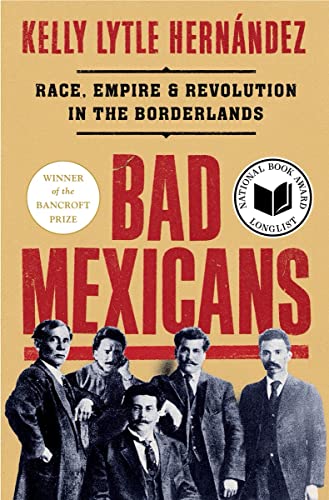
Bad Mexicans
by Kelly Lytle Hernández
"Race, Empire, and Revolution in the Borderlands"
Popularity
4.62 / 5
* A book's popularity is determined by how it compares to all other books on this website.
Where to buy?
Buy from Amazon* If you buy this book through the link above, we may receive a small commission at no extra cost to you.
Bad Mexicans by Kelly Lytle Hernández
Details
Perspective:
Guerrilla Fighters
True Story:
Yes
Biography:
No
Region:
North America
Published Date:
2022
ISBN13:
9781324004370
Summary
Bad Mexicans chronicles the revolutionary movement led by the Flores Magón brothers and their allies who challenged both the Mexican dictatorship of Porfirio Díaz and American imperial power in the early 1900s. Kelly Lytle Hernández reveals how these anarchist rebels organized across the US-Mexico borderlands, facing surveillance and suppression by authorities on both sides. The book examines how their struggle against racial capitalism and state violence shaped the Mexican Revolution and influenced labor movements, while highlighting the often-overlooked role of working-class Mexicans and Indigenous peoples in this transnational fight for justice and equality.
Review of Bad Mexicans by Kelly Lytle Hernández
Kelly Lytle Hernández delivers a groundbreaking historical account in "Bad Mexicans: Race, Empire, and Revolution in the Borderlands," examining the transnational origins of the Mexican Revolution through the lens of those who fought against the authoritarian regime of Porfirio Díaz. The book centers on the stories of Mexican rebels, anarchists, and working-class revolutionaries who organized across the U.S.-Mexico border during the late nineteenth and early twentieth centuries, challenging both Mexican dictatorship and American imperial interests.
The narrative traces the decades-long rule of Porfirio Díaz, who governed Mexico from 1876 to 1911 and transformed the country into what many critics considered a police state. Hernández explores how Díaz's modernization project, while bringing railroads and foreign investment to Mexico, came at the cost of indigenous land rights, labor protections, and political freedoms. The book reveals how Díaz's government worked closely with American business interests and law enforcement agencies to suppress dissent on both sides of the border.
Hernández draws heavily on records from U.S. and Mexican government archives, including surveillance files, diplomatic correspondence, and police reports. These documents expose a sophisticated transnational surveillance network that tracked Mexican dissidents living in American border towns and cities. The collaboration between the Díaz regime and American authorities, including the Texas Rangers and private detective agencies, forms a crucial element of the narrative, demonstrating how national borders became permeable for state power even as they restricted the movement of laborers and political refugees.
The book gives particular attention to Ricardo Flores Magón and his brothers Enrique and Jesús, who founded the opposition newspaper Regeneración and became leading figures in the anti-Díaz movement. Operating from exile in the United States, the Magón brothers articulated a vision of revolutionary change that combined anarchist principles with indigenous rights and labor organizing. Hernández follows their journey from Mexico City to St. Louis, Los Angeles, and other American cities, where they continued publishing and organizing despite constant harassment from authorities.
The author complicates traditional narratives of the Mexican Revolution by emphasizing the role of ordinary people—miners, railroad workers, laundresses, and journalists—who risked everything to challenge Díaz's regime. These individuals often faced imprisonment, exile, and violence for their political activities. The book documents how Mexican women participated in revolutionary organizing, smuggling newspapers across the border, hiding fugitives, and contributing to radical publications, even as their contributions have been largely overlooked in conventional histories.
Hernández situates the Mexican revolutionary movement within broader contexts of American empire-building and racial capitalism. The book examines how American mining companies, railroad magnates, and land speculators acquired vast holdings in Mexico under Díaz's favorable policies, while Mexican workers faced exploitation and dispossession. This economic relationship bound the two nations together in ways that transcended political boundaries, creating shared interests among elites that superseded national sovereignty when it came to suppressing labor movements and radical organizing.
The author's exploration of the term "bad Mexicans" itself reveals how racial categories and political labels intersected during this period. Mexican revolutionaries were branded as criminals, terrorists, and undesirable aliens by both governments, language that justified surveillance, deportation, and imprisonment. Hernández demonstrates how these designations served specific political purposes, allowing authorities to criminalize dissent while obscuring the legitimate grievances that motivated revolutionary activity.
The book culminates with the outbreak of the Mexican Revolution in 1910 and the eventual overthrow of Díaz in 1911. However, Hernández makes clear that the revolutionary struggle extended far beyond these landmark dates, involving years of organizing, sacrifice, and setbacks. The narrative shows how ideas developed in exile and through transnational networks ultimately contributed to the revolutionary movement that transformed Mexico.
"Bad Mexicans" represents a significant contribution to borderlands history, Chicano studies, and the history of the Mexican Revolution. Hernández's research challenges readers to reconsider how national histories are written and whose stories get told. By centering the experiences of Mexican workers and revolutionaries who operated across borders, the book reveals a more complex picture of revolution as a transnational phenomenon shaped by imperial power, racial capitalism, and grassroots resistance. The work stands as both rigorous historical scholarship and an accessible narrative that illuminates a crucial period in North American history.


