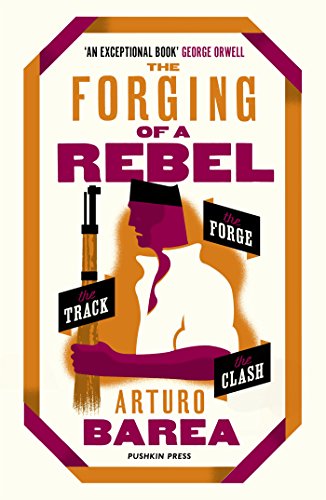
The Forging of a Rebel
by Arturo Barea
"The Forge, The Track and The Clash"
Popularity
4 / 5
* A book's popularity is determined by how it compares to all other books on this website.
Where to buy?
Buy from Amazon* If you buy this book through the link above, we may receive a small commission at no extra cost to you.
The Forging of a Rebel by Arturo Barea
Details
War:
Spanish Civil War
Perspective:
Infantry
True Story:
Yes
Biography:
Yes
Region:
Europe
Page Count:
769
Published Date:
2019
ISBN13:
9781782274933
Review of The Forging of a Rebel by Arturo Barea
Arturo Barea's "The Forging of a Rebel" stands as one of the most significant autobiographical accounts to emerge from twentieth-century Spain. Originally published in three parts during the 1940s—"The Forge," "The Track," and "The Clash"—the work was later combined into a single volume that traces Barea's life from his impoverished childhood in Madrid through his experiences as a soldier in Spanish Morocco and, finally, his role during the Spanish Civil War. Written in exile in England, the memoir offers a firsthand perspective on one of the most turbulent periods in modern Spanish history, filtered through the eyes of a man who lived through nearly all of its defining moments.
The first section, "The Forge," is perhaps the most intimate and emotionally resonant. Barea recounts his upbringing in a working-class Madrid neighborhood, raised largely by his washerwoman mother after his father's early death. This portion of the book captures the textures of daily life among Spain's urban poor with remarkable clarity. Barea does not romanticize poverty, nor does he wallow in self-pity. Instead, he presents his childhood with an unsentimental honesty that allows readers to understand how class divisions and economic hardship shaped his worldview from an early age. The relationships he describes—with his mother, his siblings, and the broader community—are rendered with psychological depth that avoids melodrama.
"The Track," the second part, shifts focus to Barea's military service in Morocco during Spain's colonial campaigns in the 1920s. This section functions almost as a war memoir in miniature, detailing the brutality, disorganization, and moral compromises inherent in colonial warfare. Barea's descriptions of the Rif War are unflinching, exposing the corruption and incompetence that plagued the Spanish military at the time. This portion of the book serves as a bridge between his personal formation and the larger political awakening that follows, showing how his experiences abroad began to shape his critical view of Spanish institutions and the ruling class.
The final and most historically weighty section, "The Clash," covers the Spanish Civil War itself. Barea's position was unique: he worked at the Foreign Press Bureau in Madrid, giving him direct access to the machinery of wartime propaganda and information control. His account of this period is valuable precisely because it avoids the black-and-white narratives often applied to the conflict. He writes with a critical eye toward all factions, documenting the internal divisions, betrayals, and human costs that characterized the Republican side without descending into simple partisanship. This nuanced perspective, informed by direct experience rather than ideological conviction, gives the memoir lasting historical value beyond its literary merits.
Structurally, the book benefits from Barea's background as a writer rather than a professional historian. His prose is direct, observational, and often quietly powerful. He has a gift for selecting telling details—a gesture, a fragment of conversation, a particular smell or sound—that bring scenes to life without excessive embellishment. The translation into English, completed with the assistance of his wife Ilsa Barea, preserves much of this directness, though readers should be aware that some idiomatic nuances from the original Spanish may not fully carry over.
What distinguishes this memoir from many similar works of the period is its refusal to present a tidy or heroic narrative. Barea emerges not as a flawless revolutionary hero but as a flawed, searching individual who is often uncertain, sometimes complicit in systems he later criticizes, and always trying to reconcile his personal experiences with larger political and moral questions. This honesty, occasionally uncomfortable, is what gives the book its enduring credibility.
"The Forging of a Rebel" remains an essential text for anyone interested in twentieth-century Spanish history, the Spanish Civil War, or the broader genre of political memoir. It offers neither easy answers nor comfortable conclusions, but rather a detailed, humane account of one man's passage through extraordinary historical circumstances. Its combination of personal narrative and historical documentation ensures its place as a significant contribution to the literature of exile, memory, and political upheaval in modern Europe.
