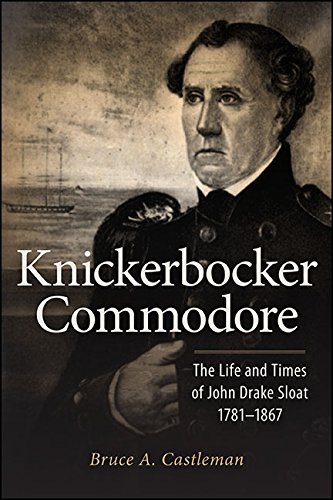
Knickerbocker Commodore
by Bruce A. Castleman
"The Life and Times of John Drake Sloat, 1781-1867"
Popularity
4.1 / 5
* A book's popularity is determined by how it compares to all other books on this website.
Where to buy?
Buy from Amazon* If you buy this book through the link above, we may receive a small commission at no extra cost to you.
Knickerbocker Commodore by Bruce A. Castleman
Details
War:
Mexican-American War
Perspective:
Commanders
Military Unit:
US Navy
True Story:
Yes
Biography:
Yes
Region:
North America
Page Count:
342
Published Date:
2016
ISBN13:
9781438461533
Summary
John Drake Sloat was a U.S. Navy commodore who played a pivotal role in the American conquest of California during the Mexican-American War. This biography by Bruce A. Castleman chronicles Sloat's life from 1781 to 1867, examining his naval career and his controversial decision to claim California for the United States in 1846. The book explores Sloat's background, his leadership during a transformative period in American expansion, and his legacy in shaping the Pacific Coast's integration into the United States.
Review of Knickerbocker Commodore by Bruce A. Castleman
Bruce A. Castleman's "Knickerbocker Commodore: The Life and Times of John Drake Sloat, 1781-1867" offers a comprehensive examination of a naval officer whose role in American history has often been overshadowed by more flamboyant military figures. Sloat, who famously raised the American flag at Monterey in 1846 to claim California for the United States, emerges from this biography as a complex figure shaped by both his New York upbringing and his decades of naval service.
The biography traces Sloat's journey from his birth in the Hudson Valley region through his lengthy career in the United States Navy. Castleman provides detailed context about the early American republic and the naval establishment during a formative period in the nation's history. The work examines how Sloat navigated the political and military challenges of his era, including the War of 1812 and various peacetime assignments that took him around the globe.
Central to the narrative is Sloat's command of the Pacific Squadron during the Mexican-American War. As commander, Sloat faced the delicate task of determining when and how to act on orders that were necessarily vague given the communication delays of the era. His decision to seize Monterey and claim California represented a pivotal moment in American expansionism, yet Castleman illustrates how Sloat's cautious temperament and concerns about exceeding his authority led to tensions with more aggressive officers and government officials.
The biography's strength lies in its balanced portrayal of Sloat as neither hero nor incompetent, but rather as a career officer operating within the constraints of his position and personality. Castleman draws on naval records, correspondence, and other primary sources to build a nuanced picture of a man who valued propriety and careful judgment over bold action. This approach provides insight into the institutional culture of the antebellum Navy and the challenges faced by officers who served far from Washington with limited guidance.
Castleman also explores the political dimensions of Sloat's career, including the patronage networks and regional loyalties that influenced naval appointments and assignments. The author examines how Sloat's New York connections, referenced in the book's title, played a role in his advancement while also shaping his worldview and approach to command. These elements add depth to what could have been a straightforward military biography.
The work addresses the controversy surrounding Sloat's relatively brief time as the conqueror of California before he was effectively superseded by more aggressive officers. Castleman analyzes the criticism Sloat faced for his measured approach and his decision to relinquish command, providing context for understanding the competing pressures he encountered. The biography neither excuses nor condemns but seeks to explain the factors that influenced his decisions during this critical period.
Beyond the California episode, the biography examines Sloat's earlier career and his post-war years, providing a complete life story rather than focusing exclusively on his most famous action. This comprehensive approach allows readers to understand Sloat's seizure of Monterey within the broader arc of his professional life and the evolution of American naval power during the first half of the nineteenth century.
Castleman's research appears thorough, drawing on archives and collections that document both Sloat's official duties and personal circumstances. The author navigates the available sources to reconstruct not only military campaigns and naval operations but also the social and familial contexts that influenced Sloat's life. The result is a biography that connects personal experience with larger historical currents.
The book serves multiple audiences, offering military historians detailed analysis of naval operations and command decisions while providing general readers with an accessible narrative about an important but understudied figure in American expansion. Castleman's prose maintains scholarly rigor without becoming overly technical, making the material approachable for those without extensive background in naval history.
"Knickerbocker Commodore" fills a gap in the historical literature by providing a full-length treatment of Sloat's life and career. While other works have examined the conquest of California and the Mexican-American War more broadly, Castleman's focus on Sloat himself offers fresh perspective on these events. The biography contributes to understanding how individual temperament, institutional culture, and historical circumstance intersected during a transformative period in American history. For readers interested in naval history, the Mexican-American War, or the acquisition of California, this work provides valuable insight into the human dimensions of territorial expansion and military command.