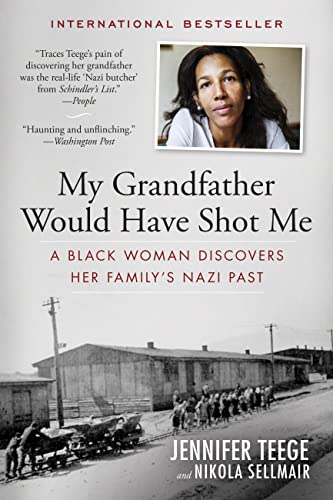
My Grandfather Would Have Shot Me: A Black Woman Discovers Her Family's Nazi Past
by Nikola Sellmair
Popularity
4.9 / 5
* A book's popularity is determined by how it compares to all other books on this website.
Where to buy?
Buy from Amazon* If you buy this book through the link above, we may receive a small commission at no extra cost to you.
My Grandfather Would Have Shot Me: A Black Woman Discovers Her Family's Nazi Past by Nikola Sellmair
Details
Perspective:
Civilian
True Story:
Yes
Biography:
Yes
Region:
Europe
Page Count:
242
Published Date:
2016
ISBN13:
9781615192540
Summary
Jennifer Teege, a German woman of mixed race who was adopted as a child, discovers at age 38 that her grandfather was Amon Goeth, the notorious Nazi concentration camp commandant depicted in Schindler's List. The book chronicles her shocking discovery and subsequent journey to understand her family history and reconcile her identity. Teege travels to Poland, researches archives, and grapples with guilt, trauma, and questions about inherited responsibility. The memoir explores themes of identity, historical memory, and how the descendants of Holocaust perpetrators cope with their devastating family legacies.
Review of My Grandfather Would Have Shot Me: A Black Woman Discovers Her Family's Nazi Past by Nikola Sellmair
Jennifer Teege's memoir stands as one of the most startling discoveries of familial heritage in recent literary memory. At age 38, while browsing in a Hamburg library, Teege stumbled upon a book that would fundamentally alter her understanding of her own identity. The volume detailed the life of Amon Goeth, the notorious Nazi commandant of the Plaszow concentration camp, immortalized in Steven Spielberg's film Schindler's List as a sadistic killer. The revelation that shook Teege to her core was simple yet devastating: Amon Goeth was her biological grandfather.
Born to a German mother and a Nigerian father, Teege spent most of her childhood in foster care and was later adopted by a loving German family. Her biological mother had given her up when she was young, and Teege grew up with limited knowledge of her birth family's history. The disconnect between her adopted life and her biological roots meant that she had lived nearly four decades without any awareness of the dark legacy that ran through her bloodline. The discovery came not through family revelation but through chance encounter with published material about her grandmother, Ruth Irene Goeth, who had been Amon Goeth's companion.
The book chronicles Teege's psychological journey following this discovery, detailing the depression and identity crisis that engulfed her upon learning the truth. The author's approach is unflinchingly honest about the emotional toll of this revelation. She describes the disorientation of suddenly viewing herself through a new and horrifying lens, questioning what this heritage might mean for her own identity and whether some kind of inherited guilt or evil could run in her blood. These questions, while perhaps scientifically unfounded, represent genuine psychological struggles that Teege confronted in the aftermath of her discovery.
What makes this memoir particularly compelling is its structure. Teege collaborated with German journalist Nikola Sellmair to create a narrative that alternates between Teege's personal story and historical context about Amon Goeth and the Holocaust. This dual approach serves multiple purposes: it educates readers unfamiliar with the specific historical details while also grounding Teege's emotional journey in concrete historical reality. The historical sections draw from trial records, testimonies, and previous publications about Goeth, including interviews with Ruth Irene Goeth that had been conducted years before Teege's discovery.
Amon Goeth's crimes are well-documented in historical records. As commandant of Plaszow, he was responsible for the deaths of thousands of prisoners and was known for shooting inmates from his villa balcony for sport. He was executed by hanging in 1946 after being convicted of war crimes. Ruth Irene Goeth maintained a complicated relationship with his memory, and her own interviews revealed a woman who struggled to reconcile the man she knew with the monster described by survivors and historical record. This complexity adds another layer to Teege's exploration of her heritage.
The memoir also addresses issues of race and identity in contemporary Germany. As a biracial woman who was adopted into a white German family, Teege had already navigated complex questions about belonging and identity before discovering her connection to one of the Holocaust's most infamous perpetrators. The intersection of these identity markers creates a unique perspective on questions of guilt, responsibility, and historical memory in modern Germany.
Teege's journey includes travel to Poland to visit the site of the Plaszow concentration camp and attempts to understand the full scope of her grandfather's actions. She also seeks to connect with Holocaust survivors and their descendants, grappling with how to position herself in relation to this history. The book does not offer easy answers about inherited guilt or the meaning of such a heritage. Instead, it presents Teege's honest struggle with these questions and her eventual path toward accepting her history while refusing to be defined solely by it.
The writing itself is clear and accessible, avoiding both sensationalism and excessive introspection. Teege presents her story in a straightforward manner that allows the inherent drama of the situation to speak for itself without embellishment. The historical sections provide necessary context without overwhelming the personal narrative, creating a balance that serves both as memoir and as educational text about this period of history.
This memoir raises profound questions about the nature of identity, the weight of historical guilt, and the possibility of reconciliation with an irredeemable past. It serves as a reminder that the Holocaust's impact continues to reverberate through generations in unexpected ways, and that the process of confronting historical atrocity remains ongoing and deeply personal for those connected to it, regardless of which side of history their ancestors stood on.