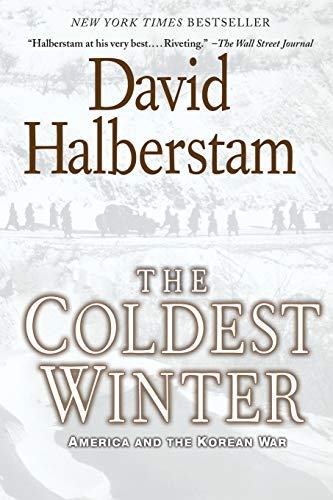
The Coldest Winter
by David Halberstam
"America and the Korean War"
Popularity
4.97 / 5
* A book's popularity is determined by how it compares to all other books on this website.
Where to buy?
Buy from Amazon* If you buy this book through the link above, we may receive a small commission at no extra cost to you.
The Coldest Winter by David Halberstam
Details
War:
Korean War
Perspective:
Infantry
Military Unit:
US Army
True Story:
Yes
Biography:
No
Region:
Asia
Page Count:
736
Published Date:
2008
ISBN13:
9780786888627
Summary
The Coldest Winter by David Halberstam is a comprehensive history of the Korean War, examining America's involvement from 1950 to 1953. Halberstam analyzes the political and military decisions that shaped the conflict, including General Douglas MacArthur's miscalculations and the tensions between military leadership and the Truman administration. The book explores how Cold War politics influenced strategy, the brutal combat conditions soldiers endured, and the war's lasting impact on American foreign policy. Drawing on extensive research and interviews, Halberstam provides insight into a often overlooked conflict that claimed millions of lives and shaped modern geopolitics.
Review of The Coldest Winter by David Halberstam
David Halberstam's "The Coldest Winter: America and the Korean War" stands as a masterful examination of one of America's most overlooked conflicts. Published posthumously in 2007, this comprehensive work represents the culmination of decades of research and reflection by one of journalism's most distinguished voices. Halberstam brings his characteristic thoroughness and narrative skill to a war that has often been overshadowed by World War II and Vietnam, providing readers with both sweeping historical context and intimate human detail.
The book excels in its dual approach to the Korean War, examining both the grand strategic decisions made in Washington and the brutal realities faced by soldiers on the frozen battlefields of Korea. Halberstam demonstrates how the conflict emerged from the complex geopolitical landscape of the early Cold War, tracing the roots of American involvement back to the immediate post-World War II period. The author carefully analyzes how miscalculations, hubris, and the limitations of intelligence led to a war that would claim millions of lives and establish patterns that would influence American foreign policy for generations.
One of the book's greatest strengths lies in Halberstam's unflinching examination of military and political leadership. General Douglas MacArthur receives particularly detailed treatment, with the author presenting a nuanced portrait of a brilliant but deeply flawed commander whose certainty and ego contributed to some of the war's most catastrophic decisions. The Inchon landing is presented as a stroke of tactical genius, while the subsequent advance toward the Yalu River and dismissal of Chinese intervention warnings appears as a case study in hubris and wishful thinking. Halberstam's treatment of MacArthur never descends into simple condemnation but rather presents a complex figure whose strengths and weaknesses had profound consequences.
The narrative also provides detailed attention to the Chinese intervention, exploring both the strategic calculations that led Mao Zedong to commit forces and the remarkable effectiveness of Chinese troops despite their technological disadvantages. Halberstam effectively conveys how Chinese forces, through tactical innovation and willingness to accept massive casualties, transformed what appeared to be an imminent UN victory into a desperate fighting retreat. The descriptions of the battles around the Chosin Reservoir are particularly vivid, capturing both the savage combat and the extreme weather conditions that made survival itself a challenge.
Halberstam dedicates substantial portions of the book to the experiences of ordinary soldiers and junior officers, drawing on extensive interviews and personal accounts. These individual stories ground the larger strategic narrative in human terms, illustrating the courage, suffering, and confusion experienced by those who actually fought the war. The author's respect for the common soldier is evident throughout, as is his anger at leadership failures that unnecessarily cost lives. These personal narratives prevent the book from becoming an abstract military history and ensure that the human cost of political and strategic decisions remains central to the story.
The political dimension of the war receives equally thorough treatment. Halberstam examines how President Harry Truman navigated the challenge of fighting a limited war in an era when the American public expected total victory, and how the conflict became entangled with domestic politics and the rise of McCarthyism. The famous confrontation between Truman and MacArthur over war strategy and civilian control of the military is presented with careful attention to both constitutional principles and political realities. The author also explores how the war influenced the 1952 presidential election and shaped the early Cold War consensus on containment.
The book is not without its challenges for readers. At over 700 pages, it demands significant commitment and attention. Halberstam's thorough approach means that the narrative sometimes moves slowly, particularly in the early chapters establishing context. Some readers may find the level of detail about military units, positions, and tactical movements overwhelming. However, this comprehensiveness is also what makes the book valuable as a historical resource, providing depth that shorter treatments cannot match.
"The Coldest Winter" serves as both a compelling historical narrative and a sobering meditation on the costs of war and the dangers of overconfidence in military and political leadership. Halberstam's final book stands as a fitting capstone to a career dedicated to examining American power and its consequences. For anyone seeking to understand the Korean War, its origins, conduct, and legacy, this work remains an essential and authoritative account that brings clarity to a conflict that has too often been relegated to historical footnotes.
