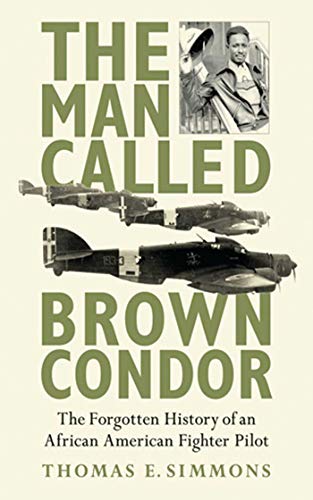
The Man Called Brown Condor
by Thomas E. Simmons
"The Forgotten History of an African American Fighter Pilot"
Popularity
4.17 / 5
* A book's popularity is determined by how it compares to all other books on this website.
Where to buy?
Buy from Amazon* If you buy this book through the link above, we may receive a small commission at no extra cost to you.
The Man Called Brown Condor by Thomas E. Simmons
Details
War:
World War II
Perspective:
Pilots
Military Unit:
US Air Force
True Story:
Yes
Biography:
Yes
Region:
Africa
Page Count:
343
Published Date:
2012
ISBN13:
9781620879474
Summary
The Man Called Brown Condor tells the remarkable true story of John C. Robinson, an African American aviator who became a pioneering fighter pilot in 1930s Ethiopia. When Italy invaded Ethiopia in 1935, Robinson commanded the Ethiopian Air Force, earning the nickname "Brown Condor" for his bravery. Despite his heroic service and contributions to aviation history, Robinson's legacy was largely forgotten. Thomas E. Simmons resurrects this extraordinary tale of courage, highlighting Robinson's significance as a trailblazing black aviator who inspired the Tuskegee Airmen and fought against fascism abroad while facing racism at home.
Review of The Man Called Brown Condor by Thomas E. Simmons
Thomas E. Simmons brings to light a remarkable yet largely forgotten chapter of aviation history in his biographical work about John Charles Robinson, the pioneering African American aviator known as the Brown Condor. This meticulously researched account chronicles the extraordinary life of a man who broke through racial barriers in the 1930s to become not only a skilled pilot but also a significant figure in international military aviation during a critical period preceding World War II.
Robinson's story begins in the segregated American South, where opportunities for African Americans in aviation were virtually nonexistent. Despite facing systemic racism and institutional obstacles, Robinson pursued his passion for flight with unwavering determination. Simmons traces Robinson's journey from his early fascination with aviation through his training at the Curtiss-Wright Aeronautical School and the Tuskegee Institute, where he would later help establish aviation programs that would prove instrumental in training future generations of Black pilots.
The heart of the narrative focuses on Robinson's service in Ethiopia during the Second Italo-Ethiopian War in 1935-1936. When Benito Mussolini's Italian forces invaded Ethiopia, Emperor Haile Selassie sought assistance from abroad, and Robinson answered the call. Simmons details how Robinson traveled to Ethiopia to train pilots and lead the fledgling Ethiopian Air Force in combat operations against the technologically superior Italian military. The sobriquet "Brown Condor" was bestowed upon him by the Ethiopian people, recognizing both his skill as a pilot and his commitment to their cause.
Simmons does not romanticize the challenges Robinson faced in Ethiopia. The narrative honestly portrays the limited resources, antiquated aircraft, and overwhelming odds that characterized the Ethiopian resistance. Robinson worked with outdated planes and undertrained personnel while facing a modern Italian air force equipped with superior technology and poison gas. Despite these formidable obstacles, Robinson's courage and tactical knowledge earned him respect and admiration from the Ethiopian military leadership and international observers alike.
The author draws upon a variety of primary and secondary sources to construct this historical account, including military records, newspaper archives, and correspondence. Simmons contextualizes Robinson's experiences within the broader framework of African American history and the pre-World War II international landscape. The book illuminates how Robinson's service in Ethiopia resonated with African American communities in the United States, who followed his exploits through the Black press and saw in him a symbol of capability and heroism that countered prevailing racial stereotypes.
Following his return from Ethiopia, Robinson continued his aviation work in the United States, though his international service brought him under scrutiny during an era of isolationist sentiment. Simmons chronicles Robinson's efforts to establish aviation schools and training programs for African Americans in Chicago, contributing to the foundation upon which the famous Tuskegee Airmen would later build their legacy. The connections between Robinson's pioneering work and the eventual success of the Tuskegee Airmen program represent an important through-line in the narrative.
The book also addresses the tragic circumstances of Robinson's death in a plane crash in 1954, an event that, like much of his life, received far less attention than it deserved. Simmons argues convincingly that Robinson's contributions to aviation history and the advancement of African Americans in the field have been unjustly overlooked in mainstream historical accounts.
One of the strengths of Simmons' work lies in its ability to place Robinson's individual story within larger historical movements, including the Italian invasion of Ethiopia, the global response to fascism, and the long struggle for civil rights in America. The narrative demonstrates how Robinson's experiences intersected with major international events while highlighting the personal determination required to overcome racial barriers in pursuit of professional goals.
The book serves as both a biographical tribute and a historical corrective, rescuing an important figure from obscurity and ensuring that Robinson's achievements receive appropriate recognition. Simmons writes with clarity and respect for his subject, avoiding hagiography while clearly admiring Robinson's courage and pioneering spirit. The narrative maintains scholarly rigor while remaining accessible to general readers interested in aviation history, African American history, or accounts of individuals who challenged societal limitations.
For readers seeking to understand the fuller picture of aviation history and the contributions of African Americans to military aviation, this work provides essential context and information. The book stands as a testament to the importance of recovering forgotten histories and recognizing the diverse individuals who shaped the development of flight in the twentieth century.


