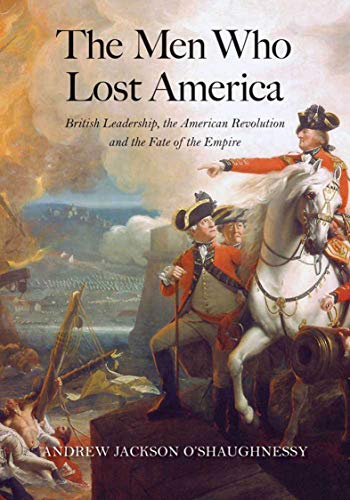
The Men Who Lost America
by Andrew Jackson O'Shaughnessy
"British Leadership, the American Revolution and the Fate of the Empire"
Popularity
4.97 / 5
* A book's popularity is determined by how it compares to all other books on this website.
Where to buy?
Buy from Amazon* If you buy this book through the link above, we may receive a small commission at no extra cost to you.
The Men Who Lost America by Andrew Jackson O'Shaughnessy
Details
War:
American Revolutionary War
Perspective:
Commanders
Military Unit:
British Army
True Story:
Yes
Biography:
Yes
Region:
North America
Page Count:
876
Published Date:
2013
ISBN13:
9780300195248
Summary
The Men Who Lost America examines the British side of the American Revolution by profiling ten key military and political leaders who managed Britain's war effort. Andrew Jackson O'Shaughnessy analyzes figures including King George III, Lord North, and various generals to explain how their decisions, personalities, and circumstances led to Britain's defeat. Rather than depicting them as incompetent villains, the book presents a nuanced view of capable individuals facing an extremely difficult strategic situation. This approach offers fresh perspective on why Britain lost its American colonies and how the loss shaped the empire's future.
Review of The Men Who Lost America by Andrew Jackson O'Shaughnessy
Andrew Jackson O'Shaughnessy's "The Men Who Lost America" offers a compelling reassessment of British leadership during the American Revolution, challenging conventional narratives about incompetence and arrogance that have long dominated discussions of Britain's defeat. Rather than dismissing British commanders and politicians as bumbling failures, O'Shaughnessy provides nuanced biographical portraits of ten key figures who shaped Britain's war effort, revealing the complex challenges they faced and the difficult decisions they made in an unprecedented conflict.
The book examines the roles of prominent figures including King George III, Prime Minister Lord North, and military commanders such as General William Howe, General Sir Henry Clinton, General John Burgoyne, General Lord Cornwallis, and Admiral Richard Howe. O'Shaughnessy also analyzes the contributions of lesser-known but significant players like Lord George Germain, the colonial secretary responsible for coordinating the war effort, General Sir Guy Carleton, and Admiral Sir George Rodney. By focusing on individual leaders rather than abstract forces, the author humanizes the British side of the conflict and demonstrates how personality, circumstance, and structural constraints combined to produce Britain's ultimate defeat.
One of the book's greatest strengths lies in its detailed examination of the practical difficulties facing British leadership. O'Shaughnessy carefully documents the logistical nightmares of conducting military operations across three thousand miles of ocean, the challenges of coordinating naval and land forces, and the political complexities of managing a war that divided British public opinion. The author shows how communication delays of months between London and American battlefields made coherent strategy nearly impossible to maintain, and how the sheer scale of the American theater stretched British military resources to their limits.
The biographical approach allows O'Shaughnessy to explore the personal rivalries and professional jealousies that undermined British effectiveness. The strained relationship between the Howe brothers and Lord George Germain receives particular attention, as does the friction between various military commanders competing for glory and resources. These interpersonal conflicts were not mere personality clashes but had real strategic consequences, contributing to missed opportunities and uncoordinated campaigns. The author demonstrates how these tensions reflected deeper structural problems in British military and governmental organization.
O'Shaughnessy's treatment of King George III deserves special mention for its revisionist perspective. Rather than portraying the monarch as a tyrant determined to crush American liberty, the author presents a more complex figure who was constrained by constitutional limitations, dependent on parliamentary support, and genuinely convinced that maintaining the empire's integrity was essential for Britain's future prosperity and security. This more sympathetic portrait does not excuse the king's policies but places them in their proper political and ideological context.
The book also excels in explaining how British leaders consistently underestimated the scale of American resistance and overestimated loyalist support in the colonies. O'Shaughnessy shows how initial British assumptions about the rebellion's limited nature shaped strategic decisions that proved disastrous when American resistance proved far more widespread and determined than anticipated. The author traces how British strategy evolved from attempts to suppress the rebellion through limited force to increasingly desperate efforts to salvage something from an unraveling situation.
Throughout the narrative, O'Shaughnessy draws on extensive primary source research, including personal correspondence, official documents, and contemporary accounts. This archival foundation gives the book considerable authority and allows the author to correct numerous misconceptions that have persisted in popular and even scholarly accounts of the Revolution. The research reveals how British leaders were often more capable and thoughtful than traditional narratives suggest, even as they struggled with problems that may have been insoluble given the resources and options available to them.
The book's analysis extends beyond military matters to examine the diplomatic and political dimensions of Britain's defeat. O'Shaughnessy discusses how Britain's failure to prevent French and Spanish entry into the war transformed a colonial rebellion into a global conflict that exposed the limits of British power. The author shows how the expansion of the war forced British leaders to make agonizing choices about resource allocation and strategic priorities that ultimately proved fatal to their hopes of retaining the American colonies.
"The Men Who Lost America" represents a significant contribution to Revolutionary War scholarship by insisting on viewing British leadership with the same complexity and nuance typically reserved for the American side. While O'Shaughnessy does not absolve British leaders of their mistakes and misjudgments, he demonstrates that they faced genuine dilemmas and operated under constraints that limited their options. The result is a more balanced and historically sophisticated understanding of how Britain lost America, one that replaces simplistic narratives of incompetence with a recognition of the multiple factors that contributed to an empire's defeat.