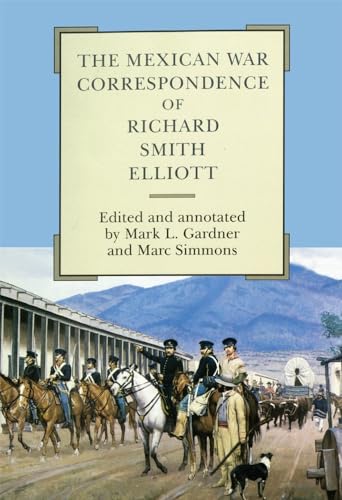
The Mexican War Correspondence of Richard Smith Elliott
by Richard Smith Elliott
Popularity
2.22 / 5
* A book's popularity is determined by how it compares to all other books on this website.
Where to buy?
Buy from Amazon* If you buy this book through the link above, we may receive a small commission at no extra cost to you.
The Mexican War Correspondence of Richard Smith Elliott by Richard Smith Elliott
Details
War:
Mexican-American War
Perspective:
Civilian
True Story:
Yes
Biography:
Yes
Region:
North America
Page Count:
308
Published Date:
2022
ISBN13:
9780806190907
Review of The Mexican War Correspondence of Richard Smith Elliott by Richard Smith Elliott
"The Mexican War Correspondence of Richard Smith Elliott" offers readers a firsthand glimpse into one of the more consequential yet often overlooked conflicts in American history. Richard Smith Elliott served during the Mexican-American War and documented his observations through correspondence that has since been compiled and preserved for historical study. This collection provides a valuable primary source for anyone interested in understanding the war from the perspective of someone who lived through it rather than through the lens of later historians and scholars.
The strength of this work lies in its immediacy. Correspondence written during or shortly after events carries a different quality than retrospective accounts. Elliott's letters capture the day-to-day realities of military campaigns, the challenges of communication in the era, and the personal observations of a participant navigating an unfamiliar landscape and culture. Readers interested in military history will find value in the details Elliott provides about troop movements, conditions faced by soldiers, and the broader context of American expansion during this period.
The Mexican-American War itself remains a significant but sometimes underexamined chapter in United States history. It resulted in substantial territorial changes, reshaping the map of North America and setting the stage for later national developments. Primary sources like Elliott's correspondence help illuminate how contemporaries understood and experienced these events, offering nuance that broader historical narratives sometimes lack. His writings serve as a window into the mindset of the era, revealing attitudes, assumptions, and observations that reflect the complexities of the time.
For readers who appreciate primary source material, this collection has genuine merit. Unlike secondary historical accounts that synthesize and interpret events after the fact, correspondence offers raw, unfiltered perspectives. Elliott's letters likely include observations on military strategy, interactions with local populations, and the physical and logistical challenges of campaigning in unfamiliar terrain. Such details enrich our understanding of the war beyond textbook summaries, providing texture and human dimension to historical events that can otherwise feel abstract or distant.
That said, readers should approach this work with certain expectations in mind. Correspondence from this era often assumes a level of contextual knowledge that modern readers may not possess. Names, places, and events referenced casually by Elliott may require additional research or supplementary material to fully appreciate. This is not necessarily a flaw in the work itself, but rather a characteristic of primary source documents that were originally written for immediate audiences rather than future historical study. Those new to the Mexican-American War may benefit from pairing this collection with a general historical overview to better contextualize Elliott's observations and experiences.
The value of this collection extends beyond mere historical curiosity. It serves as a reminder of how individual voices contribute to our collective understanding of larger historical narratives. Wars are often discussed in terms of strategic outcomes, political consequences, and broad historical significance, but the experiences of individuals who participated in these events add depth and humanity to historical study. Elliott's correspondence allows modern readers to connect with the past on a more personal level, moving beyond abstract historical analysis to engage with the lived experience of someone present during these formative events.
This compilation will likely appeal most strongly to those with a specific interest in American military history, the Mexican-American War, or primary source documentation from the nineteenth century. Academic researchers, history enthusiasts, and students studying this particular conflict will find considerable value in accessing Elliott's original observations rather than relying solely on secondary interpretations. General readers with only a passing interest in the period may find the material more specialized than accessible, though the historical significance of the content remains undeniable.
Overall, "The Mexican War Correspondence of Richard Smith Elliott" stands as an important contribution to the historical record of the Mexican-American War. It preserves a personal perspective that might otherwise have been lost to time, offering researchers and history enthusiasts alike a valuable resource for understanding this pivotal period in American expansion and international conflict.

