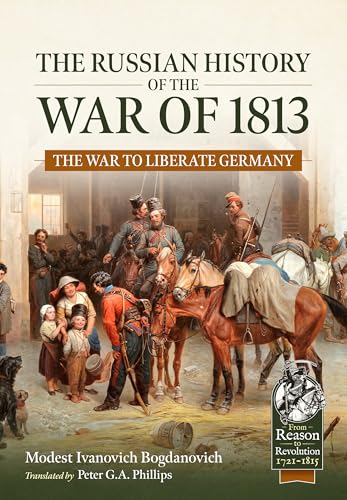
The Russian History of the War of 1813
by Major General Modest Ivanovich Bogdanovich
"The War to Liberate Germany"
Popularity
4.73 / 5
* A book's popularity is determined by how it compares to all other books on this website.
Where to buy?
Buy from Amazon* If you buy this book through the link above, we may receive a small commission at no extra cost to you.
The Russian History of the War of 1813 by Major General Modest Ivanovich Bogdanovich
Details
War:
Napoleonic Wars
Perspective:
Commanders
True Story:
Yes
Biography:
No
Region:
Europe
Published Date:
2025
ISBN13:
9781804516782
Description
Brief Summary
The Russian History of the War of 1813 by Major General Modest Ivanovich Bogdanovich provides an in-depth chronicle of the events following the Russian campaigns against Napoleon. Picking up where the History of the War of 1812 ends, this volume offers a detailed examination of 1813, a pivotal year in Europe's history. The narrative begins with the Russian invasion of the Duchy of Warsaw and covers significant developments, such as the defection of Prussia to the Russian camp, and the liberation of Berlin and Hamburg. The book concludes with the Armistice of June 1813, setting the stage for subsequent volumes chronicling further Coalition efforts against Napoleon.
Main Themes and Topics
The book focuses on several key themes, including the significance of coalition warfare and the pivotal role of the Russian army in liberating Germany from Napoleonic control. Bogdanovich meticulously details the dynamics between Russia and its allies, especially how Russia's solitary struggles in Prussia ultimately drew other major European powers, including Austria, Sweden, and Britain, into the conflict. The work is not only a military history but also an exploration of diplomatic maneuvering and alliance-building.
Writing Style and Tone
Bogdanovich's writing is characterized by its academic rigor and detailed historical analysis. The author leverages primary sources, including Russian state archives and private documents, to support his narratives, buttressed by references to German and French memoirs and histories. This attention to detail ensures a well-rounded view of events from multiple perspectives. The tone is formal and factual, aimed at readers with a keen interest in military history and strategic studies.
Criticism
While the book is praised for its thorough research and comprehensive coverage of a critical period in European history, some critiques point to its density and complexity. Readers unfamiliar with the Napoleonic era might find the wealth of details overwhelming. Additionally, the formal writing style may not appeal to casual readers looking for an accessible introduction to the period. Nonetheless, for dedicated historians or enthusiasts of Napoleonic military history, Bogdanovich's work remains an invaluable resource.