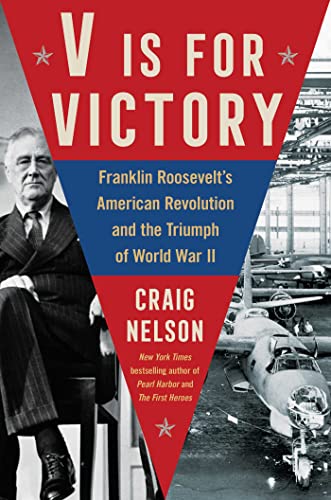
V Is For Victory
by Craig Nelson
"Franklin Roosevelt's American Revolution and the Triumph of World War II"
Popularity
4.83 / 5
* A book's popularity is determined by how it compares to all other books on this website.
Where to buy?
Buy from Amazon* If you buy this book through the link above, we may receive a small commission at no extra cost to you.
V Is For Victory by Craig Nelson
Details
War:
World War II
Perspective:
Commanders
True Story:
Yes
Biography:
No
Region:
North America
Page Count:
448
Published Date:
2023
ISBN13:
9781982122911
Review of V Is For Victory by Craig Nelson
Craig Nelson's "V is for Victory: Franklin Roosevelt's American Revolution and the Triumph of World War II" offers a sweeping account of how the United States transformed itself during the Second World War, both on the battlefield and at home. Rather than focusing narrowly on military campaigns, Nelson widens his lens to examine the political, industrial, and social changes that reshaped American life under Franklin D. Roosevelt's leadership. The result is a book that functions as both a history of the war years and a study of national identity in flux.
Nelson structures his narrative around Roosevelt's presidency, using it as a throughline that connects the many disparate threads of the wartime era. He explores the president's efforts to prepare a reluctant nation for global conflict, the massive mobilization of industry that followed Pearl Harbor, and the diplomatic balancing act Roosevelt performed with Allied leaders such as Winston Churchill and Joseph Stalin. Throughout, the author emphasizes how Roosevelt's political instincts and communication skills, particularly his use of radio addresses, helped unify a fractured public behind a shared cause.
One of the book's strengths lies in its attention to the home front. Nelson devotes considerable space to the economic and social transformations that accompanied the war effort, including the rapid expansion of manufacturing, the entry of women into the industrial workforce, and the migration of Black Americans to Northern cities in search of wartime jobs. These sections illustrate how the war accelerated changes that had been building for decades, reshaping labor patterns and demographic trends in ways that would influence postwar America. Nelson does not shy away from the contradictions of this period, noting the persistence of racial segregation and discrimination even as the nation fought against fascism abroad.
The book also addresses the internment of Japanese Americans, a policy enacted under Roosevelt's authority that remains one of the more troubling chapters of his presidency. Nelson presents this history with clarity, situating it within the broader context of wartime fear and prejudice without minimizing its human cost. This willingness to grapple with the less flattering aspects of the era gives the book a balanced perspective, avoiding the temptation to present the war years solely as a triumphant national narrative.
Military history readers will find substantial coverage of key campaigns and strategic decisions, though Nelson's primary interest remains the interplay between battlefield events and domestic policy. He traces how military setbacks and victories influenced public opinion and political strategy, and how Roosevelt navigated the competing demands of allies, military commanders, and the American electorate. The book's treatment of the Manhattan Project and the decision to use atomic weapons against Japan is handled with appropriate gravity, acknowledging the moral complexity of that choice without offering simplistic judgments.
Nelson's prose is accessible, favoring narrative momentum over dense analysis. This approach makes the book suitable for general readers interested in American history, though those seeking deep military strategy or granular policy analysis may find some sections more expansive than necessary. The author's skill in weaving together multiple storylines, from factory floors to the Oval Office to overseas battlefields, keeps the narrative engaging across its considerable length.
The title's framing of the war as an "American Revolution" reflects Nelson's central argument: that the conflict fundamentally altered the nation's economic structure, social hierarchies, and role in global affairs. By war's end, the United States had emerged as an industrial and military superpower, with its domestic institutions reshaped by the demands of total war. Nelson makes a persuasive case that these changes were not merely temporary wartime measures but lasting shifts that defined the following decades.
"V is for Victory" succeeds as an ambitious synthesis of political, social, and military history. It offers readers a comprehensive view of how Roosevelt's leadership and the collective sacrifices of ordinary Americans combined to produce victory abroad and transformation at home. While its scope means that no single topic receives exhaustive treatment, the book's strength lies in showing the interconnected nature of wartime change. For readers seeking a broad, thoughtful account of America's World War II experience, Nelson's work provides a valuable and well-researched contribution.


