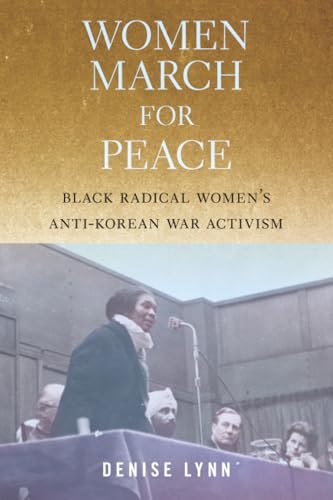
Women March for Peace
by Denise Lynn
"Black Radical Women's Anti-Korean War Activism"
Popularity
4.92 / 5
* A book's popularity is determined by how it compares to all other books on this website.
Where to buy?
Buy from Amazon* If you buy this book through the link above, we may receive a small commission at no extra cost to you.
Women March for Peace by Denise Lynn
Details
War:
Korean War
Perspective:
Civilian
True Story:
Yes
Biography:
Yes
Region:
Asia
Published Date:
2025
ISBN13:
9781625349033
Review of Women March for Peace by Denise Lynn
Denise M. Lynn's "Women March for Peace: Black Radical Women's Anti-Korean War Activism" examines a chapter of American history that has often been overlooked in broader narratives of both the Cold War era and the civil rights movement. The book centers on the activism of Black women who organized against the Korean War, situating their efforts within the larger context of radical political traditions, anti-colonial movements, and the fight for racial justice in the United States during the early 1950s.
Lynn's research draws on archival materials to reconstruct the lives and political commitments of women whose contributions to peace activism have rarely received sustained scholarly attention. The author positions these women not as peripheral figures but as central actors who linked their opposition to the Korean War with their broader critiques of American foreign policy, militarism, and racial inequality at home. This approach allows readers to see how domestic concerns about civil rights intersected with international concerns about war and empire, particularly as the United States expanded its military footprint in Asia during the early Cold War period.
One of the strengths of this book lies in its careful attention to the organizational structures that Black radical women built and sustained during a politically dangerous era. The early 1950s were marked by intense anti-communist sentiment, and those who criticized U.S. foreign policy or allied themselves with left-wing political movements often faced surveillance, harassment, or worse from government agencies and private actors alike. Lynn's narrative does not shy away from documenting these pressures, showing how the women at the center of her study navigated a hostile political climate while continuing their activism.
The book also contributes meaningfully to scholarship on Black internationalism, a field that examines how African American activists connected their struggles for equality to global movements against colonialism and imperialism. By focusing specifically on opposition to the Korean War, Lynn adds nuance to this scholarship, demonstrating that Black radical women saw the conflict not as an isolated military engagement but as part of a broader pattern of American intervention abroad that mirrored forms of racial oppression they experienced domestically. This connection between the local and the global is a recurring theme throughout the text, and it helps explain why these women felt compelled to organize despite significant personal and professional risks.
Readers interested in women's history will find much to appreciate in how Lynn foregrounds gender as a critical lens for understanding this activism. The book explores how these women navigated political spaces that were often dominated by men, whether within broader peace movements or within Black political organizations themselves. Lynn's analysis suggests that gender, race, and political ideology intersected in complex ways that shaped both the strategies these women employed and the obstacles they faced.
The writing throughout the book is grounded in historical detail without becoming overly technical, making it accessible to readers who may not have extensive background knowledge of Cold War politics or Black radical traditions. Lynn provides sufficient context for general readers while still offering the kind of depth that specialists in the field would expect from a serious historical study. The book's structure allows for a logical progression through the events and ideas it covers, building a comprehensive picture of this activist movement over time.
Overall, "Women March for Peace" fills an important gap in historical scholarship by bringing attention to a group of activists whose work has not received the recognition it deserves. Lynn's careful research and clear analytical framework make this book a valuable contribution to several overlapping fields of study, including African American history, women's history, and the history of American foreign policy during the Cold War. For readers seeking to understand the complexities of mid-twentieth-century American activism, particularly the ways in which race, gender, and international politics intersected during this period, this book offers a thoughtful and well-documented account. It stands as a useful addition to academic and general collections alike, shedding light on figures and movements that have too often remained in the shadows of more widely told historical narratives.


