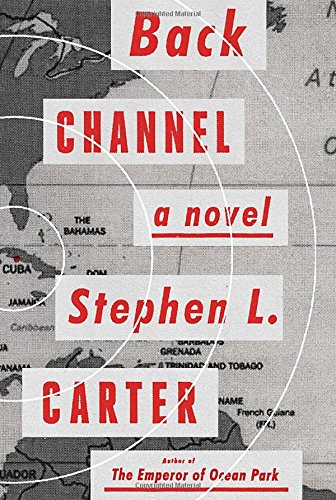
Back Channel
by Stephen L. Carter
Popularity
4.04 / 5
* A book's popularity is determined by how it compares to all other books on this website.
Where to buy?
Buy from Amazon* If you buy this book through the link above, we may receive a small commission at no extra cost to you.
Back Channel by Stephen L. Carter
Details
War:
Cuban Missile Crisis
Perspective:
Spying
Biography:
No
Region:
North America
Published Date:
2014
ISBN13:
9780385349604
Summary
Back Channel is a historical thriller set during the 1962 Cuban Missile Crisis. The story follows Margo Jensen, a young black Cornell University student who becomes an unlikely diplomatic courier between the White House and the Kremlin. As Cold War tensions escalate and nuclear war looms, Margo navigates a dangerous world of international espionage and political intrigue. The novel blends real historical events with fiction, exploring themes of race, gender, and power during one of history's most perilous moments. Carter delivers a suspenseful tale that reimagines behind-the-scenes negotiations that may have prevented global catastrophe.
Review of Back Channel by Stephen L. Carter
Stephen L. Carter's "Back Channel" takes readers into the shadowy world of Cold War diplomacy through the eyes of an unlikely protagonist. Set against the tense backdrop of the Cuban Missile Crisis in 1962, this historical thriller follows Margo Jensen, a nineteen-year-old Cornell University student who finds herself drafted into a dangerous diplomatic mission that could determine the fate of millions.
The novel opens with Margo, a brilliant African American chess prodigy and mathematics student, being recruited to serve as a secret courier between the Kennedy administration and the Soviet Union. Her role as a back channel negotiator places her at the center of one of the most perilous moments in modern history, when the world teetered on the brink of nuclear war. Carter constructs a narrative that weaves together political intrigue, personal danger, and the profound weight of historical consequence.
What distinguishes this novel is Carter's attention to the racial and social dynamics of early 1960s America. Margo's identity as a young Black woman operating in predominantly white spaces adds layers of complexity to her mission. The author explores how her race and gender simultaneously make her an unexpected choice for such sensitive work and create additional obstacles she must navigate. These elements are woven naturally into the story rather than feeling like afterthoughts or heavy-handed social commentary.
Carter, who teaches law at Yale University and has written extensively on ethics and politics, brings substantial knowledge to the historical framework of his story. The depiction of the Cuban Missile Crisis draws on well-documented events, including the tense thirteen days in October 1962 when American and Soviet leaders engaged in a high-stakes standoff. The novel incorporates real historical figures and actual diplomatic maneuvers, grounding the fictional narrative in authentic historical context.
The chess motif runs throughout the novel, serving both as a plot device and a metaphor for Cold War strategy. Margo's expertise in chess becomes essential to her mission, as the Soviets communicate through coded chess moves and problems. This element allows Carter to draw parallels between the calculated moves of a chess match and the careful positioning of international diplomacy, where one wrong move could trigger catastrophic consequences.
The pacing moves briskly through the novel's considerable length, balancing moments of quiet tension with episodes of genuine danger. Margo faces threats from multiple directions, including those who doubt her abilities, those who seek to use her for their own purposes, and those who would prefer the mission fail entirely. Carter maintains suspense even though readers familiar with history know the ultimate outcome of the missile crisis itself.
Character development extends beyond the protagonist to include a cast of diplomats, intelligence officers, and other players in the dangerous game of Cold War politics. The supporting characters feel authentic to their era, speaking and acting in ways consistent with the period's attitudes and constraints. The author avoids the temptation to make historical figures either heroes or villains, instead presenting them as complex individuals operating under extraordinary pressure.
The novel's depiction of espionage and diplomacy eschews the glamorous spy fiction formula in favor of a more grounded approach. The work highlights the unglamorous reality of intelligence gathering, the tedium mixed with terror, and the moral ambiguities inherent in such operations. Margo grapples with questions about truth, loyalty, and the cost of keeping secrets, themes that resonate beyond the specific historical moment.
Carter's prose style remains accessible while maintaining literary quality. The writing conveys the tension and urgency of the period without resorting to melodrama. Descriptions of settings, from Ivy League campuses to shadowy meeting places in Europe, create a vivid sense of place and time. The dialogue feels natural and period-appropriate, avoiding anachronistic language that might break the historical spell.
The novel also functions as a meditation on the hidden figures of history, those whose contributions remain classified or simply forgotten. By centering his story on a young Black woman thrust into a world of white male power brokers, Carter asks readers to consider whose stories get told and whose get buried in the archives. This thematic element adds depth without overwhelming the thriller aspects of the narrative.
"Back Channel" succeeds as both entertainment and a thought-provoking exploration of a pivotal moment in history. The combination of historical authenticity, compelling characters, and genuine suspense creates an engaging reading experience. For those interested in Cold War history, political thrillers, or stories about overlooked figures in major historical events, this novel offers a satisfying blend of all three elements.


