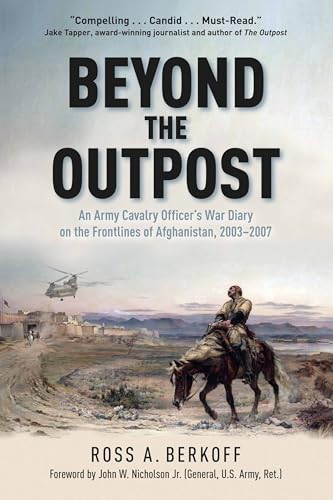
Beyond the Outpost
by Ross A. Berkoff
"An Army Cavalry Officer's War Diary on the Frontlines of Afghanistan, 2003 - 2007"
Popularity
4.7 / 5
* A book's popularity is determined by how it compares to all other books on this website.
Where to buy?
Buy from Amazon* If you buy this book through the link above, we may receive a small commission at no extra cost to you.
Beyond the Outpost by Ross A. Berkoff
Details
War:
War in Afghanistan
Perspective:
Cavalry
Military Unit:
US Army
True Story:
Yes
Biography:
Yes
Region:
Asia
Published Date:
2025
ISBN13:
9781611217629
Summary
Beyond the Outpost is a firsthand account by Army Cavalry officer Ross A. Berkoff detailing his experiences serving in Afghanistan from 2003 to 2007. The book offers an intimate look at frontline operations during the early years of the Afghan War, chronicling the challenges, decisions, and realities faced by soldiers in remote outposts. Through his war diary entries, Berkoff provides readers with an unfiltered perspective on military life, combat operations, and the complexities of counterinsurgency warfare in Afghanistan's rugged terrain.
Review of Beyond the Outpost by Ross A. Berkoff
Ross A. Berkoff's "Beyond the Outpost" offers readers an intimate chronicle of American military operations during the critical early years of the war in Afghanistan. Drawing from his personal journals and experiences as an Army Cavalry officer, Berkoff documents the period from 2003 to 2007, a timeframe that witnessed significant shifts in the conflict's nature and the evolution of counterinsurgency tactics on the ground.
The book distinguishes itself through its diary format, providing a raw and immediate perspective on daily military life in Afghanistan. Rather than presenting a retrospective analysis written years after the events, Berkoff's work preserves the contemporaneous observations and reactions of an officer navigating complex operational environments. This approach grants readers access to the uncertainties, challenges, and decision-making processes that characterized operations during this pivotal period of the conflict.
Berkoff's background as a Cavalry officer shapes the narrative significantly. The Cavalry's traditional role in reconnaissance and security operations meant exposure to diverse aspects of the Afghan theater, from remote outposts to engagement with local populations. The author's documentation captures the multifaceted nature of military service during this era, encompassing combat operations, reconstruction efforts, and the delicate work of building relationships with Afghan communities and leaders.
The timeframe covered by the book holds particular historical significance. The years 2003 to 2007 marked a period when international attention and military resources were heavily diverted toward Iraq, while Afghanistan experienced what some analysts later termed neglect. Berkoff's account provides ground-level perspective on how military personnel adapted to resource constraints and evolving mission parameters during these years. The diary entries document the transition from initial optimism about stabilization efforts to growing awareness of the conflict's complexity and the resurgence of Taliban forces.
One of the work's notable strengths lies in its preservation of the quotidian realities of deployment. The book moves beyond dramatic combat narratives to encompass the routine aspects of military service: the logistics of maintaining remote outposts, the challenges of communication across vast distances, and the psychological toll of extended deployments. These details contribute to a comprehensive understanding of what sustained military operations demanded from service members and their units.
Berkoff's documentation also captures the cultural dimensions of the mission. Interactions with Afghan civilians, local government officials, and tribal leaders form an important thread throughout the narrative. The diary format preserves the learning curve that officers experienced as they developed cultural awareness and navigated the complex social and political landscape of Afghan provinces. These passages illuminate the gap between policy objectives and on-the-ground realities that frequently challenged military personnel.
The book's value extends beyond its historical documentation to serve as a resource for understanding the human dimensions of modern warfare. Berkoff's entries reflect on leadership challenges, the bonds formed between soldiers under difficult circumstances, and the moral complexities inherent in counterinsurgency operations. The work does not shy away from depicting the frustrations and setbacks that accompanied efforts to achieve mission objectives in an environment marked by ambiguity and competing priorities.
For readers seeking to understand the Afghanistan conflict beyond headline summaries and official reports, Berkoff's diary offers valuable granular detail. The work contributes to the broader literature on the war by providing a participant's perspective during a period that later analysis identified as critical to the conflict's trajectory. The author's willingness to share personal observations and reflections adds depth to historical understanding of how the war was experienced by those serving in it.
"Beyond the Outpost" stands as a documentary account that preserves one officer's experience during consequential years of the Afghanistan war. The diary format, while occasionally resulting in a non-linear narrative structure, maintains authenticity and immediacy that more polished memoirs might sacrifice. Berkoff's contribution joins the growing body of firsthand accounts that help illuminate the complexities, challenges, and human costs of America's longest war. For military historians, policy analysts, and general readers interested in understanding the Afghanistan conflict through the eyes of those who served, this work provides substantive and authentic perspective.