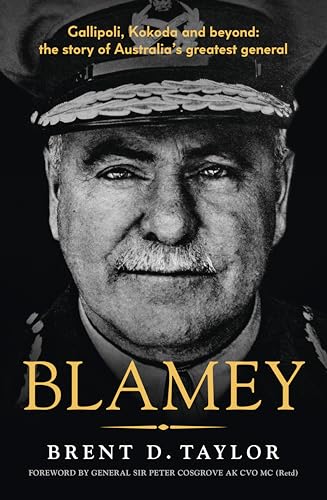
Blamey
by Brent D. Taylor
"The story of Australia's greatest general, for readers of Grantlee Kieza, Peter FitzSimons and Roland Perry"
Popularity
4.08 / 5
* A book's popularity is determined by how it compares to all other books on this website.
Where to buy?
Buy from Amazon* If you buy this book through the link above, we may receive a small commission at no extra cost to you.
Blamey by Brent D. Taylor
Details
War:
World War II
Perspective:
Commanders
True Story:
Yes
Biography:
Yes
Region:
Australia/Oceania
Page Count:
441
Published Date:
2025
ISBN13:
9781460718216
Summary
This biography chronicles the life and military career of Field Marshal Sir Thomas Blamey, Australia's most senior army officer during World War II. The book examines Blamey's controversial leadership, from his command of Australian forces in the Middle East and New Guinea to his complex relationships with Allied commanders. Taylor explores both Blamey's strategic brilliance and the controversies that surrounded him, offering readers insight into a pivotal figure in Australian military history whose legacy remains debated among historians and military scholars.
Review of Blamey by Brent D. Taylor
Field Marshal Sir Thomas Blamey remains one of the most controversial and least understood figures in Australian military history. Brent D. Taylor's biography seeks to rehabilitate Blamey's reputation and cement his place as Australia's greatest general, positioning the work for readers who have enjoyed popular military histories by Grantlee Kieza, Peter FitzSimons, and Roland Perry. The book tackles the formidable challenge of presenting a nuanced portrait of a man whose legacy has been fiercely debated for decades.
Blamey's military career spanned both World Wars, and his influence on the development of the Australian military cannot be overstated. Rising through the ranks to become the first Australian-born field marshal, Blamey commanded Australian forces during some of the most critical campaigns of World War II, including operations in North Africa, Greece, and the pivotal New Guinea campaign. His role in shaping the Australian Army and his relationship with General Douglas MacArthur during the Pacific War form central elements of any serious examination of his career.
Taylor's biography arrives at a time when reassessments of controversial historical figures have become increasingly common. Blamey has long been a polarizing character, praised by some for his strategic acumen and organizational abilities while criticized by others for alleged personal failings and questionable decisions. The general's reputation suffered particularly from accusations of corruption during his pre-war police career in Victoria and from tensions with other military leaders and war correspondents during the war years.
The book's positioning for readers of popular military historians suggests an accessible narrative approach rather than a dense academic treatment. This style has proven effective in bringing Australian military history to broader audiences, making complex campaigns and strategic decisions understandable without oversimplification. The challenge for any biographer of Blamey lies in balancing the undeniable achievements of his military career against the controversies that have clouded his legacy.
Blamey's command during the New Guinea campaign represents perhaps his most significant contribution to Allied victory in the Pacific. The grueling jungle warfare, fought under appalling conditions against a determined Japanese enemy, tested Australian forces to their limits. The strategic importance of preventing Japanese forces from reaching Port Moresby and threatening Australia itself cannot be understated. How Taylor addresses Blamey's leadership during this critical period and his management of relations with American command structures provides crucial insight into his assessment of the field marshal's capabilities.
The relationship between Blamey and MacArthur remains one of the more complex aspects of Pacific War command structures. As the senior Australian commander operating under American supreme command, Blamey occupied a difficult position, needing to represent Australian interests while maintaining operational cooperation. The dynamics of this relationship and how it affected strategic decisions and the deployment of Australian forces merit careful examination in any comprehensive biography.
Questions surrounding Blamey's earlier career, particularly his time as Chief Commissioner of Victoria Police, have long complicated assessments of his character. These controversies preceded his military achievements but never entirely disappeared from public consciousness. A thorough biography must address these issues while maintaining focus on the military career that defines his historical significance.
The title's claim of Blamey as Australia's greatest general invites comparison with other distinguished Australian military leaders. Figures such as Lieutenant General Sir John Monash, who commanded with distinction during World War I, often feature prominently in such discussions. The case for Blamey's preeminence must rest on careful analysis of his strategic contributions, organizational reforms, and the scale and complexity of forces under his command during World War II.
Taylor's work contributes to ongoing scholarly and popular interest in reassessing World War II leadership and Australia's role in the Pacific theater. The evolution of Australian military independence and identity during this period remains a subject of considerable historical interest. Blamey's role in this transformation, as the highest-ranking Australian commander operating during the war, makes his biography significant beyond mere military history.
For readers interested in Australian military history, particularly the Pacific War and the development of Australian command structures, this biography offers an examination of a figure whose influence extended well beyond his death. Whether Taylor succeeds in establishing Blamey as Australia's greatest general will likely depend on how convincingly he addresses both the achievements and controversies that have made the field marshal such an enduring subject of historical debate. The book joins an important conversation about how military leaders should be evaluated and remembered within their full historical context.


