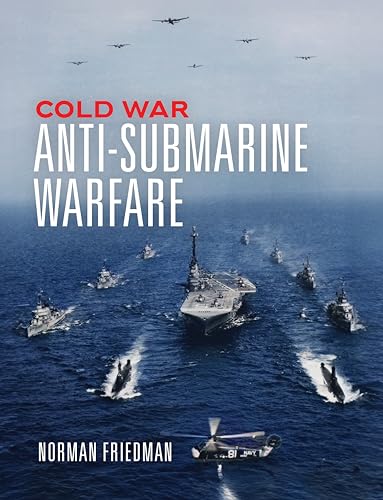
Cold War Anti-Submarine Warfare
by Norman Friedman
Popularity
4.83 / 5
* A book's popularity is determined by how it compares to all other books on this website.
Where to buy?
Buy from Amazon* If you buy this book through the link above, we may receive a small commission at no extra cost to you.
Cold War Anti-Submarine Warfare by Norman Friedman
Details
War:
Cold War
Perspective:
Submarines
Military Unit:
US Navy
True Story:
Yes
Biography:
No
Region:
North America
Published Date:
2025
ISBN13:
9781682478578
Summary
Cold War Anti-Submarine Warfare by Norman Friedman examines the technological and strategic evolution of ASW operations during the Cold War era. The book explores how NATO and Soviet forces developed detection systems, weapons, and tactics to counter submarine threats. Friedman analyzes sonar technology, aircraft and surface ship capabilities, and the strategic importance of anti-submarine warfare in maintaining naval superiority. Drawing on technical details and operational history, the work provides insight into how Cold War superpowers approached the challenge of detecting and tracking increasingly sophisticated submarines in a high-stakes maritime environment.
Review of Cold War Anti-Submarine Warfare by Norman Friedman
Norman Friedman's "Cold War Anti-Submarine Warfare" stands as a comprehensive examination of one of the most critical yet least understood aspects of twentieth-century naval strategy. This work represents a significant contribution to military history literature, offering readers an in-depth analysis of the technologies, tactics, and strategic thinking that defined underwater warfare during the decades-long superpower confrontation.
The book methodically traces the evolution of anti-submarine warfare (ASW) from the end of World War II through the dissolution of the Soviet Union. Friedman, a respected naval analyst and historian with numerous publications on naval technology and strategy, brings his characteristic attention to technical detail while maintaining accessibility for readers without specialized engineering backgrounds. His approach balances the examination of hardware developments with the operational doctrines and strategic considerations that drove technological innovation.
One of the book's greatest strengths lies in its thorough documentation of the technological race between submarine capabilities and the systems designed to detect and counter them. Friedman explores the development of sonar systems, from passive arrays to active detection methods, explaining how improvements in submarine quieting technology necessitated corresponding advances in detection capabilities. The text addresses the challenges posed by ocean acoustics, thermal layers, and the cat-and-mouse game between submarine stealth and surface ship detection systems.
The author devotes considerable attention to the role of maritime patrol aircraft in ASW operations, detailing the evolution of platforms and sensors employed by NATO and Soviet forces. The progression from World War II-era technology to sophisticated electronic systems capable of detecting submarines over vast ocean areas receives thorough treatment. Friedman examines how airborne ASW complemented surface ship operations and the development of coordinated tactics that integrated multiple platforms into coherent operational strategies.
A particularly valuable aspect of the work is its treatment of the strategic context surrounding ASW developments. The book explores how concerns about Soviet submarine-launched ballistic missiles influenced Western naval planning and resource allocation. The threat posed by Soviet attack submarines to NATO's sea lines of communication across the Atlantic receives detailed analysis, as does the development of barrier strategies and choke point tactics designed to contain Soviet naval forces.
Friedman does not limit his analysis to Western perspectives and capabilities. The book includes substantive discussion of Soviet ASW developments, their tactical approaches, and the strategic imperatives that shaped their naval programs. This balanced treatment provides readers with a more complete understanding of the bilateral nature of Cold War naval competition and the action-reaction cycles that characterized technological development on both sides.
The work also addresses the institutional and organizational dimensions of ASW. Friedman examines how different navies structured their ASW forces, the training requirements for personnel operating complex detection systems, and the challenges of maintaining readiness for a mission that involved extensive peacetime operations. The book touches on exercises, deployments, and the real-world tracking operations that occurred throughout the Cold War period.
Technical readers will appreciate the detailed specifications and performance characteristics Friedman provides for various systems, while the broader strategic discussions ensure the material remains relevant to those interested in Cold War history and naval strategy beyond pure technical analysis. The author's ability to connect specific technological capabilities to their operational and strategic implications elevates the work beyond a simple catalog of systems and platforms.
The book benefits from Friedman's access to both published sources and his extensive network within naval and defense communities. His research draws on official documents, technical publications, and the perspectives of practitioners who participated in Cold War ASW operations. This combination of sources lends authority to the analysis and provides insights not readily available in more general histories of the period.
"Cold War Anti-Submarine Warfare" serves multiple audiences effectively. Military historians will find it an essential reference on a crucial aspect of Cold War military competition. Defense analysts and naval professionals gain valuable perspective on how current ASW challenges connect to Cold War-era developments. General readers interested in Cold War history or naval warfare will find the book accessible despite its technical subject matter, though some sections demand careful reading due to the complexity of the systems and concepts discussed.
This volume represents a definitive treatment of its subject, filling a gap in Cold War military history literature. Friedman's combination of technical expertise, strategic insight, and clear writing makes this work an important contribution to understanding how the silent war beneath the waves shaped the broader superpower confrontation.


