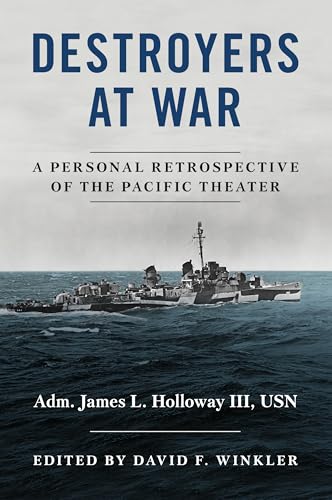
Destroyers at War
by James L. Holloway
"A Personal Retrospective of the Pacific Theater"
Popularity
4.53 / 5
* A book's popularity is determined by how it compares to all other books on this website.
Where to buy?
Buy from Amazon* If you buy this book through the link above, we may receive a small commission at no extra cost to you.
Destroyers at War by James L. Holloway
Details
War:
World War II
Perspective:
Destroyers
Military Unit:
US Navy
True Story:
Yes
Biography:
Yes
Region:
Pacific
Page Count:
338
Published Date:
2025
ISBN13:
9781682473665
Review of Destroyers at War by James L. Holloway
"Destroyers at War: A Personal Retrospective of the Pacific Theater" by David F. Winkler offers readers an accessible entry point into one of the most demanding and dangerous roles of naval warfare during World War II. Winkler, a naval historian with a long record of work on U.S. Navy history, brings both scholarly grounding and narrative sensitivity to this examination of destroyer operations in the Pacific. The book positions itself not as a dry technical account but as a retrospective that blends historical analysis with personal testimony, giving the subject matter a human dimension often missing from broader strategic histories of the war.
Destroyers occupied a peculiar and vital place in the naval order of battle. Smaller and faster than battleships or cruisers, they were tasked with an extraordinarily wide range of duties: screening larger vessels from submarine and air attack, conducting anti-submarine warfare, providing shore bombardment, rescuing survivors, and engaging in surface actions against enemy ships. Winkler's work captures this versatility well, walking readers through the many roles these ships and their crews were expected to fulfill, often with minimal armor and limited margin for error. The Pacific theater, with its vast distances, extreme weather, and relentless kamikaze threat in the war's later years, placed particular strain on destroyer crews, and the book conveys the intensity of that experience without resorting to melodrama.
One of the strengths of this retrospective is its attention to the individuals who served aboard these ships. Rather than focusing exclusively on fleet movements and command decisions, Winkler incorporates personal recollections and firsthand perspectives that illuminate the day-to-day realities of shipboard life. This includes the physical hardships of extended deployments, the psychological toll of combat, and the camaraderie that developed among crews who depended on one another for survival in extraordinarily hazardous conditions. By weaving these personal accounts into the broader historical narrative, the book succeeds in humanizing a subject that could otherwise become an abstract catalog of battles and statistics.
The structure of the book allows readers to appreciate both the tactical evolution of destroyer warfare and the lived experience of those who fought aboard these vessels. Winkler does not shy away from describing the technical aspects of destroyer design and armament, but he integrates this information in a way that supports the narrative rather than overwhelming it. Readers with a strong interest in naval technology will find enough detail to satisfy their curiosity, while those more interested in the human story of the Pacific War will not feel bogged down by excessive technical explanation.
Winkler's background as a historian affiliated with naval historical organizations lends credibility to the work, and his familiarity with archival material and oral histories is evident throughout. The book benefits from this expertise, presenting information that feels well-researched and carefully considered. At the same time, the retrospective format allows for a more personal and reflective tone than might be found in a purely academic treatment of the subject, making the book approachable for general readers as well as those with a more specialized interest in naval history.
The Pacific Theater setting is particularly significant, given the unique challenges it presented compared to the Atlantic. The scale of the Pacific, the nature of Japanese naval and aerial tactics, and the logistical demands of sustained operations far from home ports all shaped the destroyer's role in ways that differed from European waters. Winkler's focus on this specific theater allows for a more concentrated and detailed examination than a broader history might permit, giving readers a clearer sense of how destroyer operations evolved throughout the war years.
Overall, "Destroyers at War" succeeds in its stated aim of providing a personal retrospective that honors the experiences of destroyer crews while situating their service within the larger context of Pacific naval warfare. It is a worthwhile addition to the literature on World War II naval history, particularly for readers interested in the intersection of personal testimony and historical analysis. Winkler's clear prose and balanced approach make this a book that can be appreciated by both newcomers to the subject and those already familiar with the broader history of the Pacific War.


