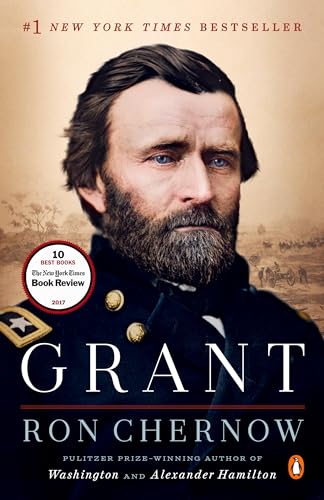
Grant Takes Command
by Bruce Catton
Popularity
4.98 / 5
* A book's popularity is determined by how it compares to all other books on this website.
Where to buy?
Buy from Amazon* If you buy this book through the link above, we may receive a small commission at no extra cost to you.
Grant Takes Command by Bruce Catton
Details
War:
American Civil War
Perspective:
Commanders
True Story:
Yes
Biography:
Yes
Region:
North America
Page Count:
351
Published Date:
2015
ISBN13:
9781504024211
Summary
Grant Takes Command chronicles Ulysses S. Grant's Civil War leadership from 1863 to 1865, when he commanded all Union armies. Bruce Catton details Grant's strategic brilliance, his partnership with Lincoln, and the final campaigns that defeated the Confederacy. The book explores Grant's military philosophy, his coordination of multiple armies, and key battles including the Wilderness Campaign, Petersburg siege, and Lee's surrender at Appomattox. Catton portrays Grant as a determined, clear-thinking commander who understood modern warfare's realities and possessed the resolve to see the war through to Union victory.
Review of Grant Takes Command by Bruce Catton
Bruce Catton's "Grant Takes Command" stands as the compelling continuation of his earlier biographical work on Ulysses S. Grant, picking up the story in October 1863 when Grant assumed command of the Military Division of the Mississippi. This volume carries readers through the final eighteen months of the Civil War, chronicling Grant's rise from western theater commander to General-in-Chief of all Union armies and his ultimate triumph over Robert E. Lee's Army of Northern Virginia.
Catton, a Pulitzer Prize-winning historian renowned for his vivid prose and deep understanding of the Civil War era, brings his characteristic narrative skill to this biographical study. The book examines a crucial period in American history through the lens of one man's military leadership, offering readers a detailed account of the campaigns that brought the war to its conclusion. Published in 1968, this work represents Catton's mature assessment of Grant's generalship and character, drawing on extensive research and the author's lifetime of engagement with Civil War history.
The narrative begins with Grant's successful operations around Chattanooga, where his tactical acumen and ability to coordinate multiple army movements first demonstrated the qualities that would later define his command of all Union forces. Catton carefully traces Grant's promotion to lieutenant general in March 1864, a rank previously held only by George Washington, and his decision to make his headquarters with the Army of the Potomac in Virginia. This strategic choice placed Grant in direct operational control of the campaign against Lee while simultaneously coordinating Union military efforts across all theaters of the war.
Central to Catton's account is the Overland Campaign of 1864, that grinding series of battles from the Wilderness through Cold Harbor to the siege of Petersburg. The author presents these engagements with clarity and detail, explaining Grant's strategy of constant pressure and his willingness to accept heavy casualties in pursuit of decisive results. Catton does not shy away from the controversial aspects of Grant's generalship, including the staggering losses sustained by Union forces during the spring and summer of 1864. However, the book places these tactical decisions within the broader strategic context of a war that required the destruction of Confederate armies in the field, not merely the occupation of territory.
The biographical portrait that emerges is of a commander who combined strategic vision with operational persistence. Catton depicts Grant as a general who understood that the Confederacy's limited manpower and industrial resources could be exhausted through coordinated, simultaneous offensives across multiple fronts. This strategy, which kept Confederate forces from reinforcing one another, marked a significant evolution in Union military planning. The book details Grant's coordination with Sherman's Atlanta campaign, Sheridan's Shenandoah Valley operations, and other Union movements, showing how Grant orchestrated a unified military effort that had eluded his predecessors.
Catton also explores Grant's relationship with President Abraham Lincoln, portraying their partnership as one of mutual respect and shared determination to preserve the Union. The author examines the political pressures Grant faced during the difficult summer of 1864, when military stalemate threatened Lincoln's reelection and consequently the entire war effort. The book illuminates how Grant's steadfast commitment to his strategy helped sustain Northern will during this critical period.
The final chapters chronicle the collapse of Confederate resistance, from the fall of Petersburg and Richmond to Lee's surrender at Appomattox Court House in April 1865. Catton renders these climactic events with appropriate gravity, emphasizing Grant's generous surrender terms and his respect for his defeated opponents. The author presents the Appomattox meeting as emblematic of Grant's character: practical, magnanimous, and focused on reconciliation rather than retribution.
Throughout the narrative, Catton's prose remains accessible and engaging, transforming military operations and strategic decisions into compelling human drama. His ability to explain complex tactical situations without overwhelming readers with minutiae represents skilled historical writing. The book benefits from Catton's deep familiarity with primary sources, including Grant's own memoirs and correspondence, though the author synthesizes these materials into a flowing narrative rather than a heavily footnoted academic study.
"Grant Takes Command" serves as both military history and biographical study, offering insight into the general who became the Union's most successful commander. The book complements Catton's earlier work on Grant and fits within his broader body of Civil War literature. For readers seeking to understand the final campaigns of the Civil War and the military leadership that brought them to conclusion, this volume provides an authoritative and readable account that has maintained its relevance decades after publication.