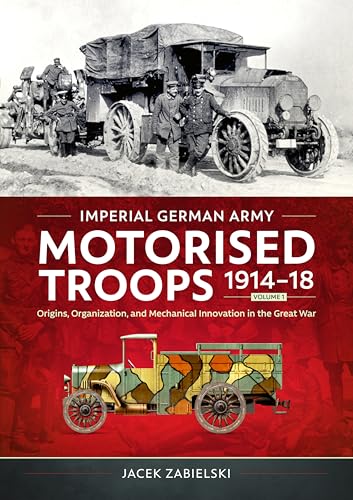
Imperial German Army Motorised Troops 1914-18 Volume 1
by JACEK. ZABIELSKI
"Origins, Organization, and Mechanical Innovation in the Great War"
Popularity
4.65 / 5
* A book's popularity is determined by how it compares to all other books on this website.
Where to buy?
Buy from Amazon* If you buy this book through the link above, we may receive a small commission at no extra cost to you.
Imperial German Army Motorised Troops 1914-18 Volume 1 by JACEK. ZABIELSKI
Details
War:
World War I
Perspective:
Engineers
True Story:
Yes
Biography:
No
Region:
Europe
Published Date:
2025
ISBN13:
9781804517642
Summary
This book examines the development and operations of motorized units in the Imperial German Army during World War I. It covers the origins of German military motorization, organizational structures, and technological innovations that emerged during the conflict. As the first volume in a series, it focuses on how Germany adapted motor vehicles for military purposes, including trucks, cars, and motorcycles, and integrated them into combat operations. The work provides detailed analysis of the mechanical developments and tactical applications that shaped early twentieth century military motorization during the Great War.
Review of Imperial German Army Motorised Troops 1914-18 Volume 1 by JACEK. ZABIELSKI
Jacek Zabielski's examination of Imperial German Army motorised troops during the First World War offers a detailed exploration of a military subject that has received relatively little attention in English-language historiography. This first volume focuses on the origins, organizational structures, and mechanical innovations that characterized Germany's early adoption of motorized warfare between 1914 and 1918. The work fills a notable gap in Great War literature by documenting the technical and logistical aspects of Germany's motorization efforts during a period when military transport was transitioning from horse-drawn systems to mechanized vehicles.
The book's strength lies in its systematic approach to a complex subject. Zabielski traces the development of motorized units within the Imperial German Army from their experimental beginnings before the war through their evolution during four years of sustained conflict. The organizational focus proves particularly valuable, as the author details how the German military structure adapted to incorporate these new technological assets. This includes examination of the various motorized transport columns, ammunition columns, and specialist units that emerged to support both offensive and defensive operations across multiple fronts.
The technical content demonstrates thorough research into the mechanical innovations that defined this period. Zabielski addresses the variety of vehicle types employed by German forces, from staff cars and trucks to specialized transport vehicles designed for specific military purposes. The discussion of mechanical challenges faced by these early motorized units provides insight into the practical difficulties of maintaining combustion engines under wartime conditions. Issues such as fuel supply, spare parts availability, road conditions, and the technical training required for drivers and mechanics all receive appropriate attention.
One of the volume's notable contributions is its documentation of how motorization affected military logistics and operational planning. The book illustrates how the introduction of motor vehicles began to alter traditional concepts of supply chain management and troop movement, even as horse-drawn transport remained dominant throughout the war. This balanced perspective acknowledges both the promise of motorization and its limitations during the 1914-18 period, avoiding the temptation to overstate the impact of these early mechanized units.
The organizational analysis extends beyond mere unit designations to examine the command structures and administrative systems that governed motorized troops. Zabielski explores how the German Army integrated these new formations into existing military hierarchies and the challenges this integration presented. The book documents the creation of specialized training programs and the development of doctrine specifically tailored to motorized operations, showing how military thinking evolved in response to technological change.
The work benefits from apparent access to primary source material and period documentation, which lends authority to the technical specifications and organizational details presented throughout. This research foundation allows the author to provide specific information about unit compositions, vehicle allocations, and operational deployments that would otherwise remain obscure to English-speaking readers. The level of detail suggests extensive archival work and consultation of contemporary military records.
For readers interested in military history, logistics, or the technological evolution of warfare, this volume serves as a valuable reference work. The focus on a specific aspect of German military operations allows for depth of coverage that broader surveys of the First World War cannot provide. Military historians researching the Great War's logistical dimensions will find substantial material here, as will those studying the early development of mechanized warfare.
The book's specialized nature means it appeals primarily to readers with existing interest in military history or the technical aspects of World War One. Those seeking narrative battle history or strategic analysis of campaigns may find the organizational and technical focus less engaging. However, for its intended audience of serious military history enthusiasts and researchers, the comprehensive treatment of this narrow subject represents a significant contribution to the literature.
As the first volume in what appears to be a multi-volume series, this work establishes a solid foundation for understanding German motorization during the Great War. The coverage of origins and early development sets the stage for presumably more detailed examination of operational employment and later war developments in subsequent volumes. Zabielski's methodical approach and attention to technical detail mark this as a serious scholarly effort that advances understanding of how the Imperial German Army adapted to the mechanical age during one of history's most significant conflicts.


