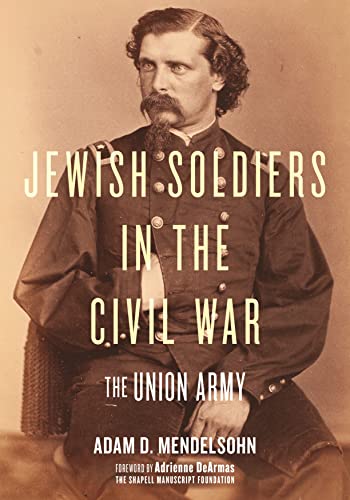
Jewish Soldiers in the Civil War
by Adam D. Mendelsohn
"The Union Army"
Popularity
4.84 / 5
* A book's popularity is determined by how it compares to all other books on this website.
Where to buy?
Buy from Amazon* If you buy this book through the link above, we may receive a small commission at no extra cost to you.
Jewish Soldiers in the Civil War by Adam D. Mendelsohn
Details
War:
American Civil War
Perspective:
Infantry
True Story:
Yes
Biography:
No
Region:
North America
Page Count:
336
Published Date:
2022
ISBN13:
9781479812233
Summary
Jewish Soldiers in the Civil War: The Union Army examines the experience of Jewish Americans who served in the Union forces during the American Civil War. Adam D. Mendelsohn explores how these soldiers navigated their dual identities as Jews and Americans during this pivotal conflict. The book documents their military service, the challenges they faced regarding religious observance in army life, and instances of antisemitism within the ranks. It also analyzes how their participation in the war shaped both Jewish-American identity and their integration into American society during the nineteenth century.
Review of Jewish Soldiers in the Civil War by Adam D. Mendelsohn
Adam D. Mendelsohn's study of Jewish soldiers in the Union Army addresses a chapter of Civil War history that has often been overlooked in broader narratives of the conflict. Rather than treating Jewish participation as a footnote, Mendelsohn positions it as a subject worthy of sustained scholarly attention, drawing on archival research to reconstruct the experiences of Jewish men who served in the Union forces between 1861 and 1865.
One of the strengths of this work lies in its careful attention to numbers and demographics. Mendelsohn engages with the difficult task of estimating how many Jewish soldiers actually served, a question complicated by inconsistent record-keeping and the absence of religious identifiers on most military documents. His methodical approach to this problem reflects the broader rigor that characterizes the book as a whole. Readers interested in the mechanics of historical research, particularly the challenges of working with incomplete or ambiguous archival sources, will find this discussion illuminating.
Beyond the statistical questions, Mendelsohn explores the lived experience of Jewish soldiers within a military culture that was overwhelmingly Christian in its rhythms and assumptions. He examines how these soldiers navigated religious practice, camp life, and the social dynamics of their units. The book does not shy away from documenting instances of antisemitism that some soldiers encountered, while also noting evidence of camaraderie and acceptance in other contexts. This balanced treatment avoids both romanticizing the wartime experience and reducing it to a simple narrative of victimization.
The book also situates Jewish military service within the larger context of American Jewish history during this period. Mendelsohn considers how immigration patterns, particularly the arrival of German Jewish immigrants in the decades before the war, shaped the community from which these soldiers emerged. This background is essential for understanding why Jewish enlistment took the particular contours it did, and Mendelsohn integrates this context without allowing it to overwhelm the military history at the center of his study.
A notable contribution of the book is its attention to the question of how Jewish soldiers themselves understood their service. Mendelsohn draws on letters, diaries, and other personal accounts to give voice to individual soldiers rather than treating them as an undifferentiated mass. This approach humanizes the historical record and allows readers to see the diversity of motivations, experiences, and perspectives among those who served. Some soldiers appear to have viewed their service as an opportunity to demonstrate loyalty and belonging in American society, while others left less explicit testimony about their motivations, requiring careful inference from available sources.
Mendelsohn's prose is clear and accessible, avoiding excessive academic jargon while still maintaining the analytical rigor expected of serious historical scholarship. The book strikes a reasonable balance between narrative storytelling and analytical argument, making it suitable for both general readers interested in Civil War history and specialists in American Jewish studies. The organization of the material, moving between broad historical context and specific case studies, helps maintain reader engagement throughout.
The book's scope is appropriately focused on the Union Army, which allows for a more thorough treatment than a study attempting to cover both Union and Confederate Jewish soldiers might achieve. This focus does mean that readers interested in the experiences of Jewish soldiers who served the Confederacy will need to look elsewhere, but the depth gained from this narrower scope justifies the choice.
Some readers may wish for more extensive discussion of postwar experiences, examining how Jewish veterans' wartime service influenced their subsequent lives and their place within American Jewish communities. The book's primary focus remains on the war years themselves, which is a reasonable editorial decision given the scope of the project, though it leaves room for future scholarship to build upon this foundation.
Overall, this work represents a valuable contribution to both Civil War historiography and American Jewish history. Mendelsohn's careful research, balanced analysis, and attention to individual voices combine to create a study that enriches understanding of a community whose wartime experiences deserve greater recognition. The book succeeds in demonstrating that Jewish soldiers were neither uniformly celebrated nor uniformly marginalized, but rather navigated a complex landscape of acceptance and prejudice much like other minority groups within the Union Army.


