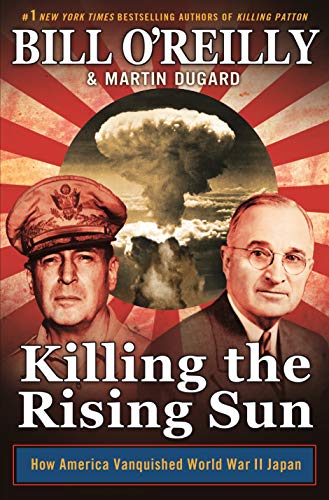
Killing the Rising Sun
by Bill O'Reilly
"How America Vanquished World War II Japan"
Popularity
4.96 / 5
* A book's popularity is determined by how it compares to all other books on this website.
Where to buy?
Buy from Amazon* If you buy this book through the link above, we may receive a small commission at no extra cost to you.
Killing the Rising Sun by Bill O'Reilly
Details
War:
World War II
Perspective:
Bombers
True Story:
Yes
Biography:
No
Region:
Asia
Page Count:
337
Published Date:
2016
ISBN13:
9781627790628
Summary
Killing the Rising Sun chronicles America's final years of World War II against Imperial Japan, from 1944 through 1945. Bill O'Reilly examines the brutal Pacific campaign, including key battles like Iwo Jima and Okinawa, and the controversial decision to drop atomic bombs on Hiroshima and Nagasaki. The book details the fierce fighting, kamikaze attacks, and the clash between American military strategy and Japanese warrior culture. Through historical accounts and personal stories, it explores how the United States ultimately achieved victory and forced Japan's surrender, ending the deadliest conflict in human history.
Review of Killing the Rising Sun by Bill O'Reilly
Bill O'Reilly and Martin Dugard present a detailed chronicle of the final phase of World War II in the Pacific Theater with "Killing the Rising Sun: How America Vanquished World War II Japan." Published in 2016 as part of the popular "Killing" series, this historical narrative focuses on the events spanning from 1944 to the war's conclusion in 1945, examining the brutal combat, strategic decisions, and technological developments that ultimately led to Japan's surrender.
The book opens by establishing the dire circumstances facing American forces as they pushed closer to the Japanese mainland. O'Reilly and Dugard chronicle the island-hopping campaign, detailing the horrific battles at Iwo Jima and Okinawa where casualties mounted on both sides. The authors emphasize the ferocity of Japanese resistance and the willingness of soldiers to fight to the death rather than surrender, a cultural phenomenon rooted in the bushido code and loyalty to Emperor Hirohito. These battles serve as crucial context for understanding the military calculations that would later influence decisions about how to end the war.
A significant portion of the narrative centers on the development and deployment of the atomic bomb. The authors trace the Manhattan Project's secretive work, introducing readers to the scientists, military personnel, and political leaders involved in creating this unprecedented weapon. The book details President Harry Truman's assumption of the presidency following Franklin Roosevelt's death and the enormous burden of deciding whether to authorize the use of atomic weapons against Japanese cities. O'Reilly and Dugard present the various factors that influenced this decision, including estimates of casualties that would result from a conventional invasion of Japan's home islands.
The book provides accounts of the missions to drop atomic bombs on Hiroshima and Nagasaki in August 1945. The authors describe the crews who flew these missions, the immediate devastation caused by the explosions, and the subsequent suffering of survivors. These sections represent some of the most sobering content in the book, as the authors confront the massive scale of civilian casualties while contextualizing the military and strategic rationale behind the attacks.
Throughout the narrative, O'Reilly and Dugard incorporate personal stories of individuals caught up in these historic events. American servicemen, prisoners of war enduring brutal conditions in Japanese camps, and Japanese civilians all appear in the pages. This approach aims to humanize the vast historical forces at play and provide readers with relatable perspectives on the war's final months. The book describes the treatment of Allied prisoners of war, including instances of forced labor, starvation, and execution, adding another dimension to the moral complexity of the conflict's conclusion.
The authors also examine the role of Emperor Hirohito and Japanese military leadership in prolonging the war despite mounting evidence that victory was impossible. The book discusses the internal debates within Japanese leadership about surrender terms, particularly regarding the preservation of the emperor's position. The eventual decision to accept the Potsdam Declaration's terms and the emperor's unprecedented radio address announcing Japan's surrender receive detailed attention.
O'Reilly's background as a television personality and journalist is evident in the book's accessible prose style. The writing emphasizes narrative momentum and dramatic tension over academic analysis, making complex historical events digestible for general readers. Short chapters and present-tense narration create a sense of immediacy, though some critics have noted this approach occasionally sacrifices nuance for readability.
The book has generated discussion regarding its interpretation of controversial historical events, particularly the decision to use atomic weapons. O'Reilly and Dugard present this decision largely as a necessary action that saved lives by avoiding a catastrophic invasion of Japan. While this reflects one widely held historical perspective, the book has faced criticism from some historians for not engaging more thoroughly with ongoing scholarly debates about alternatives that may have been available or the role of other factors, such as Soviet entry into the Pacific War, in Japan's decision to surrender.
"Killing the Rising Sun" achieves its primary goal of providing an engaging, fast-paced account of World War II's Pacific conclusion for popular audiences. The book offers extensive detail about military operations, technological developments, and key decisions that shaped the war's final chapter. Readers seeking an introduction to this period or those interested in a narrative-driven approach to history will find the book serves as an accessible entry point. However, those looking for comprehensive scholarly analysis or exposure to multiple interpretive frameworks may need to supplement this work with additional sources. The book stands as a commercial success that brought renewed attention to this pivotal period in world history, regardless of debates about its interpretive choices.