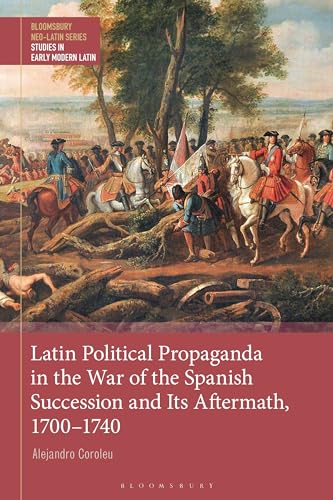
Latin Political Propaganda in the War of the Spanish Succession and Its Aftermath, 1700-1740
by Alejandro Coroleu
Popularity
0 / 5
* A book's popularity is determined by how it compares to all other books on this website.
Where to buy?
Buy from Amazon* If you buy this book through the link above, we may receive a small commission at no extra cost to you.
Latin Political Propaganda in the War of the Spanish Succession and Its Aftermath, 1700-1740 by Alejandro Coroleu
Details
War:
War of the Spanish Succession
Perspective:
Researcher
Biography:
No
Region:
Europe
Page Count:
233
Published Date:
2023
ISBN13:
9781350214897
Summary
This book examines how Latin language texts were used as political propaganda during the War of the Spanish Succession and the decades following it. Alejandro Coroleu analyzes various Latin writings from 1700 to 1740 that served to promote different political positions and legitimize claims to the Spanish throne. The study explores how Latin, still an important language of learned communication in early eighteenth-century Europe, became a vehicle for political messaging during this significant period of European dynastic conflict and its diplomatic resolution.
Review of Latin Political Propaganda in the War of the Spanish Succession and Its Aftermath, 1700-1740 by Alejandro Coroleu
Alejandro Coroleu's examination of Latin political propaganda during the War of the Spanish Succession offers a specialized study of how classical language served as a weapon in early eighteenth-century European conflicts. This work addresses a frequently overlooked aspect of the period, focusing on the ways Latin texts functioned as instruments of political persuasion during one of Europe's most consequential dynastic struggles.
The War of the Spanish Succession, fought between 1701 and 1714, emerged from competing claims to the Spanish throne following the death of the childless Charles II. The conflict drew in major European powers, with France and Spain on one side supporting Philip of Anjou, and the Grand Alliance of England, the Dutch Republic, Austria, and various German states supporting Archduke Charles of Austria. While military and diplomatic histories of this war are abundant, Coroleu's work distinguishes itself by concentrating on the literary and rhetorical dimensions of the conflict, particularly the role of Latin texts in shaping opinion and legitimizing political positions.
Latin remained a significant medium for learned discourse in the early modern period, even as vernacular languages increasingly dominated political communication. Coroleu demonstrates how both sides in the conflict exploited Latin's prestige and its association with classical authority to frame their arguments. The book examines various forms of propaganda, including pamphlets, occasional verses, historical narratives, and ceremonial texts that circulated among educated elites across Europe. These materials sought to justify territorial claims, celebrate military victories, and denigrate opponents through classical allusion and rhetorical strategies inherited from ancient Rome.
The temporal scope of the study extends beyond the formal conclusion of the war in 1714, continuing through 1740 to capture the propaganda efforts that persisted during the peace settlements and subsequent diplomatic maneuvering. This extended timeframe allows for analysis of how propagandistic themes evolved from wartime urgency to post-war legitimization and memory construction. The Utrecht and Rastatt treaties that ended the war did not immediately silence partisan voices, and Coroleu traces how Latin propaganda adapted to the challenges of the post-conflict period.
The book's approach combines literary analysis with historical contextualization, examining how authors deployed classical topoi and rhetorical devices to serve contemporary political ends. Coroleu's background in Neo-Latin studies equips him to navigate these texts with appropriate scholarly rigor, identifying sources, allusions, and literary conventions that would escape readers unfamiliar with the Latin tradition. The work illuminates how propagandists appropriated figures and episodes from Roman history to construct parallels with current events, casting their patrons as modern Caesars or Scipios while portraying enemies as Hannibals or treacherous conspirators.
One of the study's contributions lies in demonstrating the transnational circulation of these Latin texts. Because Latin functioned as a lingua franca among educated Europeans, propaganda composed in this language could reach audiences across linguistic boundaries. Coroleu tracks how texts produced in one location were reprinted, translated, or responded to in distant regions, revealing networks of intellectual and political communication that transcended national borders. This international dimension underscores the sophisticated nature of early modern propaganda operations.
The book also addresses questions of authorship and patronage, exploring the relationships between writers and the political figures or institutions that commissioned their works. Many of these texts were produced by scholars, clerics, and court intellectuals who saw service to a political cause as compatible with their learned vocations. Coroleu examines how these authors balanced rhetorical effectiveness with classical erudition, producing works that simultaneously advanced partisan arguments and displayed their own literary credentials.
For readers interested in the War of the Spanish Succession, this study complements traditional political and military histories by revealing an additional dimension of the conflict. The propaganda examined here shaped how contemporaries understood the war's causes, progress, and outcomes. For scholars of Neo-Latin literature, the work provides valuable case studies of how Latin served practical political purposes in an era often characterized by its linguistic turn toward vernacular expression. The book also contributes to broader discussions about early modern media, information networks, and the construction of political narratives.
Coroleu's research rests on examination of primary sources scattered across European libraries and archives, bringing together materials that have received limited scholarly attention. The specialized nature of the subject matter means this work will appeal primarily to academic readers with interests in early modern history, Neo-Latin studies, or the history of propaganda. Those seeking a general introduction to the War of the Spanish Succession or its major political developments will find more accessible entry points elsewhere, though specialists will value the detailed analysis of this understudied aspect of the period.