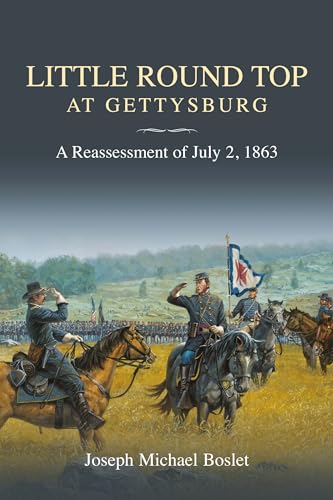
Little Round Top at Gettysburg
by Joseph Michael Boslet
"A Reassessment of July 2 1863"
Popularity
4.79 / 5
* A book's popularity is determined by how it compares to all other books on this website.
Where to buy?
Buy from Amazon* If you buy this book through the link above, we may receive a small commission at no extra cost to you.
Little Round Top at Gettysburg by Joseph Michael Boslet
Details
War:
American Civil War
Perspective:
Researcher
True Story:
Yes
Biography:
No
Region:
North America
Published Date:
2025
ISBN13:
9781611215649
Summary
This book provides a detailed reexamination of the battle for Little Round Top during the second day of the Battle of Gettysburg. Boslet challenges traditional narratives and interpretations of this critical engagement, analyzing tactical decisions, troop movements, and the actions of key commanders. Through careful research, the author offers fresh perspectives on one of the Civil War's most famous encounters, questioning accepted accounts and providing readers with a more nuanced understanding of what actually occurred on this strategic hilltop position.
Review of Little Round Top at Gettysburg by Joseph Michael Boslet
Joseph Michael Boslet's examination of Little Round Top represents a significant contribution to Civil War scholarship, challenging long-held assumptions about one of Gettysburg's most celebrated defensive stands. This reassessment takes a critical look at the events of July 2, 1863, when Union forces defended the rocky hill against Confederate attacks that threatened to turn the Union left flank. Rather than simply retelling the familiar heroic narrative, Boslet presents a more nuanced analysis of the tactical decisions, troop movements, and strategic implications of this crucial engagement.
The book distinguishes itself through meticulous research and a willingness to question the mythologized version of events that has dominated popular understanding for generations. Boslet draws on primary sources, official reports, and soldiers' accounts to construct a detailed picture of the fighting that differs in important ways from traditional interpretations. The analysis pays particular attention to the terrain itself, examining how the physical landscape influenced tactical choices and combat outcomes in ways that have sometimes been oversimplified in earlier accounts.
One of the work's strengths lies in its treatment of the Confederate perspective. While many accounts focus heavily on the Union defense, particularly the famous actions of the 20th Maine under Colonel Joshua Lawrence Chamberlain, Boslet provides substantial attention to the Confederate assault forces and their commanders. This balanced approach allows readers to understand the challenges faced by both sides and the complexities of the decision-making process during the heat of battle. The Confederate delays, command confusion, and coordination problems receive careful examination, offering insights into why the attacks unfolded as they did.
The reassessment also scrutinizes the Union response, including the movement of troops to Little Round Top and the defensive preparations made once the threat became apparent. Boslet explores the role of various officers and units beyond the most famous participants, demonstrating that the defense involved contributions from multiple regiments and commanders whose actions have received less attention in popular accounts. This broader perspective enriches understanding of how the position was held and why Confederate efforts ultimately failed to dislodge the defenders.
Boslet's treatment of the tactical situation benefits from his careful analysis of timing and troop dispositions. The book examines when different units arrived on the scene, how quickly defensive positions were established, and how these factors influenced the course of the fighting. This attention to chronological detail helps clarify moments of confusion and provides a clearer picture of how the battle developed throughout the afternoon and evening. The work also considers alternative scenarios, exploring what might have happened had timing or decisions been different, though always grounded in the available evidence rather than speculation.
The writing maintains an academic rigor while remaining accessible to general readers interested in Civil War history. Boslet avoids unnecessary jargon and presents complex tactical situations in clear terms that allow non-specialists to follow the analysis. The narrative moves logically through the events while incorporating the author's critical examination of sources and interpretations. This balance makes the book valuable both as a scholarly contribution and as a resource for battlefield visitors and enthusiasts seeking deeper understanding.
The reassessment challenges certain aspects of the traditional narrative without diminishing the significance of the fighting or the courage displayed by soldiers on both sides. Instead, it offers a more complete and accurate understanding of what actually occurred on that rocky hillside. By questioning accepted interpretations and examining evidence with fresh eyes, Boslet demonstrates that even well-studied battles can yield new insights when subjected to rigorous analysis.
For readers familiar with Gettysburg, this book provides an opportunity to reconsider assumptions about Little Round Top's role in the battle and the broader campaign. The work fits into ongoing scholarly debates about the battle's crucial moments and turning points, contributing evidence and analysis that will likely influence future interpretations. Those seeking to understand not just what happened but why events unfolded as they did will find substantial value in Boslet's careful reconstruction and assessment.
The book serves as a reminder that historical understanding continues to evolve as researchers examine evidence with new methodologies and perspectives. While the defense of Little Round Top remains a significant moment in the Battle of Gettysburg, Boslet's reassessment encourages a more sophisticated understanding of the tactical situation, the decisions made by commanders, and the contributions of various units to the final outcome. This work stands as an important addition to the extensive literature on Gettysburg, offering both corrections to the historical record and deeper insights into this pivotal engagement.


