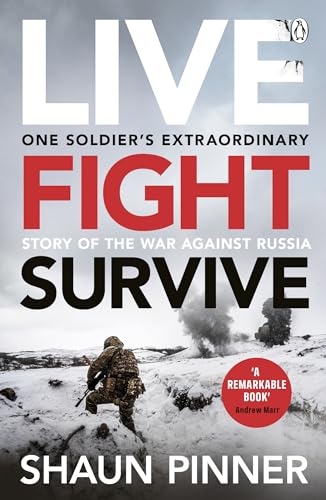
Live. Fight. Survive.
by Shaun Pinner
"An ex-British soldier’s account of courage, resistance and defiance fighting for Ukraine against Russia"
Popularity
4.64 / 5
* A book's popularity is determined by how it compares to all other books on this website.
Where to buy?
Buy from Amazon* If you buy this book through the link above, we may receive a small commission at no extra cost to you.
Live. Fight. Survive. by Shaun Pinner
Details
Biography:
No
Page Count:
277
Published Date:
2023
ISBN13:
9781405959780
Summary
Live. Fight. Survive is Shaun Pinner's firsthand account of his capture and imprisonment during the Russian invasion of Ukraine. As a British former soldier fighting alongside Ukrainian forces, Pinner was taken prisoner in Mariupol in 2022 and faced a death sentence from Russian-backed authorities. The book chronicles his harrowing experience as a prisoner of war, his fight for survival under brutal conditions, and the international efforts that eventually secured his release. It offers an intimate perspective on modern warfare, resilience, and the human cost of conflict.
Review of Live. Fight. Survive. by Shaun Pinner
Shaun Pinner's "Live. Fight. Survive" stands as a harrowing firsthand account of captivity during the Russian invasion of Ukraine. The memoir chronicles Pinner's experience as a foreign fighter who was captured alongside fellow British volunteer Aiden Aslin in the besieged city of Mariupol in April 2022. What follows is a detailed narrative of survival under extreme duress, offering readers an unfiltered glimpse into the reality of modern warfare and the psychological toll of imprisonment in a conflict zone.
The book's strength lies in its unflinching honesty. Pinner does not present himself as a hero or attempt to glorify his circumstances. Instead, he delivers a raw and often uncomfortable portrayal of the physical and mental challenges faced during months of captivity. The narrative captures the uncertainty that defined each day, the constant threat of execution that loomed over the prisoners, and the strategies employed to maintain sanity when stripped of freedom and dignity. This authenticity gives the memoir considerable weight and distinguishes it from more sanitized accounts of conflict.
Pinner's background as a former soldier in the British Army provides essential context for understanding his decision to travel to Ukraine and join the fight against Russian forces. The book traces this decision-making process and explores the motivations that drive individuals to volunteer in foreign conflicts. However, the focus remains firmly on the capture and imprisonment, with detailed descriptions of the conditions endured, the interactions with captors, and the show trial that resulted in a death sentence. These sections offer valuable insight into the propaganda mechanisms at work and the ways in which prisoners of war can be exploited for political purposes.
The narrative benefits from Pinner's ability to convey the psychological dimensions of captivity. The mental exhaustion, the constant surveillance, the separation from loved ones, and the manipulation tactics employed by interrogators all receive thorough examination. Readers gain understanding of how hope and despair alternate in such circumstances, and how small acts of resistance or moments of human connection can sustain the will to survive. The relationship between fellow prisoners emerges as a crucial element, with bonds formed under pressure providing essential emotional support.
One of the book's most compelling aspects is its documentation of the broader humanitarian situation in Mariupol during the siege. Through Pinner's observations and experiences, the reality of urban warfare becomes starkly apparent. The destruction of infrastructure, the civilian casualties, and the breakdown of normal life under bombardment create a sobering backdrop to the personal narrative. This context enriches the memoir and elevates it beyond a simple survival story.
The eventual prisoner exchange that secured Pinner's release, brokered with Saudi Arabian assistance in September 2022, marks a turning point in the narrative. The transition from captivity to freedom brings its own challenges, and the book does not shy away from exploring the complex emotions that accompany such a dramatic shift in circumstances. The psychological impact of the experience and the process of reintegration receive thoughtful consideration.
The writing itself maintains a direct and accessible style throughout. Pinner avoids unnecessary embellishment, allowing the events themselves to carry the emotional weight. This approach serves the material well, as the circumstances require no dramatic enhancement. The pacing keeps the narrative moving forward while providing sufficient detail to immerse readers in each phase of the experience. Occasional moments of dark humor emerge naturally, reflecting the coping mechanisms that helped sustain the prisoners through their ordeal.
For readers interested in contemporary conflict, military history, or human resilience under extreme pressure, this memoir offers considerable value. It provides a ground-level perspective on a war that continues to shape global politics and humanitarian concerns. The book also contributes to the broader discussion about foreign fighters, the laws of war, and the treatment of prisoners in modern conflicts. These themes give the work relevance beyond its immediate narrative.
"Live. Fight. Survive" stands as an important document of a specific moment in the Ukraine conflict while also serving as a universal meditation on survival, courage, and the human capacity to endure. Pinner's willingness to share his story with such candor creates a powerful and memorable reading experience that illuminates the human cost of war in ways that statistics and news reports cannot capture.