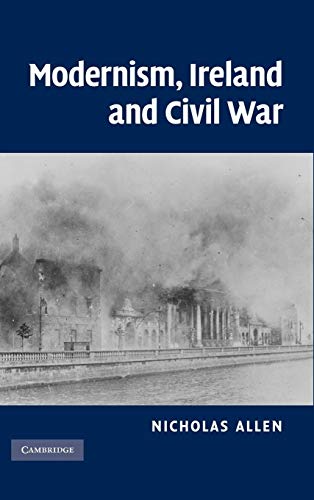
Modernism, Ireland and Civil War
by Nicholas Allen
Popularity
1.35 / 5
* A book's popularity is determined by how it compares to all other books on this website.
Where to buy?
Buy from Amazon* If you buy this book through the link above, we may receive a small commission at no extra cost to you.
Modernism, Ireland and Civil War by Nicholas Allen
Details
War:
English Civil War
Perspective:
Researcher
Biography:
No
Region:
Europe
Page Count:
240
Published Date:
2009
ISBN13:
9780521489959
Review of Modernism, Ireland and Civil War by Nicholas Allen
Nicholas Allen's "Modernism, Ireland and Civil War" examines the intersection of literary experimentation and political upheaval in early twentieth-century Ireland. The book positions the Irish Civil War of 1922-1923 as a pivotal moment not only in political history but also in the development of Irish literary modernism. Allen argues that the fractures and uncertainties of civil conflict shaped the aesthetic choices of writers who sought new forms to represent a divided and rapidly changing society.
The study draws on a wide range of literary figures associated with the Irish Free State period, situating their work within the broader currents of European modernism while remaining attentive to the specific historical circumstances of Ireland. Allen's approach is grounded in close textual analysis combined with historical contextualization, allowing him to trace how political violence, institutional collapse, and ideological division found expression in literary form. This dual focus on aesthetics and history gives the book its distinctive character, moving beyond simple biographical readings to consider how formal innovation itself became a response to social rupture.
One of the strengths of Allen's work is its refusal to treat modernism as a purely aesthetic movement detached from political circumstance. Instead, the book insists on the entanglement of literary form and historical experience, showing how writers grappled with the instability of the new Irish state through experimental narrative structures, fragmented perspectives, and shifting registers of language. This approach situates Irish modernism as a response not merely to European artistic trends but to the specific pressures of civil war, partition, and state formation.
Allen's prose is scholarly but accessible, and his argument unfolds with a clear sense of purpose. He builds his case methodically, moving through different literary examples to demonstrate how the civil war period generated a body of writing preoccupied with questions of legitimacy, memory, and the representation of violence. The book benefits from Allen's evident familiarity with the archival and historical record, which lends weight to his readings without overwhelming the literary analysis with excessive detail.
The book also makes a valuable contribution to the broader field of Irish Studies by challenging assumptions about the relationship between the Irish Literary Revival and the modernist experimentation that followed. Allen suggests that the transition between these movements was neither smooth nor straightforward, but was instead marked by the disruptions of civil conflict. This reframing invites readers to reconsider familiar narratives about Irish literary history, particularly the tendency to see the Revival and its aftermath as a continuous cultural project rather than one interrupted and reshaped by political violence.
Readers with a background in Irish history or literary studies will find the book particularly rewarding, as Allen assumes a degree of familiarity with the period and its key figures. Those less versed in the specifics of Irish Free State politics may need to supplement their reading with additional historical context, though the book does provide sufficient background to follow its central arguments. The writing avoids unnecessary jargon, though the subject matter itself demands careful attention given the density of historical and literary references.
Structurally, the book is organized in a way that allows its argument to build cumulatively, with each chapter contributing to a larger picture of how civil war shaped literary production. This structure serves the book well, as it allows Allen to move between broad historical claims and specific textual examples without losing coherence. The result is a study that feels both rigorous and purposeful, avoiding the meandering quality that sometimes affects works of literary history.
Overall, "Modernism, Ireland and Civil War" offers a thoughtful and well-researched contribution to the study of Irish literature during a formative and turbulent period. Allen's central argument, that literary modernism in Ireland cannot be fully understood apart from the experience of civil war, is persuasively developed and supported by careful analysis. The book will be of particular interest to scholars and students of Irish literature and history, though its clear prose style makes it accessible to general readers with an interest in the period. It stands as a significant addition to the growing body of work examining the cultural consequences of Ireland's revolutionary decade.