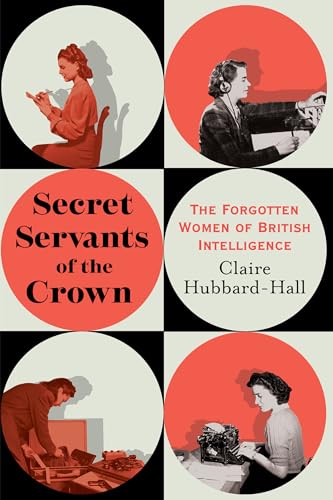
Secret Servants of the Crown
by Claire Hubbard-Hall
"The Forgotten Women of British Intelligence"
Popularity
4.35 / 5
* A book's popularity is determined by how it compares to all other books on this website.
Where to buy?
Buy from Amazon* If you buy this book through the link above, we may receive a small commission at no extra cost to you.
Secret Servants of the Crown by Claire Hubbard-Hall
Details
War:
World War II
Perspective:
Spying
True Story:
Yes
Biography:
Yes
Region:
Europe
Page Count:
361
Published Date:
2025
ISBN13:
9780806543710
Review of Secret Servants of the Crown by Claire Hubbard-Hall
"Secret Servants of the Crown: The Forgotten Women of British Intelligence" by Claire Hubbard-Hall offers a carefully researched account of the women who worked behind the scenes of British espionage during some of the twentieth century's most turbulent decades. Rather than focusing on the well-known male figures who typically dominate histories of MI5 and MI6, Hubbard-Hall shifts attention to the female operatives, clerks, and analysts whose contributions have long been overlooked or deliberately obscured by official secrecy.
The book draws on archival material, personal papers, and declassified records to reconstruct the lives of women who served in various intelligence roles from the early days of the modern British secret services through the World Wars and into the Cold War era. Hubbard-Hall, an academic historian, brings a scholarly rigor to her subject while managing to keep the narrative accessible to general readers. She avoids dense theoretical language, instead letting the individual stories of these women carry the historical weight of her argument.
One of the strengths of this work is its attention to the structural barriers these women faced. Many were relegated to positions officially labeled as clerical or administrative, even when their actual work involved code-breaking, agent handling, or intelligence analysis. Hubbard-Hall demonstrates how gender norms of the period shaped not only what tasks women were assigned but also how their contributions were recorded, or more often, left out of official histories entirely. This pattern of erasure forms a central thread throughout the book, and the author makes a compelling case that the secrecy inherent to intelligence work compounded the more general historical tendency to overlook women's professional achievements.
The book benefits from Hubbard-Hall's evident command of primary sources. She has clearly spent considerable time in archives such as the National Archives at Kew, piecing together fragments of information about women whose names rarely appear in standard intelligence histories. This archival diligence gives the book credibility and depth, though readers should be aware that some sections necessarily rely on incomplete records, given the classified nature of the work described. Hubbard-Hall is transparent about these limitations, which adds to the book's overall trustworthiness as a historical account.
Stylistically, the prose is clear and measured, avoiding sensationalism even when describing genuinely dramatic events. This restraint suits the subject matter well, allowing the historical facts to speak for themselves rather than being dressed up for dramatic effect. At the same time, the book does not read like a dry academic monograph. Hubbard-Hall structures her chapters around individual women and specific historical episodes, which helps maintain narrative momentum and makes the book suitable for readers with a general interest in twentieth-century British history, not just specialists in intelligence studies.
The scope of the book is ambitious, covering multiple decades and numerous individuals, which occasionally means that some figures receive less detailed treatment than others might wish. Readers hoping for an exhaustive biography of any single woman may find themselves wanting more, but this is a natural consequence of the book's broader aim: to establish a collective history rather than focus narrowly on one or two prominent figures. This approach succeeds in demonstrating that women's involvement in British intelligence was not an anomaly but a consistent, if underappreciated, feature of the system.
Overall, "Secret Servants of the Crown" makes a valuable contribution to the historiography of British intelligence services. It corrects a long-standing gap in the historical record and does so with scholarly care and narrative clarity. The book will appeal to readers interested in women's history, twentieth-century British political history, and the hidden mechanics of intelligence work. Claire Hubbard-Hall has produced a well-documented and thoughtfully written account that gives deserved recognition to women whose work was, by design, meant to remain invisible.


