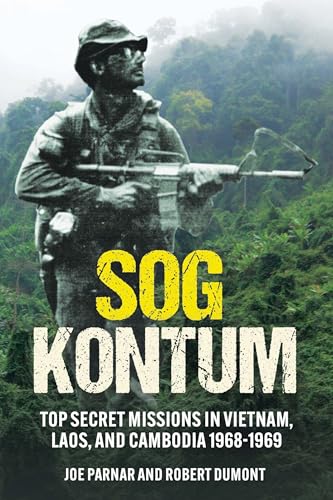
Sog Kontum
by Joe Parnar
"Top Secret Missions in Vietnam, Laos, and Cambodia, 1968-1969"
Popularity
4.39 / 5
* A book's popularity is determined by how it compares to all other books on this website.
Where to buy?
Buy from Amazon* If you buy this book through the link above, we may receive a small commission at no extra cost to you.
Sog Kontum by Joe Parnar
Details
War:
Vietnam War
Perspective:
Special Forces
True Story:
Yes
Biography:
No
Region:
Asia
Published Date:
2025
ISBN13:
9781636245355
Summary
SOG Kontum is a firsthand account of covert operations conducted by the Studies and Observations Group during the Vietnam War. Author Joe Parnar recounts his experiences running dangerous cross-border reconnaissance missions into Laos and Cambodia from the Kontum base in 1968-1969. The book details the highly classified operations of small teams gathering intelligence, conducting raids, and engaging enemy forces along the Ho Chi Minh Trail. Parnar provides an insider's perspective on the tactics, challenges, and intense combat faced by SOG operators during one of the war's most secretive campaigns.
Review of Sog Kontum by Joe Parnar
Joe Parnar's "SOG Kontum" offers a gripping firsthand account of some of the most dangerous and classified operations conducted during the Vietnam War. As a member of the Studies and Observations Group, Parnar participated in covert cross-border missions that took him deep into enemy-controlled territory in Laos and Cambodia during 1968 and 1969. This memoir pulls back the curtain on operations that remained classified for decades, providing readers with an unvarnished look at the realities faced by SOG reconnaissance teams operating behind enemy lines.
The Studies and Observations Group, commonly known as SOG, was a joint special operations force that conducted highly classified missions throughout Southeast Asia. These operations included reconnaissance, prisoner rescues, and direct action missions in areas officially off-limits to American forces. The men who served in these units faced extraordinary dangers, operating in small teams far from any hope of immediate reinforcement. Parnar's account focuses specifically on his time with Command and Control North, based in Kontum, which was responsible for operations along the Ho Chi Minh Trail and into the tri-border area where Vietnam, Laos, and Cambodia meet.
One of the book's greatest strengths lies in its detailed descriptions of mission planning and execution. Parnar walks readers through the meticulous preparation required before each operation, from studying maps and aerial photographs to briefing with pilots and finalizing equipment loads. The level of tactical detail provided gives readers genuine insight into how these missions were conceived and carried out. Rather than presenting sanitized or dramatized versions of events, the narrative conveys the constant tension, uncertainty, and split-second decision-making that characterized life on a recon team.
The author does not shy away from describing the harsh realities of combat in the jungle. The physical challenges of moving through triple-canopy rainforest while carrying heavy loads, maintaining noise discipline, and staying alert for enemy contact come through clearly in the prose. Parnar recounts firefights, narrow escapes, and the ever-present threat of being overrun by numerically superior North Vietnamese forces. The book also addresses the psychological toll of this type of warfare, where every sound could signal discovery and where teams sometimes spent days evading pursuit after being compromised.
Beyond the combat narratives, the memoir provides valuable context about the composition and dynamics of SOG teams. These units typically consisted of a small number of American Special Forces soldiers working alongside indigenous personnel, often Montagnard tribesmen or Vietnamese special forces. Parnar's respect for his indigenous teammates is evident throughout the text, and he highlights their crucial contributions to mission success. The relationships between team members, built under extreme conditions, form an important thread running through the narrative.
The book also touches on the political and operational constraints that governed these missions. Despite operating in Laos and Cambodia, these incursions remained officially denied by the U.S. government for many years. This political sensitivity created unique challenges for the men on the ground, who understood that their actions could not be publicly acknowledged. The author's matter-of-fact discussion of these limitations adds an important dimension to understanding the broader strategic context of the war.
Parnar's writing style is straightforward and unembellished, which serves the material well. The narrative maintains a steady pace, moving from mission to mission while providing enough downtime scenes to give readers a sense of life at the base between operations. The author avoids the temptation to glorify or sensationalize his experiences, instead presenting events in a direct manner that allows the inherent drama of the situations to speak for itself.
For readers interested in special operations history or the Vietnam War more broadly, this memoir fills an important niche. SOG operations remained classified long after the war ended, and firsthand accounts like this one contribute to a more complete understanding of the conflict. The book serves as both a historical document and a tribute to the men who served in these dangerous missions, many of whom did not return.
The level of operational detail may appeal particularly to military history enthusiasts and those with an interest in special operations tactics and procedures. However, the human elements of the story—the bonds between teammates, the stress of sustained danger, and the personal costs of this type of service—make the book accessible to a wider audience as well. "SOG Kontum" stands as a valuable contribution to the literature on the Vietnam War and special operations, offering readers an authentic window into a shadowy chapter of military history that has only gradually come to light.