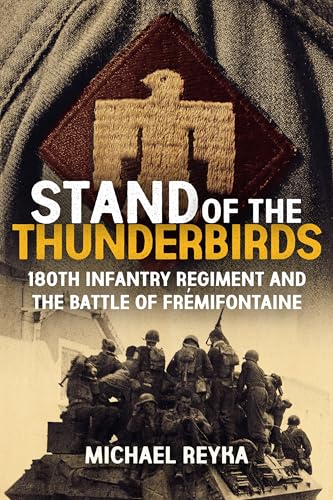
Stand of the Thunderbirds
by Michael Reyka
"180th Infantry Regiment and the Battle of Frémifontaine"
Popularity
4.76 / 5
* A book's popularity is determined by how it compares to all other books on this website.
Where to buy?
Buy from Amazon* If you buy this book through the link above, we may receive a small commission at no extra cost to you.
Stand of the Thunderbirds by Michael Reyka
Details
War:
World War I
Perspective:
Infantry
Military Unit:
US Army
True Story:
Yes
Biography:
No
Region:
Europe
Published Date:
2025
ISBN13:
9781636245829
Summary
Stand of the Thunderbirds chronicles the 180th Infantry Regiment's heroic defense during the Battle of Frémifontaine in October 1944. Part of the 45th Infantry Division, known as the Thunderbirds, the regiment faced a ferocious German counterattack in the Vosges Mountains of France. Michael Reyka details how American forces held their ground against overwhelming odds in brutal close-quarters combat. The book examines this lesser-known World War II engagement through extensive research, highlighting the courage and sacrifice of the soldiers who prevented a potential German breakthrough during the Allied advance toward Germany.
Review of Stand of the Thunderbirds by Michael Reyka
Michael Reyka's "Stand of the Thunderbirds: 180th Infantry Regiment and the Battle of Frémifontaine" offers a detailed examination of a lesser-known yet significant engagement during World War II. The book focuses on the actions of the 180th Infantry Regiment, part of the 45th Infantry Division, during their operations in the Vosges Mountains of northeastern France in October 1944. This work fills an important gap in the historical literature surrounding the European Theater, bringing attention to a battle that has received relatively little coverage despite its tactical importance and the valor displayed by the soldiers involved.
The 45th Infantry Division, known by its Thunderbird shoulder patch, earned a formidable reputation throughout the war. The division saw extensive combat across multiple campaigns, from Sicily and Italy to southern France and into Germany itself. The 180th Infantry Regiment served as one of the division's primary combat units, and Reyka's work specifically chronicles their experience during the brutal fighting around the town of Frémifontaine in the Vosges region. This battle occurred during a period when Allied forces were pushing through challenging terrain against determined German resistance, making every advance costly and hard-won.
Reyka approaches the subject with meticulous attention to detail, drawing upon a variety of primary sources to reconstruct the events of the battle. The narrative traces the regiment's movements, tactical decisions, and the intense combat that characterized the engagement. The Vosges Mountains presented formidable challenges to Allied forces, with dense forests, steep terrain, and autumn weather creating conditions that favored defensive operations. German forces utilized these natural advantages effectively, establishing strong positions that required coordinated infantry assaults to overcome.
The book provides context for understanding why this particular battle mattered within the broader strategic picture of late 1944. As American forces advanced toward the Rhine River and the German border, clearing the Vosges region became essential for securing supply lines and preventing German forces from threatening the Allied flanks. The fighting around Frémifontaine represented part of this larger effort, with the 180th Infantry Regiment tasked with breaking through German defensive lines and securing key terrain.
One of the strengths of Reyka's work lies in its focus on the experiences of individual soldiers and units within the regiment. Rather than presenting only a high-level tactical overview, the narrative incorporates the perspectives of company and platoon-level participants, offering insight into the realities of combat as experienced by those on the ground. This approach helps convey the intensity of the fighting and the challenges faced by infantrymen operating in difficult conditions against a skilled and determined enemy.
The author documents the specific tactical problems encountered during the battle, including challenges with coordination, communication difficulties in the mountainous terrain, and the constant threat from German artillery and small arms fire. The narrative describes how the regiment adapted to these conditions and the methods used to overcome German defensive positions. The combat around Frémifontaine exemplified the type of close-quarters, infantry-intensive fighting that characterized much of the Vosges campaign.
Reyka also addresses the human cost of the battle, acknowledging the casualties sustained by the regiment during the engagement. The fighting in the Vosges proved particularly costly for American units, and the 180th Infantry Regiment was no exception. The book serves as a tribute to those who fought and died in this engagement, ensuring that their sacrifice receives appropriate recognition and documentation.
The work benefits from Reyka's evident research into the operational records and historical documents related to the 180th Infantry Regiment and the 45th Infantry Division. This research foundation allows the narrative to maintain accuracy while still remaining accessible to general readers interested in World War II history. The book avoids excessive technical military jargon while still conveying the tactical realities of the battle.
"Stand of the Thunderbirds" makes a valuable contribution to the historiography of World War II by illuminating a specific engagement that might otherwise remain obscure. While major battles and campaigns naturally receive the bulk of historical attention, works like this remind readers that the war consisted of countless smaller actions, each significant to the participants and each contributing to the eventual Allied victory. The Battle of Frémifontaine deserves remembrance both for its tactical importance and for the courage displayed by the soldiers of the 180th Infantry Regiment.
This book will appeal to readers with specific interests in the 45th Infantry Division, the Vosges campaign, or small-unit actions during World War II. It serves as both a historical record and a memorial to a regiment that performed its duty under challenging circumstances. Reyka has produced a work that honors the legacy of the Thunderbirds while contributing meaningful scholarship to the study of the European Theater.


