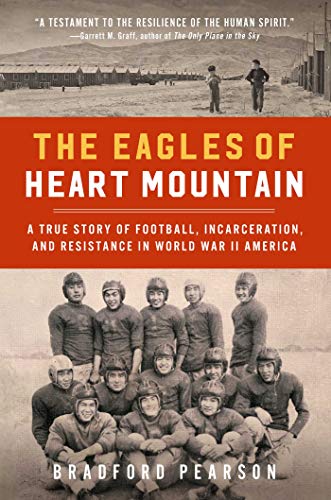
The Eagles of Heart Mountain
by Bradford Pearson
"A True Story of Football, Incarceration, and Resistance in World War II America"
Popularity
4.34 / 5
* A book's popularity is determined by how it compares to all other books on this website.
Where to buy?
Buy from Amazon* If you buy this book through the link above, we may receive a small commission at no extra cost to you.
The Eagles of Heart Mountain by Bradford Pearson
Details
War:
World War II
Perspective:
Civilian
True Story:
Yes
Biography:
No
Region:
North America
Page Count:
400
Published Date:
2021
ISBN13:
9781982107031
Summary
The Eagles of Heart Mountain tells the true story of Japanese American teenagers incarcerated at the Heart Mountain camp in Wyoming during World War II. Despite being unjustly imprisoned, these young men formed a football team that became a symbol of resilience and community pride. Bradford Pearson weaves together the sports narrative with the broader history of the incarceration camps, including the resistance movement against the draft. The book explores themes of identity, injustice, and perseverance, offering a powerful look at a lesser known chapter of American history.
Review of The Eagles of Heart Mountain by Bradford Pearson
Bradford Pearson's "The Eagles of Heart Mountain" tells a story that sits at the intersection of American sports history and one of the most troubling chapters of the nation's past: the incarceration of Japanese Americans during World War II. The book centers on the Heart Mountain Relocation Center in Wyoming, one of ten camps where the United States government forcibly confined more than 110,000 people of Japanese descent, the majority of them American citizens, following the attack on Pearl Harbor. Within this bleak setting, a group of young men formed a high school football team, and their improbable success on the field became a source of pride and cohesion for a community stripped of its freedom and dignity.
Pearson, a journalist by training, approaches this material with the instincts of a reporter and the patience of a historian. He does not simply recount wins and losses. Instead, he builds a layered narrative that moves between the football field, the barracks, and the broader political currents shaping the incarceration policy. Readers meet players, coaches, and camp administrators, but also draft resisters, community organizers, and government officials whose decisions had lasting consequences. This multiplicity of perspectives keeps the book from becoming a simple underdog sports story. It insists, instead, on complexity: joy and humiliation existing side by side, patriotism and resistance intertwined.
One of the book's strongest contributions is its attention to the draft resistance movement that emerged at Heart Mountain. Pearson does not shy away from the moral and legal questions raised by young men who refused to be drafted into an army representing a government that had imprisoned their families without trial. This thread runs parallel to the football narrative, and the tension between the two is handled with care. The football team represents a kind of hopeful normalcy, a way for teenagers to feel like teenagers again, while the resistance movement represents a direct confrontation with injustice. Pearson allows both stories room to breathe without forcing an artificial reconciliation between them.
The research underpinning the book is extensive. Pearson draws on interviews, camp newspapers, personal letters, and government records to reconstruct daily life at Heart Mountain with granular detail. Descriptions of the harsh Wyoming winters, the makeshift football field, and the psychological toll of confinement are rendered vividly, but never at the expense of factual grounding. The book avoids sentimentality, choosing instead to let the historical record speak. This restraint is one of its more admirable qualities, particularly given how easily this subject matter could tip into melodrama.
Structurally, the book alternates between the personal and the systemic. Chapters focused on specific players and their families are interspersed with broader context about the legal and political mechanisms that made incarceration possible, including the role of Executive Order 9066 and the various government agencies involved in its implementation. This back-and-forth can occasionally slow the narrative momentum, particularly for readers primarily drawn in by the sports angle. However, it also ensures that the football story never becomes disconnected from its historical circumstances, which seems to be precisely Pearson's intention.
The prose itself is clear and unadorned, favoring clarity over stylistic flourish. Pearson trusts the material to carry emotional weight rather than relying on dramatic language. This choice suits the subject matter well, given that the facts alone are often startling enough. The book does not need embellishment to convey the absurdity of teenagers playing football behind barbed wire while their government debated their loyalty.
"The Eagles of Heart Mountain" succeeds as both a work of sports history and a contribution to the broader literature on Japanese American incarceration. It resists easy categorization, refusing to be simply an inspirational sports narrative or a straightforward historical account. Instead, it occupies a space where these genres intersect, using football as a lens through which to examine larger questions of citizenship, loyalty, and resilience. For readers interested in World War II history, civil rights, or the social function of sports during periods of crisis, this book offers a thoughtful and well-documented account of a story that deserves wider recognition.