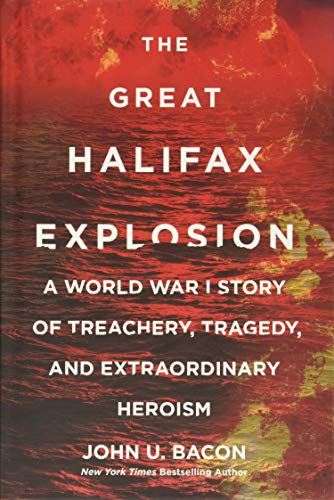
The Great Halifax Explosion
by John U. Bacon
"A World War I Story of Treachery, Tragedy, and Extraordinary Heroism"
Popularity
4.93 / 5
* A book's popularity is determined by how it compares to all other books on this website.
Where to buy?
Buy from Amazon* If you buy this book through the link above, we may receive a small commission at no extra cost to you.
The Great Halifax Explosion by John U. Bacon
Details
War:
World War I
Perspective:
Civilian
True Story:
Yes
Biography:
No
Region:
North America
Published Date:
2017
ISBN13:
9780062666536
Summary
The Great Halifax Explosion chronicles the devastating December 6, 1917 disaster when two ships collided in Halifax Harbor, causing the largest man-made explosion before the atomic bomb. Author John U. Bacon recounts how a French munitions ship and a Norwegian vessel crashed, obliterating much of the city, killing nearly 2,000 people, and injuring thousands more. The book details the wartime context, the catastrophic event itself, and the remarkable heroism of ordinary citizens and rescuers who responded amid the chaos. Bacon combines meticulous historical research with compelling storytelling to bring this largely forgotten tragedy to life.
Review of The Great Halifax Explosion by John U. Bacon
John U. Bacon's "The Great Halifax Explosion" delivers a meticulously researched account of one of history's most devastating yet overlooked disasters. On December 6, 1917, two ships collided in the harbor of Halifax, Nova Scotia, triggering an explosion that leveled much of the city and killed nearly 2,000 people. Bacon transforms this catastrophic event into a gripping narrative that reads with the intensity of a thriller while maintaining rigorous historical accuracy.
The book excels in its comprehensive approach to the disaster, beginning well before the actual explosion and extending far beyond its immediate aftermath. Bacon establishes the wartime context that brought these two vessels into Halifax harbor on that fateful morning. The Mont-Blanc, a French cargo ship loaded with wartime explosives, and the Imo, a Norwegian vessel, were both navigating the narrow channel when a series of miscommunications and navigational errors led to their collision. The resulting fire aboard the munitions ship gave Halifax residents approximately twenty minutes before the massive detonation that would reshape the city.
One of the book's greatest strengths lies in Bacon's ability to humanize the tragedy through individual stories. Rather than presenting the explosion as a distant historical event, he introduces readers to the people who lived through it: families preparing for their daily routines, sailors manning the ships, railway dispatcher Vincent Coleman who stayed at his post to warn an incoming passenger train despite the imminent danger, and the many others whose lives were forever altered. These personal narratives provide emotional weight to the historical record without descending into sentimentality.
Bacon's research is evident throughout the work. He draws from extensive archival materials, personal accounts, and historical records to construct a detailed timeline of events. The technical aspects of the explosion receive thorough attention, explaining how the collision occurred, why the ship's cargo was so volatile, and the mechanics of the blast itself. The author presents this information in accessible language that clarifies rather than overwhelms, making complex maritime and military details understandable to general readers.
The aftermath of the explosion receives equally detailed treatment. Bacon describes the immediate chaos as survivors emerged from the rubble, the devastating injuries caused by flying glass and debris, and the additional suffering brought by a blizzard that struck the city the following day. The response efforts, including the arrival of relief trains from neighboring communities and the massive reconstruction project that followed, demonstrate both the scale of the catastrophe and the resilience of the affected population.
The book also addresses the geopolitical dimensions of the disaster, occurring as it did during World War I. Halifax served as a crucial port for Allied operations, and the explosion had implications for the war effort. Bacon explores how wartime conditions contributed to the tragedy and how the disaster affected maritime operations during this critical period. The subsequent inquiry and legal proceedings receive thorough examination, including the initial attempts to assign blame and the eventual understanding of how multiple factors contributed to the collision.
Bacon's narrative structure keeps the pace brisk despite the wealth of detail. Chapters move logically from setup through crisis to resolution, with each section building on what came before. The writing maintains clarity even when dealing with multiple storylines and numerous historical figures. Technical explanations integrate smoothly into the narrative flow rather than interrupting it.
The book serves multiple purposes effectively. For readers interested in World War I history, it provides insight into a lesser-known aspect of the home front experience. Those drawn to disaster narratives will find a thoroughly documented case study in both catastrophe and human response. The work also functions as regional history, capturing a pivotal moment in Halifax's development and the maritime history of Atlantic Canada.
While the subject matter is inherently tragic, Bacon balances the horror of the disaster with stories of heroism, compassion, and recovery. The book documents both the worst and best of human behavior under extreme circumstances. Medical personnel, relief workers, and ordinary citizens responded with remarkable courage and generosity, and these accounts provide counterweight to the devastation.
"The Great Halifax Explosion" stands as a definitive account of this historic disaster. Bacon has produced a work that honors the victims and survivors while making their story accessible to contemporary readers. The combination of rigorous research, clear prose, and compelling narrative structure results in a book that informs and engages in equal measure. For anyone interested in maritime history, World War I, disaster studies, or Canadian history, this volume offers an essential and remarkably readable examination of a tragedy that deserves wider recognition.


