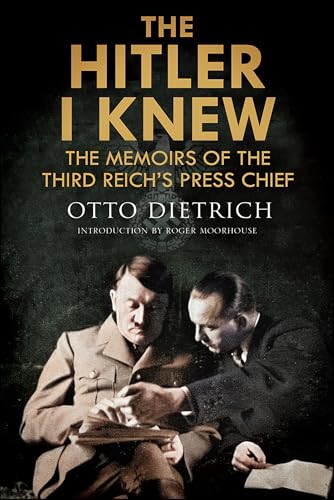
The Hitler I Knew
by Otto Dietrich
"The Memoirs of the Third Reich's Press Chief"
Popularity
4.75 / 5
* A book's popularity is determined by how it compares to all other books on this website.
Where to buy?
Buy from Amazon* If you buy this book through the link above, we may receive a small commission at no extra cost to you.
The Hitler I Knew by Otto Dietrich
Details
War:
World War II
Perspective:
Commanders
True Story:
Yes
Biography:
Yes
Region:
Europe
Page Count:
256
Published Date:
2023
ISBN13:
9781784389956
Summary
Otto Dietrich served as Adolf Hitler's press chief from 1933 to 1945, making him one of the closest observers of the Nazi leader. In this memoir, Dietrich provides a firsthand account of Hitler's personality, daily routines, and decision making processes during the Third Reich. Written from his unique position within Hitler's inner circle, the book offers insights into the propaganda machine of Nazi Germany and the Führer's methods of controlling information and public opinion. Dietrich's observations cover both Hitler's public persona and private behavior during this pivotal period in history.
Review of The Hitler I Knew by Otto Dietrich
Otto Dietrich's memoir offers a unique perspective on Adolf Hitler and the inner workings of the Nazi regime from someone who served as the Reich Press Chief from 1937 to 1945. As one of the few high-ranking officials who had regular access to Hitler throughout most of the Third Reich's existence, Dietrich's account provides insights into the dictator's personality, decision-making processes, and the propaganda machinery that sustained Nazi power.
The book presents Dietrich's recollections of his years working closely with Hitler, beginning with his early involvement in the Nazi party's rise to power and continuing through the war years. Dietrich was responsible for managing the regime's relationship with both domestic and international press, making him a key figure in shaping how the Nazi government communicated with the world. His position gave him frequent opportunities to observe Hitler in various settings, from formal state occasions to more private moments within the inner circle.
One of the memoir's most significant contributions lies in its portrayal of Hitler's personality and working methods. Dietrich describes a leader who was often unpredictable, prone to sudden shifts in mood, and increasingly isolated from reality as the war progressed. The press chief recounts instances of Hitler's persuasive abilities and charisma, which helped explain his hold over many followers, while also documenting the dictator's growing irrationality and refusal to acknowledge military setbacks.
The account provides details about the propaganda apparatus of the Nazi state and how information was controlled and manipulated. Dietrich explains the mechanisms by which the regime sought to maintain public morale and suppress dissent, offering a practitioner's view of totalitarian information control. His descriptions of daily press conferences, censorship decisions, and the coordination of messaging across different media outlets illuminate the systematic nature of Nazi propaganda efforts.
However, readers must approach this memoir with appropriate skepticism and historical context. Written after the war's end and Dietrich's imprisonment, the book contains elements of self-justification and attempts at distancing the author from the regime's worst crimes. Dietrich portrays himself as a technocrat caught up in events beyond his control, a characterization that historians have challenged. His claims of limited knowledge about the Holocaust and other atrocities strain credibility given his position within the regime's upper echelons.
The memoir also reveals the internal contradictions and competing power centers within the Nazi hierarchy. Dietrich describes tensions with Joseph Goebbels, the Propaganda Minister, and details the sometimes chaotic nature of decision-making in Hitler's government. These accounts align with historical scholarship showing that the Nazi state was often characterized by overlapping jurisdictions and personal rivalries rather than efficient totalitarian control.
From a historical documentation standpoint, the book contains information about specific events, meetings, and conversations that historians have used as source material, though always with careful corroboration from other sources. Dietrich's presence at numerous significant moments in Nazi Germany's history makes his testimony valuable, even when his interpretations and justifications are questionable.
The writing style reflects the formal tone common to memoirs by German officials of that era, and the translation maintains this character. The narrative moves chronologically through Dietrich's service, though it occasionally circles back to revisit themes or provide additional context. Some sections offer more detailed analysis than others, with particularly extensive coverage of the war years when Dietrich's role became increasingly complex.
Readers interested in World War II history, the Nazi regime, or the mechanics of totalitarian propaganda will find valuable material here, provided they approach it as a primary source requiring critical analysis rather than as an objective historical account. The book works best when read alongside other memoirs from the period and scholarly analyses that can provide context and correction for Dietrich's self-serving narratives.
The memoir's ultimate value lies not in Dietrich's attempts at self-exoneration but in the inadvertent revelations about life within Hitler's inner circle and the functioning of the Nazi state. Despite the author's obvious biases and evasions, the details he provides about daily operations, Hitler's habits and attitudes, and the atmosphere of the regime contribute to the historical record. Scholars and serious readers of World War II history will find this memoir useful as one piece of the larger puzzle, always keeping in mind the need for critical evaluation of its claims and the context in which it was written.


