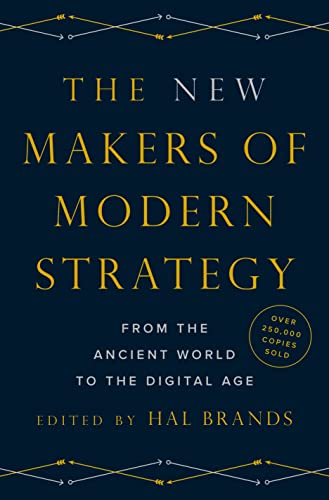
The New Makers of Modern Strategy
by Hal Brands
"From the Ancient World to the Digital Age"
Popularity
4.79 / 5
* A book's popularity is determined by how it compares to all other books on this website.
Where to buy?
Buy from Amazon* If you buy this book through the link above, we may receive a small commission at no extra cost to you.
The New Makers of Modern Strategy by Hal Brands
Details
Biography:
No
Page Count:
1184
Published Date:
2023
ISBN13:
9780691226729
Summary
The New Makers of Modern Strategy is a comprehensive anthology examining strategic thought from ancient times through the digital era. Edited by Hal Brands, this collection features essays by leading scholars analyzing history's most influential strategic thinkers and military leaders. The book updates the classic 1986 Makers of Modern Strategy, exploring how figures from Sun Tzu to contemporary theorists have shaped warfare and statecraft. It addresses traditional military strategy alongside modern challenges including cyber warfare, terrorism, and great power competition, making it essential reading for understanding how strategic thinking has evolved and applies to today's complex security environment.
Review of The New Makers of Modern Strategy by Hal Brands
Hal Brands has assembled an ambitious and comprehensive examination of strategic thought that spans millennia in "The New Makers of Modern Strategy: From the Ancient World to the Digital Age." This volume serves as both an update and expansion of the classic 1986 work "Makers of Modern Strategy," edited by Peter Paret, bringing strategic analysis into the contemporary era while maintaining rigorous historical grounding.
The book distinguishes itself through its sweeping chronological scope, beginning with ancient strategists and philosophers of war before progressing through medieval, early modern, and modern periods to arrive at present-day challenges. This structure allows readers to trace the evolution of strategic thinking across civilizations and centuries, demonstrating how foundational concepts have been adapted, refined, or sometimes forgotten and rediscovered by successive generations of military and political leaders.
Brands has gathered contributions from leading scholars in military history, international relations, and strategic studies, ensuring that each chapter benefits from deep expertise in its particular subject matter. The anthology format permits detailed exploration of individual thinkers, nations, and strategic traditions that a single-author work could not achieve with comparable depth. Each essay functions as a standalone piece while contributing to the broader narrative about how strategy has evolved in response to changing technologies, political systems, and international contexts.
The volume pays careful attention to non-Western strategic traditions, addressing a significant gap in earlier works that focused predominantly on European and American military thought. Chapters examine Chinese, Indian, and Islamic approaches to strategy and statecraft, recognizing that strategic wisdom has emerged from multiple civilizations and that contemporary strategists must understand diverse intellectual traditions in an interconnected world.
One of the book's central themes concerns the relationship between technological change and strategic thinking. The essays explore how innovations from gunpowder to nuclear weapons to cyber capabilities have forced strategists to reconsider fundamental assumptions about power, deterrence, and conflict. This technological thread becomes particularly relevant in the final sections, which grapple with how artificial intelligence, autonomous weapons systems, and digital warfare are reshaping strategic calculations in ways that earlier theorists could not have imagined.
The treatment of classic strategic thinkers provides fresh perspectives on familiar figures. Rather than simply rehearsing well-known interpretations of Clausewitz, Mahan, or Douhet, the contributors situate these theorists within their historical contexts and examine how their ideas have been interpreted, misinterpreted, and applied across different eras. This approach reveals that strategic classics remain relevant not because they provide timeless answers but because they ask enduring questions about the nature of conflict and competition.
The book also addresses the strategic challenges of irregular warfare, counterinsurgency, and asymmetric conflict, recognizing that conventional interstate war represents only one dimension of strategic competition. Essays examine how both state and non-state actors have developed strategies to counter technologically superior opponents, demonstrating that material power alone does not guarantee strategic success. These chapters prove particularly valuable given the prominence of irregular conflicts in recent decades.
The section on contemporary strategic challenges tackles issues including great power competition, nuclear deterrence in a multipolar world, and the intersection of economics and security. The contributors avoid simplistic predictions while highlighting key uncertainties and dilemmas facing policymakers and military leaders. The analysis acknowledges that the international system faces stresses from multiple directions simultaneously, requiring strategists to think across domains and timeframes.
The quality of writing varies somewhat across the anthology, as is typical with edited volumes, but generally maintains high standards of clarity and analytical rigor. Some chapters prove more accessible to general readers, while others assume greater familiarity with strategic studies literature. This variation reflects the different approaches of individual contributors rather than inconsistent editing.
"The New Makers of Modern Strategy" stands as an essential reference for students of military history, international relations scholars, and defense professionals seeking to understand how strategic thought has developed and where it might be heading. The book succeeds in demonstrating that strategy remains both an art and a discipline, requiring historical knowledge, theoretical understanding, and practical judgment. While comprehensive, the volume never feels encyclopedic or mechanical in its coverage. Instead, it offers engaged analysis of how humans have thought about organized violence, competition, and survival across vastly different contexts. For readers willing to engage seriously with questions of strategy, statecraft, and military affairs, this collection provides an indispensable foundation for understanding both enduring principles and emerging challenges in an increasingly complex world.