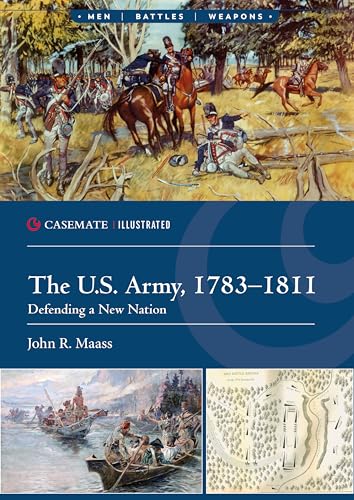
The U.S. Army, 1783–1811
by John R. Maass
"Defending a New Nation"
Popularity
4.77 / 5
* A book's popularity is determined by how it compares to all other books on this website.
Where to buy?
Buy from Amazon* If you buy this book through the link above, we may receive a small commission at no extra cost to you.
The U.S. Army, 1783–1811 by John R. Maass
Details
War:
American Revolutionary War
Perspective:
Infantry
Military Unit:
US Army
True Story:
Yes
Biography:
No
Region:
North America
Page Count:
97
Published Date:
2025
ISBN13:
9781636245539
Summary
The U.S. Army, 1783-1811: Defending a New Nation by John R. Maass examines the early American military during its formative years following independence. The book chronicles how the young nation struggled to establish a standing army amid political debates about military power and limited resources. Maass explores the Army's roles in frontier defense, relations with Native Americans, coastal fortifications, and preparations leading to the War of 1812. The work details organizational challenges, training, leadership, and the evolution of military policy as the United States balanced republican ideals with practical defense needs during this critical developmental period.
Review of The U.S. Army, 1783–1811 by John R. Maass
John R. Maass has carved out a reputation as a careful, detail-oriented historian of the early American military, and "The U.S. Army, 1783-1811: Defending a New Nation" reflects that same disciplined approach. The book examines a period often overshadowed by the drama of the Revolutionary War on one side and the War of 1812 on the other. Yet the decades between these two conflicts were formative for the young republic's military institutions, and Maass makes a persuasive case that this era deserves closer attention.
The central theme of the book is the struggle to define what kind of army the United States should have. After the Revolution, many Americans were deeply suspicious of standing armies, viewing them as instruments of tyranny reminiscent of British rule. This ideological wariness collided with the practical necessities of frontier defense, diplomatic credibility, and internal order. Maass traces how political leaders, military officers, and ordinary citizens wrestled with these competing pressures, producing a military establishment that was often underfunded, understaffed, and politically contentious.
One of the book's strengths is its attention to the institutional development of the Army during this period. Maass walks readers through the various reorganizations, reductions, and expansions that characterized the force under successive administrations. He explains how the Army's size and structure fluctuated according to the political climate, reflecting broader debates about federal power and the proper role of the military in a republic. These administrative details, while sometimes dense, are presented with enough context to remain accessible to readers without specialized military history backgrounds.
The book also gives substantial attention to the Army's actual operations during this era, particularly its role in frontier conflicts with Native American nations. Campaigns such as those led by Josiah Harmar and Arthur St. Clair, which ended in significant defeats, receive careful treatment. Maass does not shy away from documenting these failures, using them to illustrate the broader challenges facing a poorly resourced and inexperienced military force. The eventual reorganization under Anthony Wayne, culminating in the Battle of Fallen Timbers, is presented as a turning point that demonstrated what a more professionalized force could accomplish.
Maass pays considerable attention to the officers and soldiers who populated the ranks during this period, offering insight into the daily realities of military service. Pay was often inconsistent, supplies were unreliable, and morale suffered as a result. The author draws on primary sources, including official correspondence and military records, to paint a picture of an institution still finding its footing. This grounding in archival material lends credibility to the narrative and distinguishes the book from more general surveys of the era.
The political dimensions of military policy receive thoughtful treatment as well. Maass explores how figures like Alexander Hamilton, Henry Knox, and others debated the appropriate size and funding of the Army, often along partisan lines that foreshadowed later political divisions. The tension between Federalist preferences for a stronger military establishment and Republican suspicions of centralized power runs throughout the narrative, providing useful context for understanding the broader political currents of the early republic.
While the book is thorough, it does assume a baseline familiarity with the broader political history of the period. Readers coming to the subject without prior knowledge of early American politics may find themselves needing to do some additional research to fully appreciate certain references. The prose itself, however, remains clear and measured throughout, avoiding unnecessary jargon while still conveying the complexity of the subject matter.
Overall, "The U.S. Army, 1783-1811" fills a notable gap in the historiography of early American military institutions. Maass succeeds in demonstrating that this often-overlooked period was anything but static, as the young nation worked through fundamental questions about defense, governance, and national identity. The book will likely appeal most to readers with a serious interest in military history, early American politics, or the institutional development of the United States government. For those audiences, it offers a well-researched and balanced account of a formative chapter in American history.