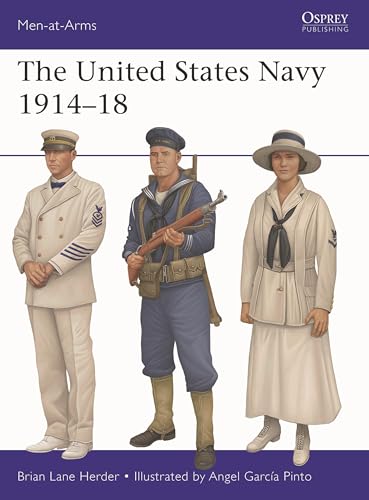
The United States Navy 1914–18
by Brian Lane Herder
Popularity
4.64 / 5
* A book's popularity is determined by how it compares to all other books on this website.
Where to buy?
Buy from Amazon* If you buy this book through the link above, we may receive a small commission at no extra cost to you.
The United States Navy 1914–18 by Brian Lane Herder
Details
War:
World War I
Military Unit:
US Navy
Biography:
No
Region:
Europe
Published Date:
2025
ISBN13:
9781472867681
Summary
The United States Navy 1914-18 examines the American naval forces during World War I, covering the period from the war's outbreak through U.S. involvement. The book details the Navy's organization, ships, personnel, and operations during this transformative era. It explores how the U.S. Navy expanded rapidly, adapted to modern naval warfare, and contributed to the Allied victory through convoy escort duties, submarine operations, and capital ship deployments. The work provides insight into the technological, tactical, and strategic developments that shaped American naval power during the Great War.
Review of The United States Navy 1914–18 by Brian Lane Herder
Brian Lane Herder's examination of the United States Navy during World War I offers readers a comprehensive look at a pivotal period in American naval history. Published as part of Osprey Publishing's New Vanguard series, this illustrated work provides detailed analysis of the transformation and operations of the U.S. Navy during the Great War, a conflict that fundamentally reshaped naval warfare and America's role on the world stage.
The book addresses a period that often receives less attention than other naval conflicts in American history. While World War II dominates popular naval literature, the First World War represents a crucial transitional phase for the United States Navy. When America entered the war in April 1917, the service faced the challenge of rapidly expanding its capabilities while adapting to modern naval warfare conditions that included submarines, mines, and convoy operations on an unprecedented scale.
Herder traces the development of American naval power during this era with careful attention to both technical and operational aspects. The work examines the various classes of warships that comprised the U.S. fleet, from dreadnought battleships to destroyers, submarines, and auxiliary vessels. This technical coverage provides readers with a solid understanding of the material capabilities available to American naval commanders. The author explains how these vessels were designed, constructed, and ultimately deployed in the Atlantic theater.
One of the book's strengths lies in its treatment of the convoy system and anti-submarine warfare. The German U-boat campaign posed an existential threat to the Allied war effort, and American destroyers played a vital role in protecting merchant shipping across the Atlantic. Herder details how American naval forces integrated with British and Allied units to combat this menace, describing the tactical developments and operational challenges that characterized this new form of warfare.
The work also addresses the diplomatic and strategic considerations that shaped American naval involvement. The relationship between the United States Navy and the Royal Navy proved essential to Allied success, yet coordination between these forces required navigating complex questions of command authority and national priorities. The author examines how American naval leaders balanced cooperation with their British counterparts while maintaining operational independence and protecting American interests.
Herder provides context for understanding the Navy's rapid expansion during the war years. The service grew substantially in both personnel and materiel, transforming from a force primarily concerned with hemispheric defense to one capable of projecting power across the Atlantic. This expansion required not only building new ships but also training thousands of sailors and officers, establishing new bases, and developing logistical systems to support distant operations.
The book benefits from Osprey's characteristic attention to visual presentation. Period photographs and specially commissioned artwork help readers visualize the vessels and operations described in the text. These illustrations serve an educational purpose, making technical information more accessible and providing visual reference points for the narrative. The artwork depicts various ship types, paint schemes, and operational scenarios that characterized American naval service during the war.
The author addresses both the Atlantic focus of American naval operations and the lesser-known activities in other theaters. While the primary effort centered on combating German submarines and supporting the transport of American troops to France, U.S. naval forces also operated in the Mediterranean and maintained a presence in the Pacific. This broader perspective prevents the narrative from becoming too narrowly focused on a single operational area.
Herder examines the lessons learned from the conflict and their impact on subsequent naval development. The experience of World War I influenced American naval doctrine, ship design, and strategic thinking for years to come. The war demonstrated the importance of anti-submarine warfare, the vulnerability of surface vessels to underwater attack, and the necessity of strong logistical support for sustained operations far from home waters.
The book serves multiple audiences effectively. Readers seeking an introduction to American naval operations in World War I will find a clear and accessible overview. Those with more specialized interests in naval history will appreciate the technical details and operational analysis. Modelers and enthusiasts interested in the visual aspects of naval vessels will benefit from the illustrations and color plates.
As part of a series known for concise, focused treatments of military subjects, this work delivers substantial information within a manageable format. The book does not claim to be an exhaustive history but rather provides a solid foundation for understanding the United States Navy's role and transformation during the Great War. For readers interested in this often-overlooked chapter of American military history, Herder's work offers a valuable and well-executed resource.


