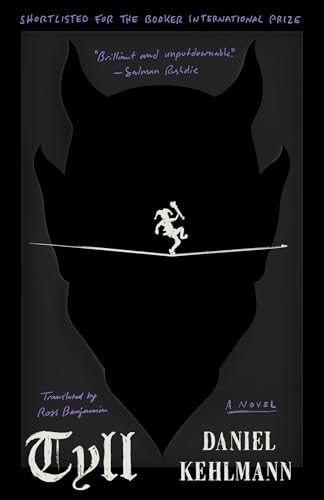
Tyll
by Daniel Kehlmann
"A Novel"
Popularity
4.92 / 5
* A book's popularity is determined by how it compares to all other books on this website.
Where to buy?
Buy from Amazon* If you buy this book through the link above, we may receive a small commission at no extra cost to you.
Tyll by Daniel Kehlmann
Details
Biography:
No
Page Count:
354
Published Date:
2021
ISBN13:
9780525562726
Summary
Tyll is a historical novel set during the Thirty Years War in 17th century Europe. It follows the life of Tyll Ulenspiegel, a legendary trickster and wandering entertainer who travels through a war torn landscape performing for peasants and nobility alike. The narrative weaves together multiple perspectives and timelines, depicting how Tyll encounters various historical figures including the exiled Winter King and Queen of Bohemia. Through Tyll's journey as a jester and rope dancer, Kehlmann explores themes of survival, art, truth, and the human cost of religious and political conflict during one of Europe's most devastating wars.
Review of Tyll by Daniel Kehlmann
Daniel Kehlmann's "Tyll" reimagines the legendary figure of Till Eulenspiegel, the cunning trickster of German folklore, through a kaleidoscopic narrative that spans the devastating Thirty Years' War. This ambitious historical novel, published in German in 2017 and translated into English by Ross Benjamin in 2020, weaves together multiple perspectives and timelines to create a portrait of an age consumed by religious conflict, superstition, and violence.
The novel opens with Tyll Ulenspiegel as a young boy in a small village, where his father, a miller and secret freethinker, teaches him to question authority and read forbidden texts. When his father falls victim to witch-hunting hysteria, Tyll escapes with his childhood friend Nele and reinvents himself as a traveling entertainer. His extraordinary abilities as a juggler, rope dancer, and fool allow him to move through a society torn apart by war, performing for peasants and nobility alike.
Kehlmann structures the narrative through interconnected episodes that jump backward and forward in time. Various characters encounter Tyll at different points during the war, creating a mosaic effect that gradually reveals the scope of both the historical catastrophe and the protagonist's elusive nature. This fragmented approach mirrors the chaos of the period itself, where certainty dissolved and traditional structures crumbled under the weight of seemingly endless conflict.
One of the novel's most compelling storylines follows the Winter King, Frederick V of the Palatinate, and his wife Elizabeth Stuart, daughter of England's James I. Kehlmann portrays their disastrous reign in Bohemia and subsequent exile with dark humor and psychological insight. Their chapters capture the absurdity of royal pretensions amid military defeat and the grinding poverty of displacement. When Tyll enters their service during their years of wandering, his performances provide both entertainment and a mirror reflecting their diminished circumstances.
The character of Tyll himself remains deliberately enigmatic throughout the novel. He appears and disappears like a phantom, sometimes seeming almost supernatural in his ability to survive impossible situations. His performances blend genuine skill with showmanship, leaving observers uncertain about what they have actually witnessed. This ambiguity serves the novel's larger themes about the nature of truth and reality during a period when competing religious narratives justified horrific violence.
Kehlmann's prose, even in translation, demonstrates remarkable versatility. The language shifts to match each chapter's perspective, from the elevated rhetoric of nobility to the earthier speech of soldiers and peasants. Scenes of Tyll's performances crackle with energy and wit, while descriptions of wartime atrocities achieve their impact through understated precision. The author never flinches from depicting the brutal realities of the era, including religious persecution, summary executions, and the casual cruelty that becomes normalized during prolonged conflict.
The historical setting provides rich material for exploring timeless questions about belief, power, and survival. The Thirty Years' War, which devastated Central Europe from 1618 to 1648, serves as more than mere backdrop. Kehlmann captures how religious certainty fueled atrocities on all sides, how civilian populations suffered regardless of which army passed through their lands, and how the conflict's duration created a generation that knew nothing but war. Against this darkness, Tyll's trickster nature represents a kind of freedom—the ability to mock authority, cross boundaries, and refuse allegiance to any faction.
The novel also examines the power of storytelling and performance. Tyll survives by entertaining, by making himself valuable to whoever holds temporary power. His performances offer brief respites from horror, moments of wonder and laughter in an age of fear. Yet there's always an edge to his acts, a subtle mockery of the powerful who believe themselves immune to the suffering around them. The fool speaks truths that others dare not voice, though always in ways that maintain plausible deniability.
Kehlmann based his protagonist on a historical legendary figure whose tales have been told and retold across centuries, adding his own interpretation to a long tradition. By setting these stories against the meticulously researched backdrop of the Thirty Years' War, he creates a conversation between myth and history. The novel asks what role art and storytelling play during catastrophic times, and whether there exists any space for individual agency when larger forces seem to determine everything.
"Tyll" stands as a significant achievement in contemporary historical fiction, offering both an engaging narrative and a meditation on darker aspects of human nature. The novel's episodic structure may challenge readers seeking conventional plotting, but this approach ultimately serves its themes. Like its protagonist, the book refuses to be pinned down to a single interpretation, maintaining ambiguities that provoke reflection long after the final page.