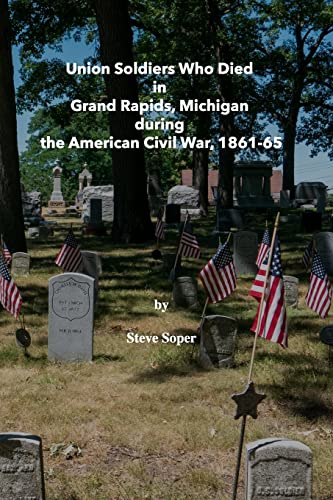
Union Soldiers who Died in Grand Rapids, Michigan During the American Civil War, 1861-1865
by Steve Soper
"Including Wartime Burials in Oak Hill, Fulton, St. Andrew's and Various Cemeteries Around the State Along with a Short Biography of Each Soldier"
Popularity
2.63 / 5
* A book's popularity is determined by how it compares to all other books on this website.
Where to buy?
Buy from Amazon* If you buy this book through the link above, we may receive a small commission at no extra cost to you.
Union Soldiers who Died in Grand Rapids, Michigan During the American Civil War, 1861-1865 by Steve Soper
Details
War:
American Civil War
Perspective:
Researcher
True Story:
Yes
Biography:
Yes
Region:
North America
Page Count:
120
Published Date:
2020
ISBN13:
9798648581777
Description
Brief Summary
Union Soldiers who Died in Grand Rapids, Michigan During the American Civil War, 1861-1865 by Steve Soper is an intriguing exploration into a lesser-known aspect of Civil War history. The book delves into why several dozen Union soldiers, who died during the war, were buried in Grand Rapids, Michigan, a quiet town in the upper Midwest. Soper investigates the circumstances surrounding these soldiers' deaths and their final resting places to provide answers to the questions of who these soldiers were, how many of them died there, and where exactly they are buried.
Main Themes and Topics
The book primarily revolves around historical documentation and investigative research. One of the central themes is the exploration of the often-overlooked soldiers who died outside the major battlefields and how their contributions have been commemorated. Soper dedicates his research to understanding how these soldiers ended up in Grand Rapids and brings to attention the peculiar nature of their presence there. The theme of remembering and honoring these unsung heroes permeates the narrative, reflecting on the broader impact of the Civil War on small towns far from the front lines.
Writing Style and Tone
Steve Soper's writing style is meticulous and research-driven, reflecting his commitment to historical accuracy and detail. The tone of the book is respectful and somber, acknowledging the gravity of the subject matter. Soper's investigative approach allows readers to engage with the content deeply, as he combines narrative storytelling with historical facts to create a compelling read. The writing is clear, concise, and accessible, appealing to both history enthusiasts and general readers interested in Civil War history.
Criticism
While Soper's book is a well-documented and respectful tribute to forgotten soldiers, readers might find the narrative somewhat dense due to its heavy reliance on factual data and historical records. Those looking for a more narrative-driven storyline might find the detailed accounts overwhelming. Nonetheless, for readers interested in a thorough historical account, this book is a valuable resource.