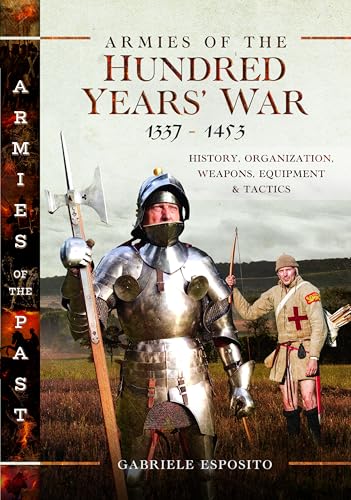
Armies of the Hundred Years' War 1337–1453
by Gabriele Esposito
"History, Organization, Weapons, Equipment and Tactics"
Popularity
4.6 / 5
* A book's popularity is determined by how it compares to all other books on this website.
Where to buy?
Buy from Amazon* If you buy this book through the link above, we may receive a small commission at no extra cost to you.
Armies of the Hundred Years' War 1337–1453 by Gabriele Esposito
Details
War:
Hundred Years' War
Perspective:
Infantry
True Story:
Yes
Biography:
No
Region:
Europe
Page Count:
267
Published Date:
2025
ISBN13:
9781399037846
Summary
This comprehensive military history examines the armies that fought during the Hundred Years' War between England and France. Esposito provides detailed analysis of military organization, troop types, weaponry, armor, and tactical developments across the conflict's various phases. The book covers both English and French forces, including knights, men-at-arms, archers, and infantry. It explores how warfare evolved during this period, from early feudal armies to more professional fighting forces, while documenting the equipment and combat methods that defined medieval warfare during this transformative era in European military history.
Review of Armies of the Hundred Years' War 1337–1453 by Gabriele Esposito
Gabriele Esposito's comprehensive examination of the military forces that clashed during the Hundred Years' War offers readers a detailed exploration of one of medieval Europe's most significant conflicts. This work stands as a valuable resource for military historians, wargamers, and enthusiasts seeking to understand the evolution of warfare during the fourteenth and fifteenth centuries. The book spans the entire duration of the conflict, from its outbreak in 1337 through to its conclusion in 1453, providing coverage of the dramatic changes in military organization and tactics that occurred across these transformative decades.
The organizational structure of the book proves to be one of its strongest features. Rather than presenting a chronological narrative of battles and campaigns, Esposito focuses on the structural and technical aspects of medieval armies. This approach allows readers to grasp how English, French, and other participating forces were organized, equipped, and deployed throughout the long conflict. The author examines the composition of armies, breaking down the roles of various troop types including knights, men-at-arms, archers, crossbowmen, and infantry. This systematic treatment helps readers understand not just what happened during famous engagements like Crécy, Poitiers, and Agincourt, but why certain tactical decisions were made and how different force compositions affected battlefield outcomes.
The coverage of weapons and equipment represents a particularly thorough aspect of the work. Esposito details the evolution of armor, from the mail and early plate combinations of the conflict's beginning to the sophisticated full plate harnesses that became standard by its end. The discussion of archery, particularly the English longbow and its tactical employment, receives substantial attention. The author explores how this weapon system, combined with dismounted men-at-arms and field fortifications, created the defensive tactical system that brought the English their most famous victories. Similarly, the coverage of polearms, swords, and siege equipment provides readers with a comprehensive understanding of the medieval arsenal.
One of the book's notable contributions lies in its treatment of forces beyond the primary English and French armies. The conflict drew in soldiers from across Europe, including Scots, Spanish, Italian, German, and Burgundian troops. Esposito's inclusion of these contingents provides a more complete picture of the war's international scope. The examination of mercenary companies and their role in the conflict adds another dimension to understanding how warfare was conducted during this period. These professional soldiers, often operating with considerable independence, significantly influenced military developments and the war's progression.
The tactical analysis throughout the book demonstrates how warfare evolved during the Hundred Years' War. Early in the conflict, cavalry charges and traditional chivalric combat dominated thinking, but successive English victories using combined-arms tactics forced adaptations. The author traces how French commanders gradually developed responses to English defensive systems, eventually achieving success through the employment of artillery and more flexible tactical approaches. This evolutionary perspective helps readers appreciate the dynamic nature of medieval warfare and dispels simplistic notions about unchanging medieval military practices.
Visual elements enhance the text's utility significantly. Illustrations depicting soldiers in period-appropriate equipment provide valuable reference material, particularly for those interested in historical recreation or miniature wargaming. These images complement the written descriptions and help clarify the often-complex details of medieval military dress and equipment. The visual documentation of heraldry, banners, and unit distinctions further aids readers in understanding how medieval armies were identified and organized on the battlefield.
The book's treatment of logistics and campaign organization, while not exhaustive, provides useful context for understanding the practical challenges of medieval warfare. The difficulties of maintaining armies in the field, the importance of foraging and supply lines, and the impact of weather and disease on military operations all receive attention. These factors often proved as decisive as battlefield tactics in determining campaign outcomes, and their inclusion rounds out the military picture.
For readers seeking an accessible yet authoritative reference on the military dimensions of the Hundred Years' War, this volume delivers substantial value. The focus on organization, equipment, and tactics rather than purely narrative history makes it particularly useful for those interested in the practical aspects of medieval warfare. While academic specialists might desire more detailed source citations or historiographical discussion, the book succeeds admirably in its apparent goal of providing a comprehensive, usable guide to the armies of this pivotal conflict. Esposito's work serves as both an informative introduction for newcomers and a handy reference for those already familiar with the period, making it a worthwhile addition to any military history collection focused on the medieval era.