The English Bowman in the Hundred Years War
by M J Trow
"The Secret Weapon of the Middle Ages"
Popularity
3.67 / 5
* A book's popularity is determined by how it compares to all other books on this website.
Where to buy?
Buy from Amazon* If you buy this book through the link above, we may receive a small commission at no extra cost to you.
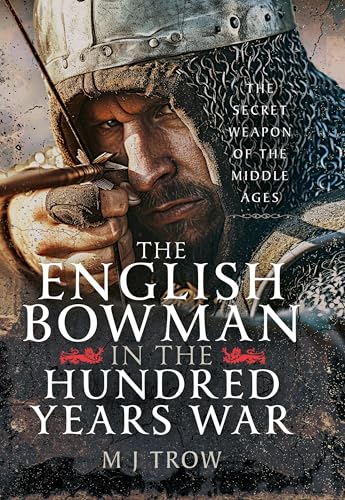
The English Bowman in the Hundred Years War by M J Trow
Details
War:
Hundred Years' War
Perspective:
Infantry
Biography:
No
Region:
Europe
Page Count:
293
Published Date:
2025
ISBN13:
9781036124748
Summary
The English Bowman in the Hundred Years War examines the crucial role of the longbow and its archers in medieval warfare. M.J. Trow explores how English bowmen became a decisive military force during the Hundred Years War, analyzing their training, tactics, and impact on famous battles like Crécy and Agincourt. The book investigates why the longbow proved so effective against French cavalry and armored knights, and how these archers transformed medieval combat. Trow presents the English bowman as an underappreciated weapon that gave England significant military advantages during this prolonged conflict with France.
Review of The English Bowman in the Hundred Years War by M J Trow
M. J. Trow's examination of the English longbowman during the Hundred Years War presents a focused study of one of medieval warfare's most transformative military technologies. The book addresses a weapon system that fundamentally altered the balance of power on European battlefields during the fourteenth and fifteenth centuries, challenging established conventions of mounted aristocratic combat.
The English longbow, constructed from yew wood and capable of launching arrows at tremendous velocity, emerged as a decisive tactical advantage in conflicts between England and France. Trow explores how this seemingly simple weapon required extraordinary skill to master, with archers beginning their training in childhood to develop the physical strength and technique necessary for effective deployment. The draw weight of these longbows often exceeded one hundred pounds, demanding substantial upper body development that has been confirmed through skeletal analysis of remains from the period.
The author examines several pivotal engagements where longbowmen proved their worth against continental forces. The battles of Crécy, Poitiers, and Agincourt serve as primary examples of how concentrated volleys of arrows could devastate advancing cavalry and infantry formations. At Crécy in 1346, English archers inflicted catastrophic casualties on French knights, demonstrating that numerical superiority and traditional chivalric tactics could be overcome through disciplined missile fire and defensive positioning.
Trow investigates the social and economic context surrounding these common soldiers who wielded such disproportionate battlefield influence. Unlike mounted knights drawn from the nobility, longbowmen typically came from yeoman backgrounds, representing a different social stratum. The book explores how military necessity elevated these individuals to positions of tactical importance, though not necessarily to social prominence. The requirement for constant practice, often mandated by law, created a substantial pool of capable archers available for military service.
The technical aspects of longbow construction and use receive considerable attention. The selection of appropriate yew wood, the careful shaping of the stave, and the precise tillering required to create an effective weapon all factor into understanding why English archery achieved such dominance. The arrows themselves required specialized fletching and arrowheads designed for armor penetration, representing sophisticated metallurgical and craft knowledge.
Tactical deployment patterns form another significant component of the analysis. English commanders learned to position their archers behind defensive stakes, on favorable terrain, and in concentrated formations that maximized their firepower while minimizing vulnerability to cavalry charges. The coordination between archers and dismounted men-at-arms created a combined arms approach that Continental opponents struggled to counter effectively.
The book addresses the longbow's gradual decline as gunpowder weapons emerged during the latter stages of the Hundred Years War and beyond. While firearms initially lacked the range and rate of fire of longbows, they required far less training to use effectively and eventually supplanted archery as military technology evolved. This transition marked not only a technological shift but also changes in military organization and recruitment.
Trow's work contributes to understanding how military innovation intersects with social structures and historical outcomes. The English longbow represents a case study in how a relatively simple technology, when combined with specialized training and appropriate tactics, could provide asymmetric advantages against supposedly superior forces. The weapon's effectiveness depended not merely on its physical properties but on the entire system of recruitment, training, and tactical employment that England developed.
The narrative maintains accessibility while addressing complex military and social questions. Readers seeking detailed analysis of specific battles will find substantial material, while those interested in broader patterns of military development can trace how the longbow influenced strategic thinking and campaign planning throughout the prolonged conflict between England and France.
The book serves both general readers interested in medieval military history and those seeking deeper understanding of how weapons technology shapes historical events. By focusing on the longbowmen themselves rather than exclusively on noble commanders or grand strategy, Trow provides perspective on the experience and contribution of common soldiers whose skill and discipline proved essential to English military success during this extended period of warfare. The work illuminates how this particular weapon system achieved legendary status and why the English longbowman remains an enduring symbol of medieval military effectiveness.