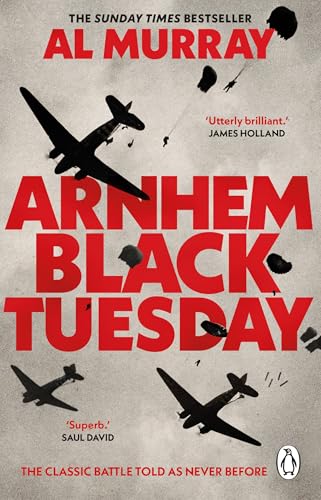
Arnhem: Black Tuesday
by Al Murray
Popularity
4.44 / 5
* A book's popularity is determined by how it compares to all other books on this website.
Where to buy?
Buy from Amazon* If you buy this book through the link above, we may receive a small commission at no extra cost to you.
Arnhem: Black Tuesday by Al Murray
Details
War:
World War II
Perspective:
Paratroopers
Biography:
No
Region:
Europe
Published Date:
2025
ISBN13:
9781804995457
Summary
Arnhem: Black Tuesday by Al Murray examines one of the most infamous failures of World War II: Operation Market Garden. Murray focuses specifically on the British airborne assault on Arnhem in September 1944, which was intended to capture key bridges in the Netherlands but ended in disaster. The book combines military history with Murray's accessible writing style, analyzing the planning errors, communication breakdowns, and tactical miscalculations that led to the operation's failure. It explores how overconfidence and flawed intelligence resulted in thousands of British paratroopers being killed, wounded, or captured in what became known as the bridge too far.
Review of Arnhem: Black Tuesday by Al Murray
Al Murray, best known as a comedian and television personality, brings his lesser-known passion for military history to bear in "Arnhem: Black Tuesday," a detailed examination of one of World War II's most controversial operations. The book focuses on Operation Market Garden, specifically the ill-fated attempt to capture the bridge at Arnhem in September 1944, offering readers a thoroughly researched account of what many historians consider one of the war's greatest strategic miscalculations.
The title references September 19, 1944, a pivotal day in the battle when British forces faced catastrophic losses while attempting to hold their positions around the Arnhem bridge. Murray's approach combines meticulous research with accessible prose, making complex military maneuvers comprehensible to general readers while maintaining the rigor expected by history enthusiasts. The narrative draws extensively from primary sources, including war diaries, after-action reports, and personal accounts from participants on both sides of the conflict.
Murray demonstrates a particular strength in contextualizing the broader strategic picture that led to Market Garden's conception. The book examines the optimism pervading Allied command following the rapid advance across France in the summer of 1944, and how this confidence contributed to critical underestimations of German defensive capabilities. The analysis explores Field Marshal Montgomery's plan to use airborne forces to seize key bridges across the Netherlands, creating a corridor for armored units to advance into Germany's industrial heartland.
The account pays considerable attention to the intelligence failures that plagued the operation from its inception. Murray details how reconnaissance photographs showing German armor near Arnhem were either dismissed or inadequately communicated through the command structure. This aspect of the book proves particularly compelling, as it reveals the human factors and organizational dysfunction that contributed to the disaster, beyond simple tactical mistakes on the battlefield.
What distinguishes this work from other treatments of Arnhem is Murray's attention to the German perspective. The book provides substantial coverage of the Wehrmacht's response, including the rapid reactions of Field Marshal Model and SS-Obergruppenführer Bittrich. This balanced approach helps readers understand why British forces faced such fierce and well-coordinated resistance, countering the persistent myth that German forces at Arnhem were merely scattered remnants incapable of effective opposition.
The combat narrative itself is rendered with clarity and appropriate gravity. Murray walks readers through the sequential breakdown of the British plan, from the initial landing zones positioned too far from objectives, through the communication failures that left units isolated, to the desperate fighting around the bridge itself. The writing conveys the chaos and confusion of battle without resorting to gratuitous detail or sensationalism. The focus remains on understanding what happened and why, rather than simply recounting violence.
Murray gives appropriate weight to the extraordinary courage displayed by British and Polish airborne troops who found themselves in an untenable position. The defense of the northern end of Arnhem bridge by Lieutenant Colonel John Frost's battalion receives detailed treatment, illustrating both the determination of the defenders and the impossibility of their situation once relief failed to arrive. The narrative acknowledges the heroism without romanticizing the operational failure that placed these soldiers in such dire circumstances.
The book also addresses the wider implications of Market Garden's failure, including its impact on the war's timeline and the subsequent suffering of Dutch civilians during the Hunger Winter. Murray connects tactical decisions made in September to consequences felt for months afterward, providing readers with a fuller understanding of the operation's significance beyond the immediate military outcome.
Murray's background in comedy might lead some to expect a lighter tone, but the text maintains appropriate seriousness throughout. The writing is engaging without being flippant, accessible without being simplistic. Technical military terminology is explained when necessary, and the narrative structure keeps readers oriented even when describing complex, multi-unit operations occurring simultaneously.
"Arnhem: Black Tuesday" serves as a solid contribution to the extensive literature on Operation Market Garden. The book synthesizes existing scholarship while presenting the material in a format that appeals to both dedicated military history readers and those newer to the subject. Murray's ability to explain command decisions, tactical movements, and their consequences in clear terms makes this account particularly valuable for understanding one of the war's most studied battles. For readers seeking a comprehensive, balanced examination of the Arnhem operation that respects both the courage of participants and the gravity of the command failures, this work delivers a thoroughly researched and well-presented narrative.