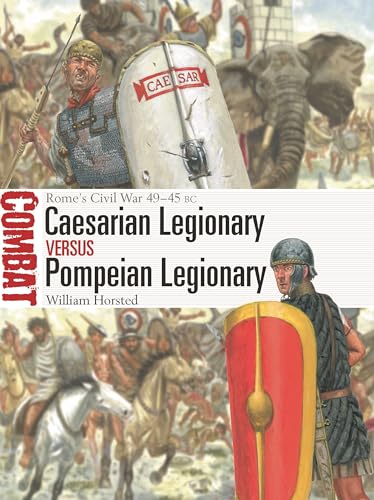
Caesarian Legionary Vs Pompeian Legionary
by William Horsted
"Rome’s Civil War 49–45 BC"
Popularity
4.72 / 5
* A book's popularity is determined by how it compares to all other books on this website.
Where to buy?
Buy from Amazon* If you buy this book through the link above, we may receive a small commission at no extra cost to you.
Caesarian Legionary Vs Pompeian Legionary by William Horsted
Details
Perspective:
Infantry
Biography:
No
Region:
Europe
Published Date:
2025
ISBN13:
9781472867049
Review of Caesarian Legionary Vs Pompeian Legionary by William Horsted
William Horsted's "Caesarian Legionary vs Pompeian Legionary: Rome's Civil War 49-45 BC" is part of Osprey Publishing's Combat series, which specialises in placing two opposing fighting forces side by side to explore how similar men, trained in similar traditions, could end up facing each other on the battlefield. This particular volume tackles one of the more unusual and tragic aspects of Roman military history: a civil war in which the two sides were not foreign enemies but soldiers drawn from the same legions, the same recruitment pools, and often the same social background.
The premise is compelling. By 49 BC, the Roman Republic had produced a professional and highly effective military system, and the legions that fought under Julius Caesar and those that fought under Pompey the Great were shaped by the same doctrines, equipment standards, and battlefield experience. Horsted's book does not attempt to portray one side as superior in raw skill or equipment, since both were drawing from the same well of Roman military tradition. Instead, the interest lies in the subtler differences: variations in unit cohesion, leadership, morale, and the practical experience gained through specific campaigns.
As with other titles in the Combat series, the book follows a structured approach. It typically opens with an overview of recruitment and organisation, then moves into training, equipment, and command structures, before focusing on specific engagements that illustrate how these factors played out in practice. For a conflict fought largely between soldiers of near-identical origin, this structure is particularly useful, allowing the differences that did exist, such as command decisions, terrain, and morale, to come into sharper focus.
Osprey's Combat series is known for its accessible format, and this volume follows that pattern. Detailed illustrations depicting arms, armour, and battlefield scenes accompany the text, alongside photographs of surviving artefacts and reconstructions. These visual elements are not simply decorative; they serve to reinforce points made in the text about equipment standardisation and the subtle distinctions that might have existed between legions raised in different provinces or under different commanders. For readers with an interest in the material culture of the late Republic, these sections offer real value.
The narrative sections dealing with key engagements of the civil war, such as the campaigns leading to Pharsalus, are handled with a focus on tactical decision-making rather than sweeping political narrative. This is consistent with the series' aim of examining combat effectiveness rather than providing a full political history of the conflict. Readers looking for an extensive account of the political motivations behind the war, or a detailed biography of Caesar or Pompey, will need to look elsewhere; this book is concerned with the men in the ranks and the tactical realities they faced.
One of the more interesting threads running through the book is the question of loyalty and motivation. Since these were Roman soldiers fighting other Roman soldiers, often with shared training and sometimes even shared service history, the usual assumptions about national or ethnic rivalry do not apply. Horsted's approach to this dimension adds a layer of nuance that distinguishes the book from more straightforward troop-comparison volumes in the series, where opposing forces come from clearly distinct cultures.
The book's length and format are consistent with other entries in the Combat series, meaning it functions best as a focused study rather than an exhaustive history. Readers already familiar with the broader narrative of Caesar's civil war will find the tactical and organisational detail rewarding, while newcomers may benefit from pairing this volume with a more general history of the period for fuller context.
Overall, this is a well-organised and visually engaging addition to the Combat series. It succeeds in its core aim of illuminating the practical realities faced by legionaries on both sides of a civil conflict, without resorting to speculation or oversimplification. For readers interested in Roman military organisation, equipment, and the tactical dimensions of the late Republic's civil wars, it offers a focused and informative resource.


