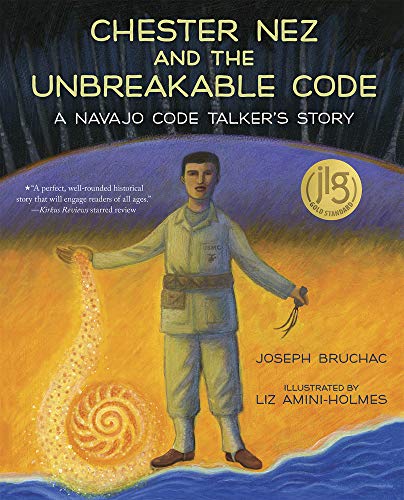
Chester Nez and the Unbreakable Code
by Joseph Bruchac
"A Navajo Code Talker's Story"
Popularity
4.65 / 5
* A book's popularity is determined by how it compares to all other books on this website.
Where to buy?
Buy from Amazon* If you buy this book through the link above, we may receive a small commission at no extra cost to you.
Chester Nez and the Unbreakable Code by Joseph Bruchac
Details
War:
World War II
Perspective:
Special Forces
Military Unit:
US Marine Corps
True Story:
Yes
Biography:
Yes
Region:
Pacific
Published Date:
2018
ISBN13:
9780807500071
Summary
Chester Nez and the Unbreakable Code tells the true story of one of the original 29 Navajo Code Talkers who served during World War II. The book follows Chester Nez as he leaves his Arizona reservation to join the Marines, where he and fellow Navajo recruits develop an ingenious code based on their native language. This unbreakable code proved crucial to American victory in the Pacific theater. Author Joseph Bruchac presents an accessible account of Nez's experiences, highlighting both his military service and the broader context of Navajo contributions to the war effort.
Review of Chester Nez and the Unbreakable Code by Joseph Bruchac
Joseph Bruchac brings to life the remarkable true story of Chester Nez, one of the original twenty-nine Navajo Code Talkers who played a crucial role in World War II. This biographical account offers readers an accessible entry point into a significant chapter of American military history while honoring the contributions of Native Americans to the war effort. Through carefully researched narrative, Bruchac presents the life journey of a man whose native language became an unbreakable weapon against enemy forces.
The book traces Chester Nez's early years on the Navajo Nation, providing essential context for understanding the cultural and personal background that would later prove invaluable to the United States Marine Corps. Nez grew up during a period when Native American children were often sent to boarding schools where they were forbidden to speak their native languages. This historical reality adds profound irony to the later military recognition that the Navajo language, once suppressed, would become vital to national security. Bruchac handles this sensitive historical context with appropriate gravity while maintaining narrative momentum.
The transformation of the Navajo language into a military code forms the heart of the narrative. In 1942, the Marine Corps recruited Navajo men to develop and implement a code based on their native language. The complexity and rarity of Navajo, combined with its lack of written form during that era, made it virtually impossible for enemy cryptographers to decipher. The original twenty-nine Code Talkers, including Chester Nez, developed a specialized vocabulary that assigned Navajo words to military terms. This ingenious system allowed for rapid, secure communication across Pacific battlefields.
Bruchac details the rigorous training these young Navajo men underwent, both as Marines and as code specialists. The dual challenge of mastering military protocols while creating and memorizing an entirely new coded vocabulary demanded exceptional dedication and mental acuity. The narrative conveys the pressure these men faced, knowing that any mistake in transmission could cost American lives. Their work required perfect accuracy under the most stressful combat conditions imaginable.
The book follows Nez through major Pacific campaigns, including Guadalcanal, Guam, and other critical battles. The Code Talkers worked in teams, often operating in the most dangerous forward positions where clear communication was essential. Their coded messages, transmitted by radio and telephone, coordinated troop movements, called in artillery strikes, and relayed strategic intelligence. The speed and security of their communications provided American forces with a significant tactical advantage. Japanese code breakers, despite their sophistication, never cracked the Navajo code.
An important aspect of the narrative addresses the secrecy that surrounded the Code Talkers' mission. For decades after the war, these men could not speak about their service because the code remained classified. This enforced silence meant that their extraordinary contributions went largely unrecognized for many years. The eventual declassification and public acknowledgment of the Code Talkers' role came late in many of their lives, though it brought deserved recognition to their service and sacrifice.
Bruchac's writing style makes this historical account accessible to a broad readership without sacrificing substance. The prose moves steadily through chronological events while incorporating enough detail to convey the significance of the Code Talkers' work. The author draws on historical records and Chester Nez's own accounts to create an authentic portrait of this period. The narrative balances military history with personal story, helping readers understand both the strategic importance of the code and the human experiences of those who created and used it.
The book serves multiple purposes effectively. It functions as a biographical tribute to Chester Nez, a military history of a unique wartime program, and an acknowledgment of Native American contributions to American military efforts. The intersection of these elements provides readers with a multifaceted perspective on World War II history that often receives insufficient attention in mainstream historical accounts.
This work contributes to the broader understanding of Native American experiences in the twentieth century, illustrating how cultural heritage and language, once targeted for elimination, became valuable national assets. The story demonstrates resilience and patriotism in the face of historical injustice, though Bruchac presents these themes through factual narrative rather than heavy-handed commentary. The book allows the historical record to speak for itself regarding both the achievements of the Code Talkers and the complex relationship between Native Americans and the United States government.
Chester Nez and the Unbreakable Code stands as an important historical document that preserves the memory of extraordinary service while educating readers about a unique aspect of World War II. The account honors the legacy of the Navajo Code Talkers and ensures that their contributions remain part of the historical record for future generations.

