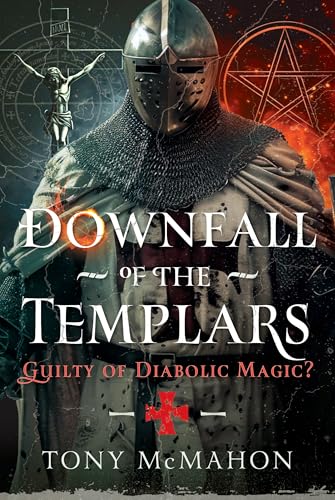
Downfall of the Templars
by Tony McMahon
"Guilty of Diabolic Magic?"
Popularity
4.93 / 5
* A book's popularity is determined by how it compares to all other books on this website.
Where to buy?
Buy from Amazon* If you buy this book through the link above, we may receive a small commission at no extra cost to you.
Downfall of the Templars by Tony McMahon
Details
War:
Crusades
Biography:
No
Region:
Europe
Published Date:
2026
ISBN13:
9781036113582
Summary
The book examines the dramatic fall of the Knights Templar in the early 14th century, questioning whether accusations of heresy and devil worship were legitimate or politically motivated. Tony McMahon investigates the historical evidence surrounding the Order's suppression by King Philip IV of France and Pope Clement V. The book explores the charges brought against the Templars, including idol worship and magical practices, while analyzing whether these were genuine crimes or fabricated pretexts to seize the wealthy Order's assets and eliminate their power.
Review of Downfall of the Templars by Tony McMahon
Tony McMahon's "Downfall of the Templars: Guilty of Diabolic Magic?" examines one of the most dramatic episodes in medieval history: the sudden and brutal suppression of the Knights Templar in the early fourteenth century. The book sets out to explore the charges brought against the order, including accusations of heresy, idol worship, and occult practices, and to assess how much truth, if any, lay behind these sensational claims. McMahon approaches the subject with a journalist's eye for narrative pacing while attempting to ground his account in the historical record.
The Templars, founded in the early twelfth century to protect pilgrims traveling to the Holy Land, grew into one of the wealthiest and most powerful institutions in medieval Europe. Their eventual downfall, orchestrated largely by King Philip IV of France with the cooperation of Pope Clement V, remains a subject of fascination for historians and general readers alike. McMahon's book walks through the sequence of events that led to the mass arrests of Templars in 1307, the subsequent trials, and the forced confessions extracted under torture. He pays particular attention to the specific charges leveled against the order, including allegations of denying Christ, spitting on the cross, and engaging in secretive rituals involving idol worship, often centered on a mysterious figure known as Baphomet.
One of the strengths of the book lies in its attempt to contextualize these accusations within the broader political and economic pressures of the time. Philip IV's financial debts to the Templars, combined with his desire to consolidate royal power, provide a plausible motive for the king's aggressive campaign against the order. McMahon draws connections between these political realities and the nature of the charges, suggesting that the accusations of diabolic magic may have served more as a tool of political expediency than as a reflection of genuine wrongdoing. This angle offers readers a useful framework for understanding why such extraordinary claims gained traction despite a lack of substantial evidence.
The book also addresses the role of torture in extracting confessions from Templar knights, a practice common in medieval judicial proceedings. McMahon highlights how confessions obtained under duress complicate any straightforward reading of the historical record, since it becomes difficult to separate genuine admissions from statements made simply to end suffering. This discussion adds nuance to the book's central question of guilt, encouraging readers to consider the unreliability of testimony extracted through coercion.
Throughout the narrative, McMahon maintains a measured tone, avoiding sensationalism despite the inherently dramatic subject matter. He presents the material in an accessible manner, making the book suitable for readers who may not have extensive background knowledge of medieval history. The writing style is clear and the chapters are organized in a way that allows the story to unfold chronologically, from the order's founding through its dissolution by papal decree in 1312 and the execution of its last Grand Master, Jacques de Molay, in 1314.
While the book engages with the mystery surrounding the Templars' alleged practices, it does not claim to offer definitive answers to questions that have puzzled historians for centuries. Instead, it presents the available evidence and allows readers to draw their own conclusions about the plausibility of the charges. This balanced approach is commendable, particularly given how easily this subject matter could lend itself to exaggerated or unsupported claims.
Overall, "Downfall of the Templars: Guilty of Diabolic Magic?" serves as an engaging introduction to a complex and often misunderstood chapter of medieval history. McMahon succeeds in presenting the political machinations, legal proceedings, and cultural context surrounding the order's demise in a way that is both informative and readable. Those with a general interest in medieval history, religious institutions, or the intersection of politics and persecution will find this book a worthwhile addition to their reading list. It does not attempt to resolve every lingering question about the Templars' true practices, but it provides a solid foundation for understanding why this order fell so swiftly and so completely from grace.


