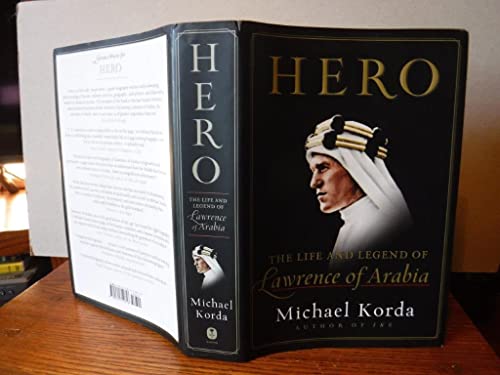
Hero
by Michael Korda
"The Life and Legend of Lawrence of Arabia"
Popularity
4.82 / 5
* A book's popularity is determined by how it compares to all other books on this website.
Where to buy?
Buy from Amazon* If you buy this book through the link above, we may receive a small commission at no extra cost to you.
Hero by Michael Korda
Details
War:
World War I
Perspective:
Commanders
True Story:
Yes
Biography:
Yes
Region:
Middle East
Page Count:
784
Published Date:
2010
ISBN13:
9780061712616
Summary
Michael Korda's biography examines T.E. Lawrence, the British officer who became legendary for his role in the Arab Revolt during World War I. The book explores Lawrence's complex character, from his archaeological work in the Middle East to his military leadership uniting Arab tribes against the Ottoman Empire. Korda analyzes how Lawrence became both a war hero and a tortured figure struggling with fame, examining the myths surrounding his exploits and his literary legacy through Seven Pillars of Wisdom. The biography provides insight into Lawrence's motivations, contradictions, and lasting impact on Middle Eastern history.
Review of Hero by Michael Korda
Michael Korda's "Hero: The Life and Legend of Lawrence of Arabia" is a sweeping, meticulously researched biography that attempts to untangle the man from the myth surrounding one of the twentieth century's most enigmatic figures. T.E. Lawrence, the British archaeologist-turned-military officer who became a central figure in the Arab Revolt during the First World War, has long been the subject of fascination, controversy, and outright legend. Korda's biography stands as one of the more comprehensive efforts to present a full and balanced portrait of the man behind the desert exploits immortalized in David Lean's 1962 film.
What distinguishes Korda's approach is his willingness to engage with both the historical record and the mythology that has accumulated around Lawrence since his death in 1935. Rather than simply debunking or reinforcing the legend, Korda carefully traces how Lawrence himself contributed to his own mythologization, particularly through his memoir "Seven Pillars of Wisdom." This self-aware complexity is one of the book's great strengths. Lawrence was not merely a passive subject of legend-making by others; he was, in many ways, an active participant in shaping his own narrative, and Korda handles this duality with considerable skill.
The biography benefits enormously from Korda's own background. As a former publishing executive with a lifelong interest in military history, he brings both narrative sensibility and historical rigor to the material. The book moves chronologically through Lawrence's life, from his unconventional upbringing and early academic pursuits in archaeology, through his transformative wartime experiences in the Middle East, to his later years of relative obscurity and his complicated relationship with fame. Korda does not shy away from the contradictions in Lawrence's character: a man who craved anonymity yet courted publicity, who displayed extraordinary courage yet suffered from deep psychological wounds, and who was both a genuine military strategist and a figure prone to self-mythologizing exaggeration.
One of the book's notable achievements is its handling of the historical and political context surrounding the Arab Revolt. Korda situates Lawrence's actions within the broader framework of British imperial strategy, Ottoman decline, and the complex web of Arab tribal politics. This contextualization helps readers understand not just what Lawrence did, but why his actions mattered within the larger geopolitical struggles of the era. The book does not oversimplify the moral and political complexities of British involvement in the Middle East during this period, nor does it present Lawrence as either a straightforward hero or villain.
The biography is particularly effective in its exploration of Lawrence's psychological complexity. His experiences of violence, his captivity and reported mistreatment at Deraa, and his subsequent struggles with fame and identity are treated with nuance rather than sensationalism. Korda draws on a wide range of sources, including Lawrence's own writings, correspondence, and the accounts of his contemporaries, to construct a portrait that feels psychologically credible rather than merely speculative.
At times, the sheer density of historical detail can feel demanding for readers unfamiliar with the intricacies of Middle Eastern geography and Ottoman-era politics. The book rewards patience and attention, and readers seeking a brisk, simplified narrative may find themselves needing to slow down and absorb the historical texture Korda provides. However, for those interested in a thorough and thoughtful examination of Lawrence's life, this depth is precisely what makes the biography valuable.
Korda's prose is generally clear and engaging, avoiding excessive academic jargon while still conveying the complexity of his subject. He maintains a balanced tone throughout, neither hagiographic nor unduly critical, which lends the biography a sense of credibility. The narrative structure, while chronological, is punctuated by moments of reflection on how Lawrence's legend has evolved in popular culture, providing useful context for readers who may primarily know Lawrence through the famous film adaptation.
Overall, "Hero: The Life and Legend of Lawrence of Arabia" succeeds as both a historical biography and an exploration of myth-making. It offers a comprehensive, well-researched account of a genuinely fascinating and contradictory figure, situating him firmly within his historical moment while acknowledging the ways in which his story has been reshaped and reimagined over time. For readers interested in military history, the complexities of the Middle East during the early twentieth century, or the nature of heroism and legend itself, Korda's biography represents a substantial and rewarding read.


