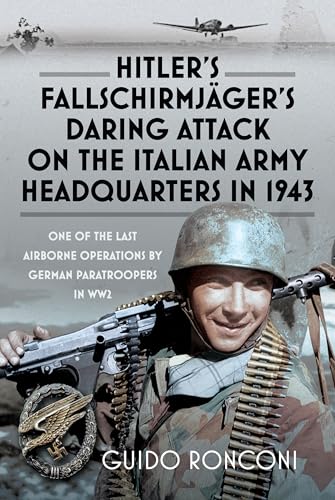
Hitler's Fallschirmjäger's Daring Attack on the Italian Army Headquarters In 1943
by Guido Ronconi
"One of the Last Airborne Operations by German Paratroopers in WW2"
Popularity
4.48 / 5
* A book's popularity is determined by how it compares to all other books on this website.
Where to buy?
Buy from Amazon* If you buy this book through the link above, we may receive a small commission at no extra cost to you.
Hitler's Fallschirmjäger's Daring Attack on the Italian Army Headquarters In 1943 by Guido Ronconi
Details
War:
World War II
Perspective:
Paratroopers
Military Unit:
Luftwaffe
True Story:
Yes
Biography:
No
Region:
Europe
Published Date:
2026
ISBN13:
9781036121846
Summary
This book examines a daring German airborne operation in 1943 targeting an Italian Army headquarters. Following Italy's armistice with the Allies, German Fallschirmjäger (paratroopers) conducted one of their final major airborne missions of World War II. Author Guido Ronconi details the planning, execution, and aftermath of this lesser-known operation, which occurred during the complex period when Italy switched sides in the war. The book provides insight into German special operations tactics and the chaotic Italian campaign of 1943.
Review of Hitler's Fallschirmjäger's Daring Attack on the Italian Army Headquarters In 1943 by Guido Ronconi
Guido Ronconi's examination of a lesser-known German airborne operation in 1943 provides military history enthusiasts with a focused study of one of the Fallschirmjäger's final combat drops during World War II. The work centers on a daring raid against an Italian Army headquarters, occurring during the tumultuous period following Italy's armistice with the Allied forces in September 1943. This operation, though not as famous as earlier German paratrooper actions like Crete or Eben-Emael, represents an important chapter in understanding the declining yet still potent capabilities of German airborne forces during the latter stages of the war.
The historical context surrounding this operation is particularly significant. By 1943, German paratroopers had largely transitioned away from their original airborne assault role. The heavy casualties suffered during the invasion of Crete in May 1941 had convinced Adolf Hitler that the era of large-scale paratrooper operations was over, leading to these elite units being primarily employed as ground infantry throughout much of the war's remaining years. The Italian campaign, however, presented unique circumstances that occasionally called for specialized airborne operations, particularly during the chaotic period when German forces moved to occupy former Italian positions and secure strategic locations following the Italian surrender.
Ronconi's work contributes to the historical record by documenting an operation that has received relatively limited attention in broader World War II literature. The Fallschirmjäger, despite their reduced role in airborne operations after 1941, maintained their reputation as elite troops and were frequently deployed in critical situations. The raid on the Italian headquarters exemplifies how German commanders still recognized the value of airborne forces for specific tactical objectives, even as strategic paratrooper operations had become rare.
The 1943 timeframe places this operation within a period of significant transition for both German and Italian forces. Following the Allied invasion of Sicily in July 1943 and the subsequent overthrow of Benito Mussolini, Italy sought an armistice with the Allies, which was announced in September. German forces, anticipating Italian defection, had prepared contingency plans to disarm Italian units and occupy key positions throughout Italy and Italian-controlled territories. This environment created numerous small-scale but tactically important military actions as German forces moved to neutralize potential threats and secure strategic assets.
The author's focus on this specific raid allows for a detailed examination of tactical-level operations that characterized much of the fighting during this transitional period. Unlike the sweeping narratives of major battles, studies of smaller operations provide insight into the practical execution of military objectives, the challenges faced by units in the field, and the human dimension of warfare. These focused accounts help fill gaps in the historical understanding of how larger strategic situations translated into ground-level military action.
German paratroopers maintained high standards of training and equipment throughout the war, even as their primary mission shifted from airborne assault to conventional infantry combat. Their involvement in operations such as the headquarters raid demonstrates the continued trust placed in these units by German high command for missions requiring speed, surprise, and tactical proficiency. The Fallschirmjäger's elite status meant they were often selected for operations demanding particular skill and reliability.
For readers interested in military history, particularly the Italian campaign or German airborne forces, this work offers specialized knowledge about an aspect of World War II that has not been extensively covered in mainstream historical literature. The Italian theater itself often receives less attention than the Western or Eastern fronts, making detailed studies of specific operations valuable for developing a more complete picture of the European war.
The book serves as a resource for understanding the operational employment of German paratroopers during a period when their role had evolved significantly from the early war years. It also sheds light on the complex military situation in Italy during 1943, when former allies became adversaries and German forces worked rapidly to establish control over territory previously held by Italian forces. This particular operation, targeting an army headquarters, reflects the importance of command and control facilities in military operations and the potential value of rapid, surprise attacks against such targets.
Ronconi's contribution to World War II historiography lies in preserving the details of this operation for future study and providing military history enthusiasts with access to information about a specific tactical action that might otherwise remain obscure. For readers seeking to understand the full scope of German airborne operations or the complexities of the Italian campaign in 1943, this focused examination offers valuable specialized content that complements broader historical narratives of the period.