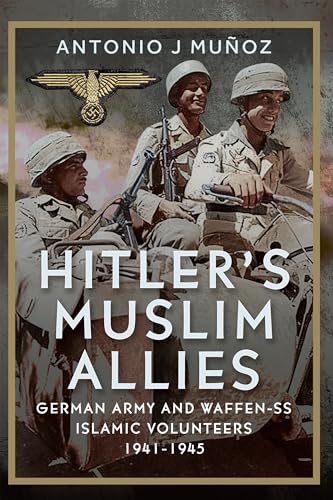
Hitler’s Muslim Allies
by Antonio J Muñoz
"German Army and Waffen-SS Islamic Volunteers 1941-1945"
Popularity
4.03 / 5
* A book's popularity is determined by how it compares to all other books on this website.
Where to buy?
Buy from Amazon* If you buy this book through the link above, we may receive a small commission at no extra cost to you.
Hitler’s Muslim Allies by Antonio J Muñoz
Details
War:
World War II
Perspective:
Researcher
Military Unit:
Waffen-SS
True Story:
Yes
Biography:
No
Region:
Europe
Page Count:
314
Published Date:
2025
ISBN13:
9781036129248
Summary
This book examines the collaboration between Nazi Germany and Muslim volunteers during World War II. Antonio J. Muñoz documents the recruitment, organization, and deployment of Islamic soldiers who served in the German Army and Waffen-SS between 1941 and 1945. The work explores the historical context of this alliance, including the motivations behind Muslim participation in German military units, their roles in various campaigns, and the strategic reasons Germany sought these volunteers. The book provides detailed documentation of these little-known military formations and their activities during the war.
Review of Hitler’s Muslim Allies by Antonio J Muñoz
Antonio J. Muñoz's examination of Islamic volunteers who served in the German Army and Waffen-SS during World War II offers a detailed exploration of a lesser-known aspect of the conflict. The book focuses on the recruitment, organization, and deployment of Muslim soldiers from various regions who fought alongside Axis forces between 1941 and 1945. This subject matter, while controversial, represents an important historical reality that has often been overlooked in broader narratives of the Second World War.
The author traces the origins of German-Muslim military collaboration to the practical military needs of the Third Reich as it expanded its operations across multiple fronts. Facing manpower shortages and seeking to exploit anti-Soviet sentiment in occupied territories, German military planners turned to Muslim populations in the Balkans, the Caucasus, and Central Asia. These recruitment efforts were driven by strategic considerations rather than ideological alignment, though Nazi propagandists attempted to frame the collaboration in terms of shared opposition to communism and British imperialism.
Muñoz provides substantial documentation on the various formations that included Muslim volunteers. The book examines units such as the Handschar Division, composed primarily of Bosnian Muslims, which became one of the largest and most notable of these formations. The author details the recruitment process, training procedures, and operational histories of these units, drawing from military records and archival sources. The narrative covers their deployment in anti-partisan operations, their performance in combat situations, and the administrative challenges involved in integrating these volunteers into the German military structure.
The work addresses the complex motivations that led individuals from Muslim-majority regions to join German forces. These motivations varied considerably depending on geographic location and local circumstances. In some cases, volunteers were driven by opposition to Soviet rule and the perceived threat of communist atheism to their religious practices. In other instances, local nationalist aspirations, economic hardship, or the desire to escape persecution played significant roles. The author attempts to present these varied motivations without imposing a single explanatory framework, recognizing the diversity of experiences and circumstances across different regions and time periods.
One of the strengths of this work lies in its attention to organizational details and unit histories. Muñoz provides information on the structure of various formations, including their numerical designations, commanding officers, and areas of operation. This level of detail makes the book particularly valuable for military historians and researchers seeking specific information about these units. The author includes discussion of the religious accommodations made for Muslim soldiers, such as the provision of imams, respect for dietary restrictions, and allowances for prayer times, which represented unusual concessions within the German military system.
The book also addresses the combat effectiveness and reliability of these units, which varied considerably. Some formations performed adequately in their assigned roles, particularly in anti-partisan operations in mountainous or difficult terrain. Others proved less effective or reliable, with instances of desertion, poor discipline, or reluctance to engage in certain operations. The author documents these variations without romanticizing or denigrating the performance of these units, instead presenting a nuanced picture based on available historical evidence.
Muñoz examines the fate of these volunteers as the war turned against Germany. Many faced difficult circumstances as Axis forces retreated and eventually collapsed. Some attempted to surrender to Western Allied forces rather than face Soviet capture, knowing the likely consequences of having fought against the Red Army. Others dispersed into civilian populations or attempted to return to their home regions. The post-war period brought additional challenges, as many of these individuals faced persecution, imprisonment, or execution by communist regimes.
The book serves as a reference work that compiles information on a subject that has been fragmentary and scattered across various sources. While the topic remains sensitive due to the nature of the regime these individuals served, the author maintains a scholarly approach focused on documenting historical facts rather than making moral judgments. This approach allows readers to understand this chapter of history within its proper context while recognizing the ethical complexities involved. The work contributes to a more complete understanding of the multinational character of World War II and the various ways different populations became involved in the conflict.