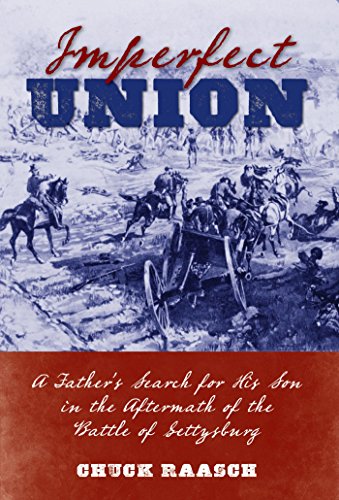
Imperfect Union
by Chuck Raasch
"A Father’s Search for His Son in the Aftermath of the Battle of Gettysburg"
Popularity
4.91 / 5
* A book's popularity is determined by how it compares to all other books on this website.
Where to buy?
Buy from Amazon* If you buy this book through the link above, we may receive a small commission at no extra cost to you.
Imperfect Union by Chuck Raasch
Details
War:
American Civil War
Perspective:
Civilian
True Story:
Yes
Biography:
Yes
Region:
North America
Page Count:
417
Published Date:
2016
ISBN13:
9780811765466
Review of Imperfect Union by Chuck Raasch
Charles Raasch's "Imperfect Union: A Father's Search for His Son in the Aftermath of the Battle of Gettysburg" tells a story that is at once deeply personal and broadly representative of the human cost of the American Civil War. Rather than focusing on strategy, tactics, or the grand narrative of the battle itself, Raasch turns his attention to the aftermath, examining how one family's private tragedy unfolded against the backdrop of one of the war's most consequential engagements. The result is a book that adds a valuable and often overlooked dimension to Gettysburg literature, one centered on grief, uncertainty, and the long, difficult process of searching for answers.
The book follows the efforts of a father determined to locate his son, who went missing in the chaos following the fighting at Gettysburg in July 1863. Through this singular search, Raasch illuminates a much larger and more troubling reality: the sheer scale of loss and disorganization that followed major Civil War battles. Thousands of soldiers were killed, wounded, or simply unaccounted for, and the systems in place to track and identify them were often inadequate to the task. Families across the country were left to piece together fragments of information, relying on letters, newspaper notices, and word of mouth to learn the fate of loved ones. Raasch's narrative captures this uncertainty vividly, allowing readers to understand the emotional toll exacted not only on soldiers but on those who waited anxiously for news at home.
One of the strengths of Raasch's approach is his ability to balance the intimate story of a single father's quest with the broader historical context of the period. He does not lose sight of the personal stakes involved, but he also situates this individual story within the larger machinery of a nation at war, where bureaucracy, incomplete records, and the sheer volume of casualties often worked against families seeking closure. This dual focus gives the book both emotional resonance and historical substance, making it accessible to general readers while still offering something of value to those already familiar with the Gettysburg campaign.
Raasch's writing style is clear and measured, avoiding melodrama even as he recounts events that are inherently emotional. He lets the facts of the search speak for themselves, trusting readers to grasp the significance of what is being described without excessive embellishment. This restraint serves the material well, lending the narrative a sense of credibility and seriousness that suits its subject matter. The pacing is steady, moving through the search methodically in a way that mirrors the painstaking, often frustrating process the father himself endured.
The book also serves as a reminder of how the Civil War's impact extended far beyond the battlefield itself. While Gettysburg is often remembered through the lens of military history, monuments, and famous speeches, Raasch's account brings attention to the less visible but equally important story of how families coped with loss and uncertainty in the war's aftermath. This perspective enriches the historical record, offering a more complete picture of what the battle meant not just for the nation, but for the individuals whose lives were upended by it.
For readers interested in Civil War history, particularly those seeking a more personal and human-centered account rather than a purely military analysis, "Imperfect Union" offers a compelling and worthwhile read. It succeeds in humanizing the statistics and abstractions often associated with large-scale historical events, reminding readers that behind every casualty figure was a family left to grapple with grief and unanswered questions. Raasch's careful research and thoughtful storytelling make this a meaningful contribution to the broader literature on Gettysburg and the Civil War era.
Overall, "Imperfect Union" stands as a poignant and well-crafted exploration of a father's determination to find his son amid the confusion and devastation following one of the war's bloodiest battles. It is a book that honors both the specific story it tells and the countless similar stories that remain untold, offering readers a deeper appreciation for the personal dimensions of historical tragedy.