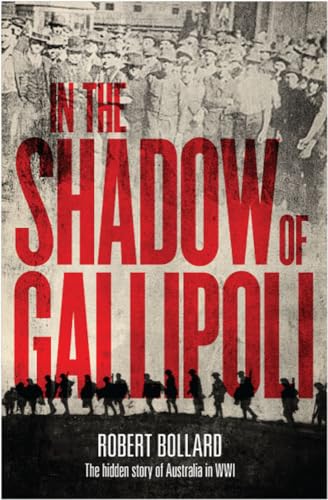
In the Shadow of Gallipoli
by Robert Bollard
"The Hidden History of Australia in World War I"
Popularity
4.61 / 5
* A book's popularity is determined by how it compares to all other books on this website.
Where to buy?
Buy from Amazon* If you buy this book through the link above, we may receive a small commission at no extra cost to you.
In the Shadow of Gallipoli by Robert Bollard
Details
War:
World War I
Perspective:
Researcher
True Story:
Yes
Biography:
No
Region:
Australia/Oceania
Page Count:
224
Published Date:
2013
ISBN13:
9781742233246
Review of In the Shadow of Gallipoli by Robert Bollard
Robert Bollard's 'In the Shadow of Gallipoli: The Hidden Story of Australia in WWI' offers a deliberately different account of Australia's First World War experience, one that moves away from the battlefield mythology of Gallipoli and the Western Front and instead turns its attention to the home front. Bollard, a historian with a background in labour history, is less interested in retelling the familiar stories of Anzac heroism than in examining the social and political fractures that the war exposed and deepened within Australian society itself.
The book's central argument is that the popular memory of World War I in Australia, dominated by the Anzac legend, has obscured a more complicated and often contentious domestic story. Bollard traces the growing divisions between those who supported the war effort unreservedly and those who grew increasingly disillusioned with its human and economic costs. He gives particular attention to the two conscription referendums of 1916 and 1917, which split the country along class, religious, and political lines. These campaigns, as Bollard demonstrates, were bitter and divisive, pitting unionists against employers, Catholics against Protestants, and the labour movement against the conservative establishment led by Prime Minister Billy Hughes.
One of the strengths of the book lies in its treatment of the industrial unrest that accompanied the war years. Bollard details the wave of strikes that swept through Australian industries, including the significant 1917 general strike, which began in New South Wales and spread to other states. He situates these events within a broader context of rising living costs, wartime profiteering, and growing working-class resentment toward a government perceived as indifferent to the sacrifices being demanded of ordinary citizens. This focus on labour history distinguishes the book from more conventional military histories of the period and gives voice to perspectives often marginalised in standard narratives.
Bollard also examines the experiences of those who opposed the war on political or religious grounds, including socialists, members of the Industrial Workers of the World, and Irish Catholics sympathetic to the cause of Irish independence following the 1916 Easter Rising. The treatment of government repression during this period, including censorship, internment, and the suppression of dissenting organisations, is handled with care and supported by historical evidence. These sections of the book serve as a reminder that wartime unity was far from universal and that the Australian government took considerable measures to suppress opposition.
The author's prose is clear and accessible, avoiding unnecessary jargon while still engaging seriously with the historical material. Bollard writes with the confidence of someone well versed in his subject, and the book benefits from his ability to connect broader political and economic trends with the lived experiences of Australians during the war years. The structure of the book, moving between political developments, industrial action, and social tensions, allows readers to see how these different threads were interconnected rather than existing in isolation.
Where the book is perhaps less comprehensive is in its treatment of the war's military dimensions, which receive relatively limited attention compared to the domestic focus. This is, however, a deliberate choice on Bollard's part rather than an oversight, as the stated purpose of the book is to address a gap in the historical record rather than to provide a complete military history of Australia's involvement in the conflict. Readers looking for detailed accounts of specific battles or campaigns will need to look elsewhere, though the book does provide sufficient context to understand how military events influenced domestic political developments.
Overall, 'In the Shadow of Gallipoli' succeeds in its aim of presenting a more complex and contested picture of Australia during the First World War. By foregrounding the conscription debates, industrial unrest, and political divisions of the period, Bollard challenges readers to reconsider the simplified narratives that have often dominated public understanding of this era. The book is a valuable contribution to Australian historical scholarship, particularly for those interested in labour history and the social consequences of war, and it serves as a useful counterpoint to more traditional accounts centred on military heroism.