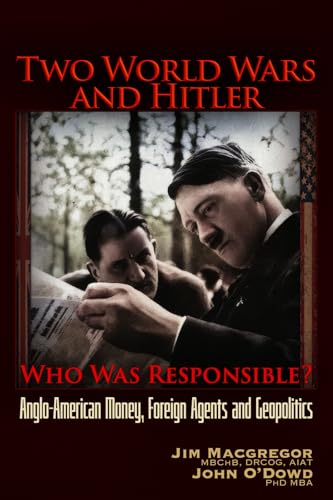
Two World Wars and Hitler: Who Was Responsible?
by John O'Dowd
"Anglo-American Money, Foreign Agents and Geopolitics"
Popularity
4.77 / 5
* A book's popularity is determined by how it compares to all other books on this website.
Where to buy?
Buy from Amazon* If you buy this book through the link above, we may receive a small commission at no extra cost to you.
Two World Wars and Hitler: Who Was Responsible? by John O'Dowd
Details
War:
World War I
Perspective:
Researcher
Biography:
No
Region:
Europe
Published Date:
2025
ISBN13:
9781634245036
Review of Two World Wars and Hitler: Who Was Responsible? by John O'Dowd
James Macgregor's "Two World Wars and Hitler: Who Was Responsible? Anglo-American Money, Foreign Agents and Geopolitics" presents a controversial examination of the economic and geopolitical factors that shaped the first half of the twentieth century. The book challenges conventional historical narratives by exploring the financial connections and international relationships that existed before and during both world wars, with particular emphasis on the role of Anglo-American banking interests in European affairs.
The author approaches this complex historical period through the lens of economic influence and power politics, arguing that financial networks and monetary considerations played a more significant role in shaping events than typically acknowledged in mainstream historical accounts. Macgregor examines the intricate web of international banking relationships, investment patterns, and economic policies that characterized the interwar period, attempting to trace connections between financial actors and political developments that led to global conflict.
The book delves into the economic conditions that followed World War One, including the controversial terms of the Treaty of Versailles and the reparations imposed on Germany. Macgregor explores how these financial burdens affected the German economy and society, contributing to the political instability that marked the Weimar Republic. The author examines the role of foreign loans, particularly from American and British financial institutions, in Germany's economic recovery during the 1920s and considers how these financial relationships may have influenced subsequent political developments.
A significant portion of the work focuses on the rise of Adolf Hitler and the Nazi Party, examining this phenomenon not merely as a result of German nationalism or ideological extremism, but as part of a broader geopolitical and economic context. Macgregor investigates the financial backing that various German industrial and political movements received during this period, questioning the sources and motivations behind such support. The book attempts to identify specific financial interests that may have benefited from or contributed to the political transformations occurring in Germany during the 1930s.
The author's exploration of geopolitics examines how major powers maneuvered for strategic advantage in the years between the wars. Macgregor considers how economic competition, territorial ambitions, and conflicting national interests created tensions that eventually erupted into another global conflict. The book discusses various diplomatic efforts, alliances, and betrayals that characterized international relations during this turbulent period, suggesting that economic considerations often drove political decisions.
Macgregor's methodology relies heavily on examining financial records, diplomatic correspondence, and economic data from the period. The author attempts to connect various historical dots, drawing links between financial transactions, political decisions, and military actions. This approach seeks to reveal patterns and relationships that might not be immediately apparent when examining political and military history in isolation from economic factors.
The book raises questions about the nature of historical responsibility and causation, challenging readers to consider whether traditional accounts adequately explain the catastrophic events of the early twentieth century. By emphasizing economic factors and financial relationships, Macgregor offers an alternative framework for understanding how two devastating world wars came about within a single generation. The author suggests that focusing solely on nationalist ideologies, military ambitions, or political personalities may provide an incomplete picture of this historical period.
However, readers should approach this work with a critical eye, as the author's thesis involves connecting complex historical events through economic relationships that may admit of multiple interpretations. The book's argument requires careful evaluation of evidence and consideration of alternative explanations for the historical developments it describes. The controversial nature of some claims made in the work necessitates that readers familiar with this historical period compare Macgregor's interpretations with other scholarly accounts.
The work contributes to ongoing historical debates about the causes of twentieth-century conflicts and the role of economic factors in shaping political events. Whether one agrees with the author's conclusions or not, the book serves as a reminder that historical events often have multiple causes and that economic relationships and financial interests represent important factors in understanding political developments. Macgregor's emphasis on following monetary flows and examining financial connections offers a perspective that complements traditional political and military histories of this period, encouraging readers to think broadly about the forces that shape historical events.


