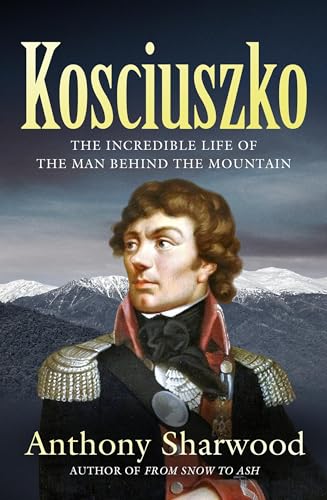
Kosciuszko
by Anthony Sharwood
Popularity
3.57 / 5
* A book's popularity is determined by how it compares to all other books on this website.
Where to buy?
Buy from Amazon* If you buy this book through the link above, we may receive a small commission at no extra cost to you.
Kosciuszko by Anthony Sharwood
Details
True Story:
Yes
Biography:
Yes
Region:
Australia/Oceania
Published Date:
2025
ISBN13:
9780733650970
Review of Kosciuszko by Anthony Sharwood
Anthony Sharwood's "Kosciuszko: The Incredible Life of the Man Behind the Mountain" sets out to answer a question that many Australians have likely never thought to ask: who exactly was Tadeusz Kosciuszko, and how did his name come to be attached to the highest peak on the Australian mainland? The book is both a biography of a historical figure largely unknown outside his native Poland and an investigation into the naming of a mountain that bears little resemblance to the man it honours.
Sharwood, a journalist with a long-standing interest in the Australian alpine region, traces Kosciuszko's life from his birth in the Polish-Lithuanian Commonwealth through his military education, his service in the American Revolutionary War, and his later leadership of the failed Polish uprising against Russian and Prussian domination. The narrative moves through Kosciuszko's time in the United States, where he worked alongside figures such as George Washington and Thomas Jefferson, and where he left instructions in his will for his American assets to be used to free and educate enslaved people. This detail, often overlooked in general histories, receives careful attention here, and Sharwood uses it to illustrate the consistency of Kosciuszko's political convictions across different causes and countries.
The book's structure alternates between the chronological telling of Kosciuszko's life and the story of how the Australian mountain received his name. In 1840, the Polish explorer Pawel Edmund Strzelecki climbed what he believed to be the highest peak in the region and named it after Kosciuszko, a man he admired for his commitment to liberty and his refusal to accept titles or rewards for his service. Sharwood explores the irony that later surveys revealed the peak Strzelecki named was not actually the tallest, and that a nearby summit, briefly and confusingly swapped in official records, holds that distinction instead. This administrative tangle, resolved only in the twentieth century, is recounted with a light touch that keeps the material accessible without trivialising its historical significance.
What distinguishes this biography from a straightforward historical account is Sharwood's evident affection for his subject, tempered by a journalist's instinct for verification. He does not shy away from acknowledging the gaps in the historical record or the difficulty of reconstructing certain episodes in Kosciuszko's life, particularly those relating to his early years in Poland. Where sources conflict or evidence is thin, Sharwood tends to say so rather than smoothing over uncertainty, which lends the book a credibility that popular biographies sometimes lack.
The prose is clear and unpretentious, suited to readers with no prior knowledge of Polish history or eighteenth-century military campaigns. Sharwood explains the political context of partitioned Poland, the shifting alliances of European powers, and the mechanics of Kosciuszko's various campaigns without assuming specialist knowledge. At the same time, the book does not oversimplify; the complexities of Kosciuszko's diplomatic relationships and the compromises he made are given due weight.
For an Australian readership, the book performs a useful service in connecting a familiar geographic landmark to a substantial and largely forgotten historical figure. Many visitors to Mount Kosciuszko National Park would be hard-pressed to say anything about the man whose name graces the summit signage, and Sharwood's book fills that gap with genuine narrative interest rather than dry recitation of dates and battles.
The pacing occasionally slows during sections dealing with the more technical aspects of Kosciuszko's military campaigns, where the level of detail may test readers seeking a brisker narrative. However, these sections are balanced by livelier passages recounting Kosciuszko's personal relationships, his time in Paris, and the surprising twists in the Australian naming controversy.
Overall, this is a well-researched and engagingly written biography that succeeds in its dual purpose: illuminating an important historical figure and explaining a piece of Australian geographic nomenclature that has puzzled many. Sharwood's background in journalism serves the book well, producing a narrative that is both informative and readable, suitable for general readers interested in history, biography, or the stories behind familiar place names.


