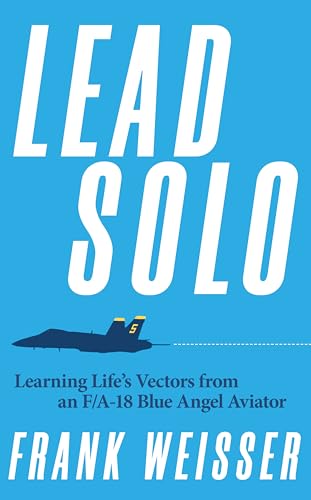
Lead Solo
by Frank Weisser
"Learning Life's Vectors from an F/A-18 Blue Angel Aviator"
Popularity
4.86 / 5
* A book's popularity is determined by how it compares to all other books on this website.
Where to buy?
Buy from Amazon* If you buy this book through the link above, we may receive a small commission at no extra cost to you.
Lead Solo by Frank Weisser
Details
Perspective:
Pilots
Military Unit:
US Navy
True Story:
Yes
Biography:
Yes
Region:
North America
Page Count:
146
Published Date:
2025
ISBN13:
9781682476673
Summary
Lead Solo is a leadership and personal development book by former Blue Angels pilot Frank Weisser. Drawing from his experience flying the F/A-18 with the Navy's elite flight demonstration squadron, Weisser shares lessons on excellence, teamwork, and decision-making under pressure. The book uses aviation principles and Blue Angels experiences as metaphors for navigating life's challenges and achieving peak performance. Weisser translates high-stakes military aviation concepts into practical guidance for business professionals and anyone seeking to improve their leadership skills and personal effectiveness.
Review of Lead Solo by Frank Weisser
Frank Weisser's "Lead Solo: Learning Life's Vectors from an F/A-18 Blue Angel Aviator" offers readers a unique perspective on leadership and personal development through the lens of one of aviation's most demanding roles. As a former Blue Angels pilot, Weisser draws from his extensive experience flying the F/A-18 Hornet in precision aerobatic demonstrations to present a framework for navigating life's challenges with the same discipline and focus required in the cockpit.
The book's central concept revolves around the idea of "vectors," a term borrowed from aviation that refers to both direction and magnitude. Weisser applies this metaphor throughout the text to help readers understand how small adjustments in trajectory can lead to significant changes in destination. This aviation-inspired framework provides a fresh approach to familiar self-improvement themes, grounding abstract concepts in the concrete realities of high-performance flight.
Weisser's background as a Blue Angels pilot lends considerable credibility to his insights on performance under pressure. The Blue Angels are the United States Navy's flight demonstration squadron, known for executing complex formations at high speeds with minimal separation between aircraft. The precision required for such maneuvers demands split-second decision-making, unwavering trust in teammates, and the ability to maintain composure in high-stress situations. These experiences form the foundation of the book's lessons on leadership and personal excellence.
The narrative structure alternates between Weisser's aviation experiences and their application to broader life situations. This approach allows readers to first understand the intensity and demands of flying in formation at speeds exceeding 400 miles per hour, then consider how the same principles might apply to professional challenges, relationship dynamics, and personal goal-setting. The author demonstrates how concepts such as situational awareness, contingency planning, and maintaining focus on objectives translate beyond the aviation environment.
One of the book's strengths lies in its exploration of preparation and practice. Weisser details the rigorous training regimen required to become a Blue Angels pilot, emphasizing that the seemingly effortless performances witnessed by millions of spectators result from countless hours of deliberate practice and continuous refinement. This emphasis on preparation over natural talent provides a practical message about the importance of consistent effort in achieving excellence in any field.
The author also addresses the role of failure and course correction in achieving success. Drawing from aviation safety protocols and the necessity of learning from mistakes in an unforgiving environment, Weisser presents failure not as an endpoint but as valuable data for adjustment. The concept of "cross-checking" instruments and constantly verifying position relative to intended flight path serves as a metaphor for self-assessment and the importance of measuring progress against defined objectives.
Team dynamics receive substantial attention throughout the text. Flying in close formation requires absolute trust and clear communication among team members, and Weisser translates these requirements into principles for building effective teams in any context. The book examines how individual excellence must be balanced with collective success, and how personal ambition can be channeled to serve group objectives without sacrificing either.
The writing style remains accessible throughout, avoiding excessive technical jargon while still providing enough detail to convey the complexity of the subject matter. Weisser explains aviation concepts in terms that non-pilots can readily understand, ensuring that the lessons remain the focus rather than the technical specifications of the aircraft or flight procedures. This balance makes the book approachable for a general audience while maintaining authenticity.
"Lead Solo" also explores the concept of leadership in high-stakes environments where decisions carry significant consequences. The author examines how leaders must balance confidence with humility, maintain composure while acknowledging uncertainty, and inspire others while remaining grounded in reality. These themes are illustrated through specific examples from Weisser's career, providing concrete context for abstract leadership principles.
The book concludes by encouraging readers to define their own flight paths and take responsibility for their trajectories. Weisser emphasizes that while external factors may present challenges, individuals ultimately control their responses and adjustments. This message of personal agency, grounded in the realities of controlling an aircraft through varying conditions, offers a pragmatic approach to self-determination.
For readers interested in leadership development, personal growth, or aviation, "Lead Solo" provides a distinctive perspective informed by experiences few people will ever have. The book's aviation framework offers a memorable way to conceptualize life's challenges and opportunities, while Weisser's firsthand accounts lend authenticity to the principles he advocates. The combination of high-performance aviation and practical life guidance creates a compelling narrative that distinguishes this work within the crowded field of leadership literature.