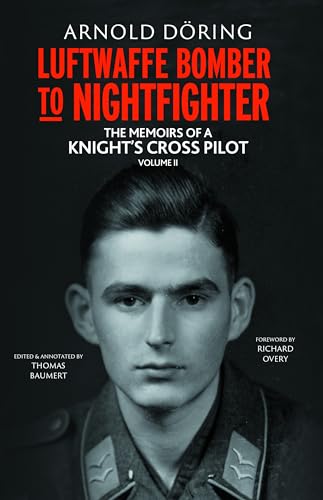
Luftwaffe Bomber to Nightfighter
by Arnold Döring
"Volume II: the Memoirs of a Knight's Cross Pilot"
Popularity
4.72 / 5
* A book's popularity is determined by how it compares to all other books on this website.
Where to buy?
Buy from Amazon* If you buy this book through the link above, we may receive a small commission at no extra cost to you.
Luftwaffe Bomber to Nightfighter by Arnold Döring
Details
War:
World War II
Perspective:
Pilots
Military Unit:
Luftwaffe
True Story:
Yes
Biography:
Yes
Region:
Europe
Published Date:
2024
ISBN13:
9781784388218
Summary
This is the second volume of Arnold Döring's World War II memoirs, detailing his experiences as a Luftwaffe pilot who transitioned from flying bombers to nightfighters. As a recipient of the Knight's Cross, one of Nazi Germany's highest military honors, Döring provides firsthand accounts of aerial combat operations during the war. The book offers insight into the challenges of nightfighter operations and the evolution of German air tactics as the war progressed, written from the perspective of an experienced combat pilot.
Review of Luftwaffe Bomber to Nightfighter by Arnold Döring
Arnold Döring's second volume of memoirs offers a compelling continuation of his wartime experiences as a Luftwaffe pilot, chronicling his transition from bomber operations to the demanding world of night fighting. This installment provides readers with an intimate perspective on one of World War II's most challenging aviation roles, delivered through the lens of a decorated Knight's Cross recipient who witnessed the evolution of Germany's defensive air war firsthand.
The memoir captures a critical period in the Luftwaffe's operational history, as the German air force adapted to the increasing Allied bombing campaign over the Reich. Döring's account details the technical and tactical developments that transformed night fighting from a nascent capability into a sophisticated defensive system. His narrative encompasses the introduction of radar technology, the refinement of ground-controlled interception techniques, and the constant adaptation required as Allied bomber streams grew larger and more protected.
What distinguishes this volume is Döring's ability to convey the stark realities of night operations without resorting to melodrama. The inherent dangers of flying in darkness, often in adverse weather conditions while attempting to locate and engage enemy aircraft, emerge naturally from his descriptions. The psychological demands of such missions receive appropriate attention, as Döring recounts the tension of stalking bomber formations through the night sky and the split-second decisions required during combat engagements.
The technical aspects of night fighting receive thorough treatment throughout the memoir. Döring explains the capabilities and limitations of various aircraft types employed in the night fighter role, along with the radar and radio equipment that became increasingly crucial to operations. His explanations remain accessible to readers without specialized aviation knowledge, while still providing sufficient detail to satisfy those interested in the technical evolution of night fighting tactics and equipment.
The memoir also documents the broader context of Germany's defensive air war, including the mounting pressure as Allied air superiority became increasingly dominant. Döring's account reflects the challenges faced by Luftwaffe units as resources became scarcer, casualties mounted, and the strategic situation deteriorated. These observations provide valuable historical context without overwhelming the personal narrative that forms the book's core.
Relationships with fellow pilots and crew members feature prominently in the narrative, illustrating the bonds formed under extreme circumstances. The camaraderie and mutual dependence inherent in night fighter operations come through clearly, as does the impact of losses on tight-knit units. These human elements balance the technical and tactical discussions, preventing the memoir from becoming a dry recitation of missions and combat engagements.
The organizational structure of the volume follows a generally chronological progression, allowing readers to trace Döring's development as a night fighter pilot and his unit's evolving role in Germany's air defense network. This approach effectively illustrates how tactics and technology changed in response to Allied innovations and the shifting nature of the air war over Europe.
Döring's status as a Knight's Cross recipient adds weight to his observations, as this decoration recognized exceptional leadership and combat effectiveness. However, the memoir avoids excessive focus on personal achievements, instead situating individual actions within the broader operational context. This balanced perspective enhances the historical value of the account while maintaining its accessibility as a personal narrative.
The second volume assumes some familiarity with the earlier installment and the general progression of the air war, though it remains comprehensible to readers approaching it independently. Those seeking a comprehensive understanding of Döring's complete wartime experience would benefit from reading both volumes in sequence, but this second installment stands on its own merits as a focused examination of the night fighter experience.
As a primary source, this memoir contributes to the historical record of Luftwaffe operations and the personal experiences of those who flew in Germany's defensive campaigns. The account offers insights into the practical realities of night fighting that complement official records and broader historical analyses. Readers interested in aviation history, World War II air operations, or personal military memoirs will find substantial value in Döring's recollections, which combine operational detail with human perspective in a manner that brings this demanding chapter of aerial warfare to life.


